  1. Home
  2. Space
  3. News

Lucy’s asteroid surprise: ‘we never suspected anything so bizarre’

Add as a preferred source on Google

The surprises keep coming for NASA’s Lucy mission, on its way to study the Trojan asteroids in the orbit of Jupiter. Lucy recently passed by a small asteroid called Dinkinesh and took this opportunity to test out some of its systems — but Dinkinesh turned out to be a fascinating system all of its own.

Last week photos from the flyby revealed that Dinkinesh had a tiny companion asteroid, making it part of a binary. Now, more photos reveal that the smaller moonlet is itself an interesting object, as it is a type of asteroid called a contact binary. That means it is made up of two objects touching each other, forming a double-lobed shape.
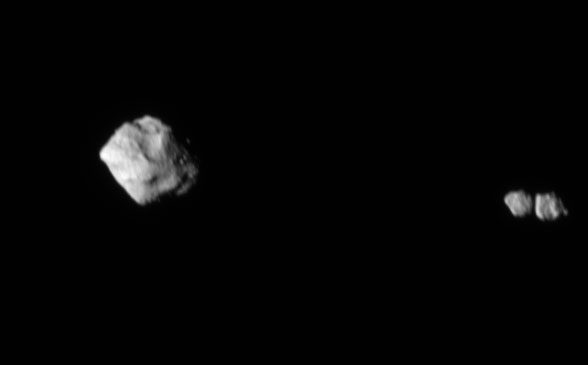
This image shows the asteroid Dinkinesh and its satellite as seen by the Lucy Long-Range Reconnaissance Imager (L’LORRI). As NASA’s Lucy Spacecraft departed the system, the SwRI-led Lucy team captured this image at 1 p.m. EDT (1700 UTC) Nov. 1, 2023, about six minutes after closest approach. From a range of approximately 1,010 miles (1,630 km), the satellite is revealed to be a contact binary, the first time such an object has been seen orbiting another asteroid.
This image shows the asteroid Dinkinesh and its satellite as seen by the Lucy Long-Range Reconnaissance Imager (L’LORRI). As NASA’s Lucy Spacecraft departed the system, the SwRI-led Lucy team captured this image at 1 p.m. EDT (1700 UTC) Nov. 1, 2023, about six minutes after closest approach. From a range of approximately 1,010 miles (1,630 km), the satellite is revealed to be a contact binary, the first time such an object has been seen orbiting another asteroid. Courtesy of NASA/Goddard/SwRI/Johns Hopkins APL

“Contact binaries seem to be fairly common in the solar system,” said Lucy deputy project scientist John Spencer of the Southwest Research Institute in a statement. “We haven’t seen many up close, and we’ve never seen one orbiting another asteroid. We’d been puzzling over odd variations in Dinkinesh’s brightness that we saw on approach, which gave us a hint that Dinkinesh might have a moon of some sort, but we never suspected anything so bizarre!”

Recommended Videos

This image was taken around six minutes after Lucy made its closest approach to the asteroids, coming within 1,010 miles of Dinkinesh. As the spacecraft traveled away from Dinkinesh, it was able to take this image from a previously unseen vantage point which revealed the strange double-lobed structure of the smaller moonlet.

“It is puzzling, to say the least,” said SwRI’s Hal Levison, the Lucy principal investigator. “I would have never expected a system that looks like this. In particular, I don’t understand why the two components of the satellite have similar sizes. This is going to be fun for the scientific community to figure out.”

Dinkinesh is located within the main asteroid belt of the solar system, between Mars and Jupiter. This region is thought to contain more than 1 million asteroids which are larger than 1 km (0.6 miles) across, plus millions more which are smaller in size. Contact binaries like the smaller moonlet observed by Lucy can form when small asteroids collide and stick together, often creating a loose “rubble pile” style of asteroid rather than a more solid object.

The unusual part of this recent finding is the fact the system is made up of not two but three parts: the larger Dinkinesh and the two parts of the smaller moonlet. It’s not clear how this contact binary came to orbit Dinkinesh itself.

“It’s truly marvelous when nature surprises us with a new puzzle,” said Tom Statler, Lucy program scientist at NASA. “Great science pushes us to ask questions that we never knew we needed to ask.”

Georgina Torbet
Georgina has been the space writer at Digital Trends space writer for six years, covering human space exploration, planetary…
Scientists warn Elon Musk’s orbital data centers could blind Earth’s biggest telescopes
A new ESO study suggests millions of satellites could make parts of the night sky effectively unusable for astronomy.
One hour of satellites over the northern Atacama Desert in Chile (October 2025)

The race to blanket Earth with satellite internet has unlocked faster connectivity for millions. But according to the European Southern Observatory (ESO), it could also make one of humanity's oldest hobbies, and one of its most important sciences, a whole lot harder. The organization warns that the rapid growth of satellite mega-constellations could severely disrupt observations made by some of the world's most powerful telescopes.

Astronomers say the night sky is reaching its limit

Read more
Amazon’s Starlink rival just crossed a major milestone, but don’t expect perfect internet just yet
Amazon finally showed up to the space internet party
Amazon Leo satellite layout across all launch vehicles

Amazon has taken a significant step toward launching its long-awaited satellite internet service. Following its latest rocket launch, the company now has 396 Project Kuiper satellites in low-Earth orbit, enough to begin offering continuous service across select regions. The milestone keeps Amazon on track for its previously announced goal of launching commercial service by mid-2026.

https://twitter.com/Weber44Chris/status/2072575499461963938?ref_src=twsrc%5Etfw%7Ctwcamp%5Etweetembed%7Ctwterm%5E2072575499461963938%7Ctwgr%5Ed727a1b853cbf519585e7bf2655943afb2f91bb8%7Ctwcon%5Es1_&ref_url=https%3A%2F%2Fwww.theverge.com%2Fscience%2F960563%2Famazon-leo-service-tipping-point

Read more
Amazon’s Starlink rival is set to launch satellite internet later this year
After launching nearly 400 satellites, Amazon says its Leo broadband service will go live later this year.
Atlas V launches 29 Amazon Leo satellites from Cape Canaveral, Florida

Amazon's long-awaited answer to SpaceX's Starlink is finally nearing liftoff. According to an exclusive report from Reuters, the company plans to begin offering its Leo satellite internet service later this year, after its latest rocket launch pushed the constellation to 394 satellites in orbit.

The pieces are finally falling into place for Project Kuiper

Read more