  1. Home
  2. Space
  3. News

SpaceX shares stunning images of Saturday’s Starship launch

Add as a preferred source on Google
SpaceX's Starship rocket leaving the launchpad on Saturday.
SpaceX

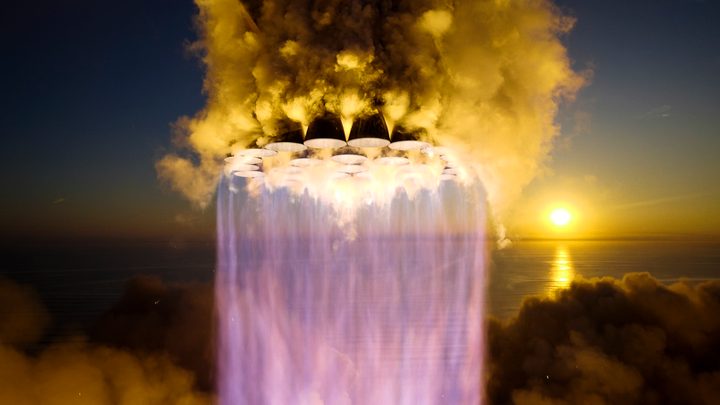
SpaceX has released some stunning images of its Starship rocket heading skyward during its second integrated test flight on Saturday.

The images (below) show the 33 Raptor engines of the first-stage Super Heavy booster as the world’s most powerful space vehicle blasted off the launchpad at SpaceX’s Starbase facility in Texas, creating around 17 million pounds of thrust in the process.

Recommended Videos

The world’s most powerful launch vehicle ever developed, powered by 33 Raptor engines, lifting off from Starbase pic.twitter.com/PqynIneFln

— SpaceX (@SpaceX) November 19, 2023

SpaceX boss Elon Musk also shared some dramatic aerial footage (below) showing the 400-foot-tall Starship rocket at the start of Saturday’s test flight.

pic.twitter.com/a3UVwshRyM

— Elon Musk (@elonmusk) November 20, 2023

pic.twitter.com/x6236wZWox

— Elon Musk (@elonmusk) November 18, 2023

Unlike the first test flight in April, this time the second-stage Starship spacecraft achieved successful separation from the Super Heavy booster about 2 minutes and 50 seconds into the flight.

However, about 30 seconds later the first-stage booster experienced what SpaceX described as a “rapid unscheduled disassembly.” In other words, it blew up.

The spacecraft also failed to complete its flight.

Despite the losses, SpaceX considered the test mission a success for achieving stage separation and lasting longer than April’s effort. Engineers will now examine every aspect of Saturday’s flight to help refine the system before it goes again.

NASA is watching SpaceX’s work on the Starship with great interest as it could one day use it to send astronauts on missions to deep space. It has already inked a deal with SpaceX to use a modified version of the Starship spacecraft to carry two astronauts from lunar orbit to the moon’s surface in the Artemis III mission, currently scheduled for 2025.

Posting on social media shortly after Saturday’s test flight, NASA chief Bill Nelson congratulated the SpaceX teams “who made progress on today’s flight test,” adding: “Spaceflight is a bold adventure demanding a can-do spirit and daring innovation. Today’s test is an opportunity to learn — then fly again. Together, NASA and SpaceX will return humanity to the moon, Mars, and beyond.”

Trevor Mogg
Contributing Editor
Not so many moons ago, Trevor moved from one tea-loving island nation that drives on the left (Britain) to another (Japan)…
China’s answer to SpaceX’s reusable rockets literally catches boosters in a net
SpaceX catches boosters on legs. China just used a net.
Ammunition, Missile, Weapon

SpaceX's playbook for recovering a rocket booster generally involves legs, a precisely controlled vertical landing, and either a concrete pad or a drone ship. 

China just managed to pull off something similar, but in a slightly different way, and on July 10, it tested the method as well.

Read more
Dimming the sun sounds unhinged, but this new study on El Niño makes a surprisingly good case for it
A natural test case, Australia's worst-ever wildfire season, suggests the idea deserves serious consideration.
Nature, Outdoors, Sky

When I first saw "scientists propose dimming the sun," I rolled my eyes. It sounds like a science fiction movie cooked up after watching many climate documentaries. But a new study, published on July 8, 2026, in the journal Science Advances, seems to have a genuinely compelling argument.

A Super El Niño is currently forming in the Pacific, feared to be the most intense in decades. It could escalate floods, wildfires, and extreme heat events worldwide. However, Researchers at UC San Diego's Scripps Institution of Oceanography, led by climate scientists Kate Ricke and Jessica Wan, are now proposing one of the most interesting solutions I’ve come across.

Read more
You can now walk through space and gaze into a black hole at this VR exhibit
Smithsonian Starstruck lets you drift past dying stars and see the origin point of the universe for as little as $18 a person.
Smithsonian Starstruck featured

Most planetarium shows ask you to sit still and look up. The Smithsonian's new VR exhibit takes a different approach, letting visitors walk through the vast expanse of the universe, drifting past stars, planets, and a black hole to get a physical sense of its true scale.

A $29 ticket to the edge of the galaxy

Read more