1. Home
  2. Space
  3. News

NASA engineers testing successor to Ingenuity helicopter rotors

Add as a preferred source on Google

The Ingenuity Mars helicopter has been more successful than anyone dared hope, lasting far, far beyond its originally planned five flights. The little helicopter recently made its 66th flight and has even weathered the tough Martian winter. With its success, NASA is now investigating the possibility of more helicopters for future Mars missions, and the agency’s Jet Propulsion Laboratory (JPL) recently shared a peek inside its testing of new Mars helicopter hardware.
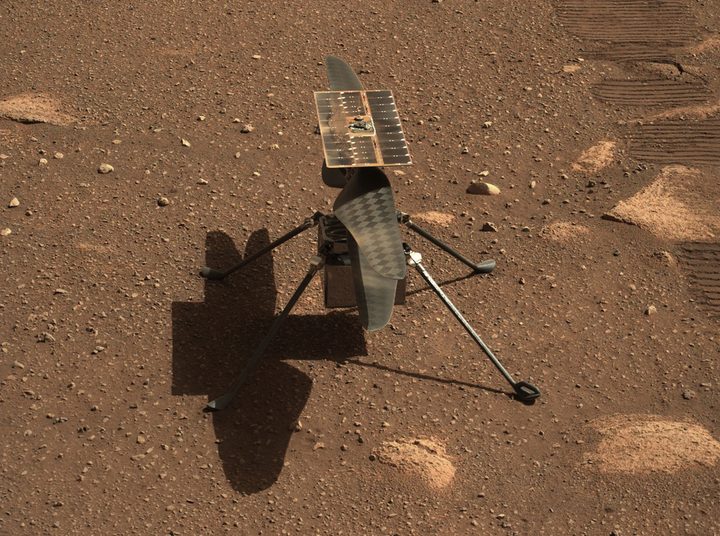
NASA’s Ingenuity Mars helicopter is seen here in a close-up taken by Mastcam-Z, a pair of zoomable cameras aboard the Perseverance rover. This image was taken on April 5, the 45th Martian day, or sol, of the mission.
NASA’s Ingenuity Mars helicopter is seen here in a close-up taken by Mastcam-Z, a pair of zoomable cameras aboard the Perseverance rover. This image was taken on April 5, the 45th Martian day, or sol, of the mission. NASA/JPL-Caltech/ASU

One of the biggest challenges in flying a helicopter on Mars is the extremely thin atmosphere, which is just 1% the density of Earth. That means that a helicopter has to displace a large amount of air to stay aloft, requiring large rotors that spin very fast. The engineers at JPL have been experimenting with a new rotor design that can spin at nearly the speed of sound, which is tested in a simulator space that can recreate Mars-like conditions of extreme cold and low pressure.

Recommended Videos

“Our next-generation Mars helicopter testing has literally had the best of both worlds,” said Teddy Tzanetos, Ingenuity’s project manager and manager for the Mars Sample Recovery Helicopters, in a statement. “Here on Earth, you have all the instrumentation and hands-on immediacy you could hope for while testing new aircraft components. On Mars, you have the real off-world conditions you could never truly re-create here on Earth.”

Testing Next-Generation Mars Helicopter Rotors

The rotor blades are made from carbon fiber and are even longer than those used on Ingenuity, with a new design that makes them stronger so they should be able to support a larger helicopter. Spinning these rotors faster helps them move more air, however, it can also create turbulence which could cause a helicopter to tip. For this reason, the engineers have been careful when increasing the speeds of the rotors — both for the new tests on Earth and for Ingenuity on Mars.

Two Views of a High-Altitude Flight for Ingenuity Mars Helicopter

“We spun our blades up to 3,500 rpm, which is 750 revolutions per minute faster than the Ingenuity blades have gone,” said Tyler Del Sesto, Sample Recovery Helicopter deputy test conductor at JPL. “These more efficient blades are now more than a hypothetical exercise. They are ready to fly.”

With this new data, the engineers can now work on a successor to Ingenuity, though any new design will require plenty more testing before it’s ready to ship off to the red planet.

“The data will be extremely useful in fine-tuning our aero-mechanical models of how rotorcraft behave on Mars,” said Travis Brown, Ingenuity’s chief engineer at JPL. “On Earth, such testing is usually performed in the first few flights. But that’s not where we’re flying. You have to be a little more careful when you’re operating that far away from the nearest repair shop because you don’t get any do-overs.”

Georgina Torbet
Georgina has been the space writer at Digital Trends space writer for six years, covering human space exploration, planetary…
China’s answer to SpaceX’s reusable rockets literally catches boosters in a net
SpaceX catches boosters on legs. China just used a net.
Ammunition, Missile, Weapon

SpaceX's playbook for recovering a rocket booster generally involves legs, a precisely controlled vertical landing, and either a concrete pad or a drone ship. 

China just managed to pull off something similar, but in a slightly different way, and on July 10, it tested the method as well.

Read more
Dimming the sun sounds unhinged, but this new study on El Niño makes a surprisingly good case for it
A natural test case, Australia's worst-ever wildfire season, suggests the idea deserves serious consideration.
Nature, Outdoors, Sky

When I first saw "scientists propose dimming the sun," I rolled my eyes. It sounds like a science fiction movie cooked up after watching many climate documentaries. But a new study, published on July 8, 2026, in the journal Science Advances, seems to have a genuinely compelling argument.

A Super El Niño is currently forming in the Pacific, feared to be the most intense in decades. It could escalate floods, wildfires, and extreme heat events worldwide. However, Researchers at UC San Diego's Scripps Institution of Oceanography, led by climate scientists Kate Ricke and Jessica Wan, are now proposing one of the most interesting solutions I’ve come across.

Read more
You can now walk through space and gaze into a black hole at this VR exhibit
Smithsonian Starstruck lets you drift past dying stars and see the origin point of the universe for as little as $18 a person.
Smithsonian Starstruck featured

Most planetarium shows ask you to sit still and look up. The Smithsonian's new VR exhibit takes a different approach, letting visitors walk through the vast expanse of the universe, drifting past stars, planets, and a black hole to get a physical sense of its true scale.

A $29 ticket to the edge of the galaxy

Read more