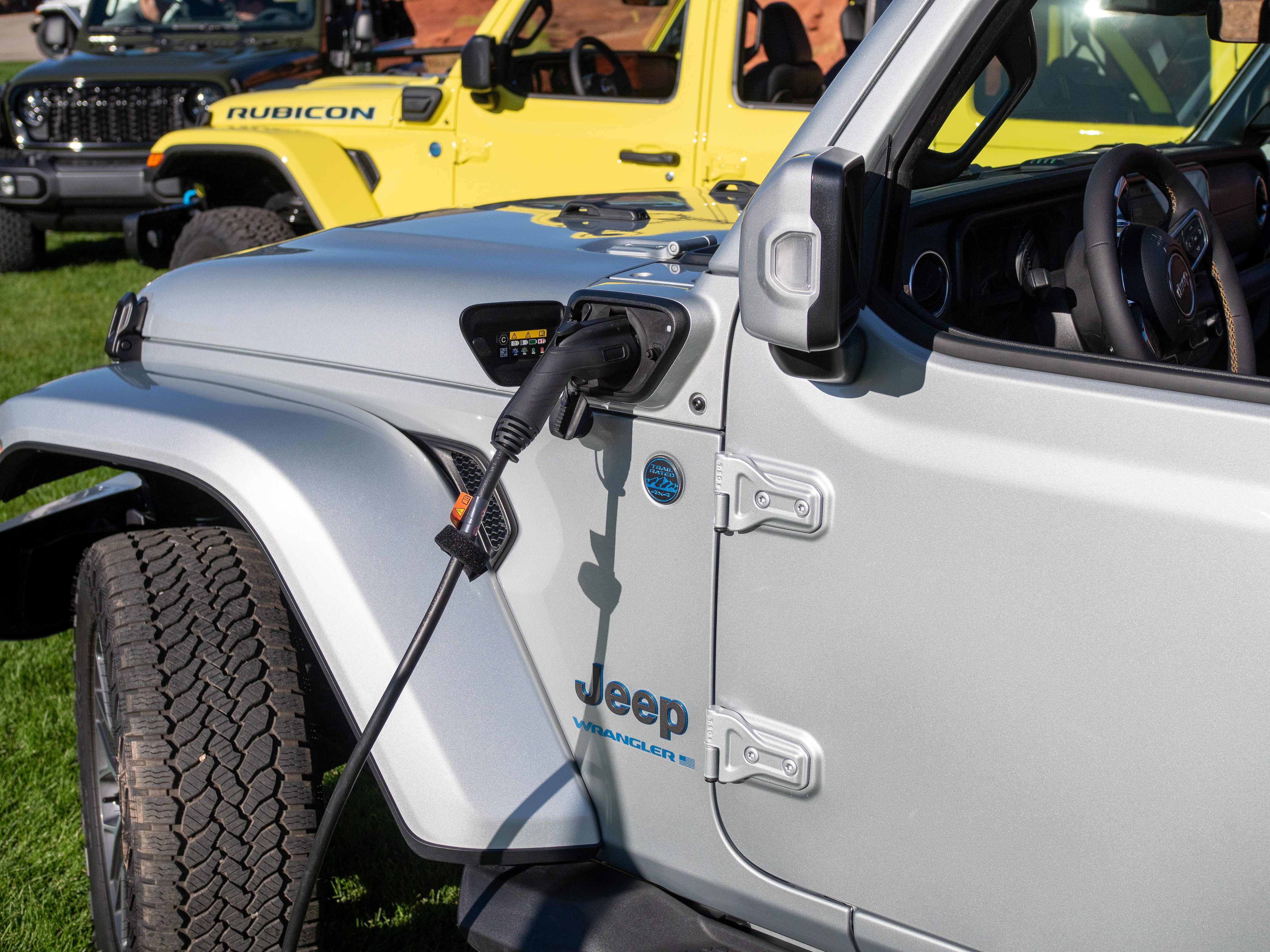
America’s bestselling plug-in hybrid (PHEV) has another battery recall on the books. Jeep just posted recall “B9A” (aka National Highway Traffic Safety Administration recall 23V-787) for the Wrangler 4xe, and it’s a doozy: the recall focuses on potential fire risk with the 4xe’s 17.3kWh battery, and until it’s fixed, owners are encouraged to stop charging their car and to park it outside away from other vehicles:
“An internally failed HV battery could lead to a vehicle fire with the ignition on or off. A vehicle fire can result in increased risk of occupant injury and/or injury to persons outside the vehicle, as well as property damage … Customers are advised to refrain from recharging these vehicles and not to park them inside of buildings or structures, or near other vehicles until the vehicle has the final repair completed.”
Stellantis (Jeep’s parent) is aware of eight instances of 4xe battery fires, six of which occurred while charging. Just over 42,000 4xes are being recalled, mostly in the U.S., though it’s expected that just 1% have the potential fire-causing issue. The fix is simple: New software is loaded onto the car, and if a specific fault is discovered afterward, the entire battery will need to be replaced.
If you have a Wrangler 4xe, you can check to see if your car is affected by entering your VIN at the Jeep recall site. That’s only the start, though: Jeep says in the recall notice that it doesn’t yet have the software distributed to dealers to fix it. You can sign up to be notified when it is ready, but that’s not going to make owners feel much better about driving a car they now know has a risk (no matter how small) of fire associated with it.
Any risk of a battery fire, no matter how small the chance, will make owners uneasy.
My own 2022 Wrangler 4xe is among the affected cars, and like many people, I live in a city and don’t actually have the choice to park outside of a garage and away from structures. So, let’s hope the software is available soon and I can get in for the fix. I won’t be charging my car until then, which is a real shame; though the 4xe’s battery is relatively small, it makes a big difference in overall fuel economy for shorter city-centric driving.
This is unfortunately not the first recall for the 4xe’s battery system. Just over a year ago, Jeep issued recall “Z71” focused on replacing incorrect fasteners on the hybrid battery that could have caused it to fail and the car to lose all power while driving. That recall, which required a simple inspection and replacement only if incorrect fasteners were discovered, took over a month from when I was notified to when I could get it addressed.
If there’s an upside to be found here, it’s that the previous recall seems to have been addressed successfully (including on my own car), and this week’s recall only affects some 4xes. Additionally, since Jeep has been using the exact same hybrid battery for the Wrangler 4xe for four model years now, it’s a well-known system and Jeep presumably has a pretty good handle on it.
But this is yet another example of the growing pains associated with our transition to PHEVs and EVs. Big batteries can be dangerous if not constructed and operated properly, and even the biggest automakers that build hundreds of thousands of them can encounter problems.