1. Home
  2. Space
  3. News

Hubble images a pair of galaxies caught in the process of merging

Add as a preferred source on Google

After last week’s image of the week from the Hubble Space Telescope showed a cluster of galaxies that appeared to be very close to each other but actually weren’t, this week’s image shows two images that are practically on top of each other. The two galaxies shown in the image below, NGC 6040 and LEDA 59642, are so close that they are interacting and have a shared name as a pair, Arp 122.
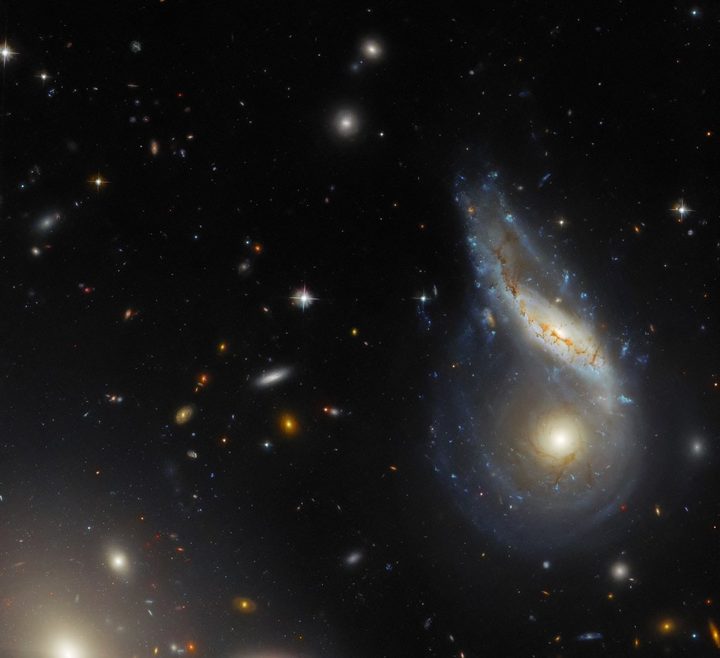
This NASA/ESA Hubble Space Telescope image features Arp 122, a peculiar galaxy that in fact comprises two galaxies – NGC 6040, the tilted, warped spiral galaxy and LEDA 59642, the round, face-on spiral – that are in the midst of a collision.
This NASA/ESA Hubble Space Telescope image features Arp 122, a peculiar galaxy that in fact comprises two galaxies – NGC 6040, the tilted, warped spiral galaxy and LEDA 59642, the round, face-on spiral – that are in the midst of a collision. ESA/Hubble & NASA, J. Dalcanton, Dark Energy Survey/DOE/FNAL/DECam/CTIO/NOIRLab/NSF/AURA Acknowledgement: L. Shatz

NGC 6040 is the galaxy on the top, which is stretched into a long, thin shape by the tremendous force of gravity from the rounder, face-on galaxy in the center-right, LEDA 59642. When galaxies come close together, the forces of gravity from both massive objects can interact and twist or distort one or both of the galaxies into unusual shapes, as has happened here.

Recommended Videos

The colliding of two galaxies is an epic event, and it can result in the destruction of one galaxy. At other times, the two colliding galaxies can merge into one. After hundreds of millions of years, the two can become one even larger galaxy, as may happen to Arp 122.

“Galaxies are composed of stars and their solar systems, dust, gas, and invisible dark matter. In galactic collisions, therefore, these constituent components may experience enormous changes in the gravitational forces acting on them,” Hubble scientists explain. “In time, this completely changes the structure of the two (or more) colliding galaxies, and sometimes ultimately results in a single, merged galaxy. That may well be what results from the collision pictured in this image.”

Our own galaxy, the Milky Way, is scheduled to collide with our galactic neighbor, the Andromeda galaxy, in around four billion years. That collision would likely create a giant elliptical galaxy as a merger between the two.

However, another theory states that before that happens, the Milky Way could collide with a smaller satellite galaxy called the Large Magellanic Cloud in around two billion years’ time. This theory states that the forces of the two colliding galaxies could spur the supermassive black hole at the center of our galaxy into overdrive, causing it to swell in size and send out powerful jets of radiation.

Georgina Torbet
Georgina has been the space writer at Digital Trends space writer for six years, covering human space exploration, planetary…
China’s answer to SpaceX’s reusable rockets literally catches boosters in a net
SpaceX catches boosters on legs. China just used a net.
Ammunition, Missile, Weapon

SpaceX's playbook for recovering a rocket booster generally involves legs, a precisely controlled vertical landing, and either a concrete pad or a drone ship. 

China just managed to pull off something similar, but in a slightly different way, and on July 10, it tested the method as well.

Read more
Dimming the sun sounds unhinged, but this new study on El Niño makes a surprisingly good case for it
A natural test case, Australia's worst-ever wildfire season, suggests the idea deserves serious consideration.
Nature, Outdoors, Sky

When I first saw "scientists propose dimming the sun," I rolled my eyes. It sounds like a science fiction movie cooked up after watching many climate documentaries. But a new study, published on July 8, 2026, in the journal Science Advances, seems to have a genuinely compelling argument.

A Super El Niño is currently forming in the Pacific, feared to be the most intense in decades. It could escalate floods, wildfires, and extreme heat events worldwide. However, Researchers at UC San Diego's Scripps Institution of Oceanography, led by climate scientists Kate Ricke and Jessica Wan, are now proposing one of the most interesting solutions I’ve come across.

Read more
You can now walk through space and gaze into a black hole at this VR exhibit
Smithsonian Starstruck lets you drift past dying stars and see the origin point of the universe for as little as $18 a person.
Smithsonian Starstruck featured

Most planetarium shows ask you to sit still and look up. The Smithsonian's new VR exhibit takes a different approach, letting visitors walk through the vast expanse of the universe, drifting past stars, planets, and a black hole to get a physical sense of its true scale.

A $29 ticket to the edge of the galaxy

Read more