Just a few days after losing contact with the Mars helicopter Ingenuity, NASA announced that it has regained communications with the plucky little helicopter. In a post on X (formerly Twitter), NASA’s Jet Propulsion Laboratory, which designed and operated the helicopter, announced that it is back in touch following an unexpected communications dropout.
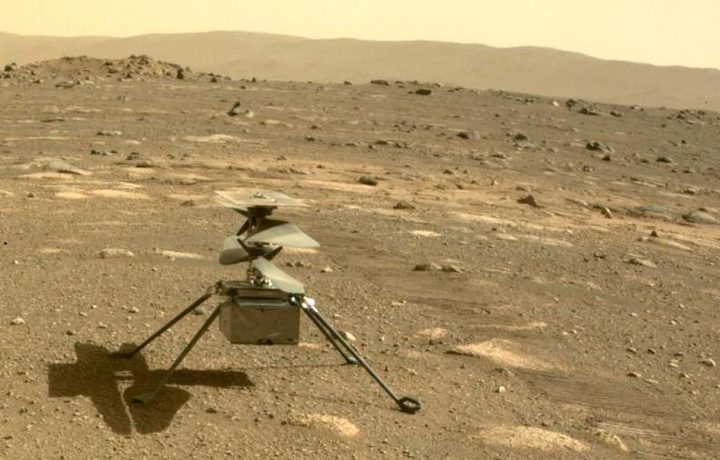
“Good news today: We’ve reestablished contact with the #MarsHelicopter after instructing @NASAPersevere to perform long-duration listening sessions for Ingenuity’s signal,” NASA’s JPL wrote on X. “The team is reviewing the new data to better understand the unexpected comms dropout during Flight 72.”
The helicopter is too small to communicate directly with Earth, as this would require a very large antenna that would be too big and heavy to attach to the helicopter. Instead, it sends its communications via the Perseverance rover, which is typically nearby on the surface of Mars. Perseverance doesn’t talk directly to Earth either, though, as it also doesn’t carry a huge antenna. Perseverance sends signals up to Mars orbiters overhead, which then transmit that data to Earth.
The orbiters used for these communications include NASA orbiters like the Mars Reconnaissance Orbiter (MRO), Mars Atmospheric and Volatile EvolutioN (MAVEN), and Mars Odyssey, plus the orbiters from the European Space Agency (ESA), the Mars Express and Trace Gas Orbiter (TGO). Together, these form the Mars Relay Network, which takes signals from Mars rovers and landers and sends them on to Earth, where they are picked up by the Deep Space Network, a set of huge antennas at three different sites around the globe.
Communications with Ingenuity have been more complex over the last year as Ingenuity and Perseverance have been further apart and have sometimes had terrain structures like hills between them. This terrain issue caused a communications dropout with Ingenuity in June last year.
The drivers of the rover and those planning the flights of Ingenuity have to be very careful to keep the two close enough to be in communications range but far enough apart that there is no danger of them crashing into each other. That’s because of the communications delay between Earth and Mars, as it can take up to 20 minutes for a signal to travel between the two, so the rover and helicopter can’t be controlled in real time.