1. Home
  2. Space
  3. News

The world’s largest digital camera for astronomy is ready to go

Add as a preferred source on Google

Ready to scan the night sky to look for evidence of dark matter, identify near-Earth asteroids, and much more, the camera for the upcoming Vera Rubin Observatory is now complete. This is the world’s largest digital camera for astronomy, with a staggering 3,200 megapixels, and it will be placed in the Rubin Observatory in Chile.
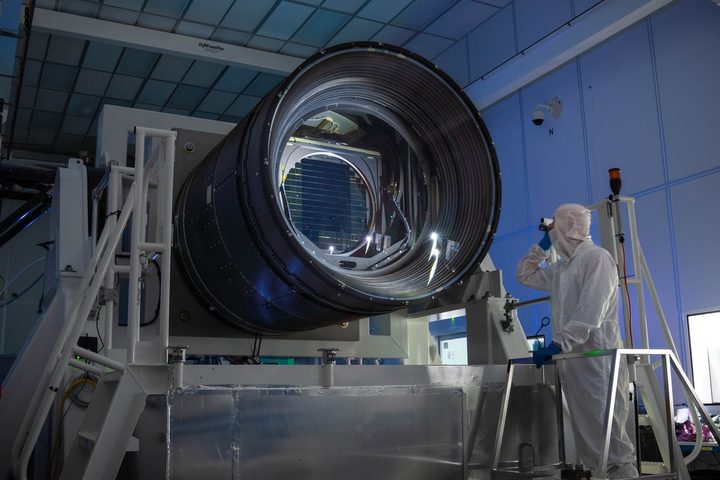
Photograph of the camera, with one of the colour filters positioned in place.
Photograph of the camera, with one of the color filters positioned in place. Olivier Bonin/SLAC National Accelerator Laboratory

The camera is vast, weighing around 3 metric tons, making it about the same size and mass as a small car. With a huge front lens that is 5 feet across, it will be able to take incredibly detailed images of large sections of the sky. Built at the Department of Energy’s SLAC National Accelerator Laboratory (SLAC), it will be used for the Legacy Survey of Space and Time (LSST), a 10-year project to image the southern sky and spot transient objects like supernovae.

Recommended Videos

“With the completion of the unique LSST Camera at SLAC and its imminent integration with the rest of Rubin Observatory systems in Chile, we will soon start producing the greatest movie of all time and the most informative map of the night sky ever assembled,” said Director of Rubin Observatory Construction, Željko Ivezić of the University of Washington, in the statement.

The huge scale of the camera makes it incredibly powerful, able to capture a very wide field of view (meaning it can take in a large portion of the sky with each observation) and to resolve very fine detail.

“Its images are so detailed that it could resolve a golf ball from around 25 kilometers (15 miles) away while covering a swath of the sky seven times wider than the full Moon. These images, with billions of stars and galaxies, will help unlock the secrets of the Universe,” said SLAC professor and Rubin Observatory Deputy Director and Camera Program Lead Aaron Roodman.

The camera has been tested at SLAC and is now ready to be shipped to Chile, where it will be installed onto the Simonyi Survey Telescope later this year. This telescope, as part of the Rubin Observatory, is located at the top of the Cerro Pachón mountain — a location that brings some challenges to installation.

Rubin is set to begin its survey in 2025 when it will scan the sky to learn about the movements of distant galaxies to help uncover information about dark matter and other key topics in astronomy.

“More than ever before, expanding our understanding of fundamental physics requires looking farther out into the universe,” said Kathy Turner, program manager for the DOE’s Cosmic Frontier Program. “With the LSST Camera at its core, Rubin Observatory will delve deeper than ever before into the cosmos and help answer some of the hardest, most important questions in physics today.”


Georgina Torbet
Georgina has been the space writer at Digital Trends space writer for six years, covering human space exploration, planetary…
Space is becoming Bezos and Musk’s next data center site, and we have every reason to worry
The AI boom is coming for the night sky
How Vast's space station will look in orbit.

AI data centers already consume vast amounts of electricity and water on Earth, so Silicon Valley has begun looking somewhere considerably more spacious... literally.

Elon Musk's SpaceX and Jeff Bezos' Blue Origin, along with several other companies, have proposed enormous constellations of satellites designed to operate as orbital data centers. However, environmental groups and former space officials are now warning that putting them into orbit at the proposed scale could have severe consequences for Earth's atmosphere and the night sky.

Read more
The first possible exomoon is here, and it makes our Moon look hilariously tiny
Scientists may have found the first exomoon, except this one is the size of Jupiter
This artist’s concept depicts a potential volcanic moon between the exoplanet WASP-49 b, left, and its parent star. New evidence indicating that a massive sodium cloud observed near WASP-49 b is produced by neither the planet nor the star has prompted researchers to ask if its origin could be an exomoon.

We have already discovered more than 6,000 planets outside of our immediate neighborhood. Yet, finding a moon orbiting one of those distant worlds has proved considerably harder. Astronomers may finally have something close to the real deal, but this particular object stretches the word “moon” almost beyond recognition.

Using the European Southern Observatory’s Very Large Telescope in Chile, researchers detected strong evidence for a moon-like object in the CD-35 2722 system. Further observations are still necessary to confirm the discovery, but it could become the first confidently detected natural satellite outside our solar system. There is still one tiny complication though. This moon is apparently massive.

Read more
China’s answer to SpaceX’s reusable rockets literally catches boosters in a net
SpaceX catches boosters on legs. China just used a net.
Ammunition, Missile, Weapon

SpaceX's playbook for recovering a rocket booster generally involves legs, a precisely controlled vertical landing, and either a concrete pad or a drone ship. 

China just managed to pull off something similar, but in a slightly different way, and on July 10, it tested the method as well.

Read more