  1. Home
  2. Space
  3. News

3D printing tested for emergency spacecraft and medical supplies in space

Add as a preferred source on Google

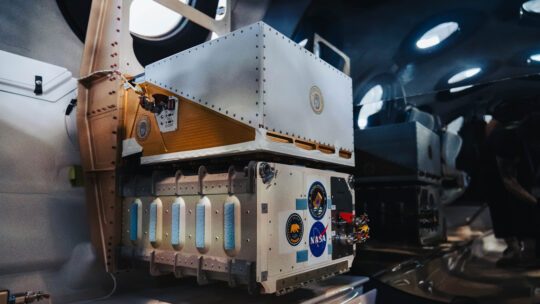
SpaceCAL 3D printer on VSS Unity, awaiting launch on June 8, 2024.
SpaceCAL 3D printer on VSS Unity, awaiting launch on June 8, 2024. Virgin Galactic

3D printing is already being used in the space industry to create rocket engines and many more parts, but experts want to use the technology not only on the ground but also in space. Europe recently launched the first metal 3D printer to the International Space Station, and regular 3D printers have been used on the ISS for a decade. But as 3D printers become more advanced, researchers want to see if these newer versions could be used in space too.

Recommended Videos

Recently a team from the University of California, Berkeley sent a new 3D printer to space on a Virgin Galactic mission. The printer, called SpaceCAL and designed specifically for microgravity environments, had just a few minutes in space but was able to print four test parts in that time. Those test prints included, appropriately enough, a tiny model space shuttle made from a liquid plastic material called PEGDA.

The idea is that such technology could be used on future missions to create tools or supplies that are needed. “We hope that someday it may be used to manufacture everything from parts and tools for spacecraft to new contact lenses and dental crowns for crew members,” said researcher Taylor Waddell. “So, with the cabin, if your spacecraft is breaking down, you can print O-rings or mechanical mounts or even tools. But CAL is also capable of repairing the crew. We can print dental replacements, skin grafts or lenses, or things personalized in emergency medicine for astronauts, which is very important in these missions, too.”

That’s because CAL doesn’t only print in plastic. When tested on Earth, it can also print in silicones, glass composites, and biomaterials, which could allow it to create emergency care for the crew as well as their spacecraft. It could even one day print human organs, which is the aim of a new grant for testing out the technology on the ISS. The next step toward this is printing more simple objects like dental crowns or a tool for closing wounds.

And such technology could have other uses in extreme or remote environments on Earth too. “These experiments are really focused on pushing technology for the betterment of everyone,” Waddell said. “Even though it’s for space, there are always tons of ways it can benefit people back here on Earth.”

Georgina Torbet
Georgina has been the space writer at Digital Trends space writer for six years, covering human space exploration, planetary…
China’s answer to SpaceX’s reusable rockets literally catches boosters in a net
SpaceX catches boosters on legs. China just used a net.
Ammunition, Missile, Weapon

SpaceX's playbook for recovering a rocket booster generally involves legs, a precisely controlled vertical landing, and either a concrete pad or a drone ship. 

China just managed to pull off something similar, but in a slightly different way, and on July 10, it tested the method as well.

Read more
Dimming the sun sounds unhinged, but this new study on El Niño makes a surprisingly good case for it
A natural test case, Australia's worst-ever wildfire season, suggests the idea deserves serious consideration.
Nature, Outdoors, Sky

When I first saw "scientists propose dimming the sun," I rolled my eyes. It sounds like a science fiction movie cooked up after watching many climate documentaries. But a new study, published on July 8, 2026, in the journal Science Advances, seems to have a genuinely compelling argument.

A Super El Niño is currently forming in the Pacific, feared to be the most intense in decades. It could escalate floods, wildfires, and extreme heat events worldwide. However, Researchers at UC San Diego's Scripps Institution of Oceanography, led by climate scientists Kate Ricke and Jessica Wan, are now proposing one of the most interesting solutions I’ve come across.

Read more
You can now walk through space and gaze into a black hole at this VR exhibit
Smithsonian Starstruck lets you drift past dying stars and see the origin point of the universe for as little as $18 a person.
Smithsonian Starstruck featured

Most planetarium shows ask you to sit still and look up. The Smithsonian's new VR exhibit takes a different approach, letting visitors walk through the vast expanse of the universe, drifting past stars, planets, and a black hole to get a physical sense of its true scale.

A $29 ticket to the edge of the galaxy

Read more