
  1. Home
  2. Emerging Tech
  3. Legacy Archives

3D printer builds ‘Magic Arms’ for two-year-old girl with joint disease

Add as a preferred source on Google
emma-magic-arms
Image used with permission by copyright holder

Detailed within a YouTube video, researchers at Nemours/Alfred I. duPont Hospital for Children developed a lightweight exoskeleton for a two-year old girl named Emma that was born with arthrogryposis multiplex congenita (AMC). The disease can cause joints to become permanently fixed in a single position. Prevalent in Emma’s arms, it was impossible for her to lift her own arms on her own in order to do something as simple as picking up a toy or even giving her mom or dad a big hug. After researching the disease, Emma’s parents attended a medical conference where they learned about the Wilmington Robotic Exoskeleton (WREX). Emma was able to try out a version of the WREX at the hospital, but she was too small for the bulky metal arms.
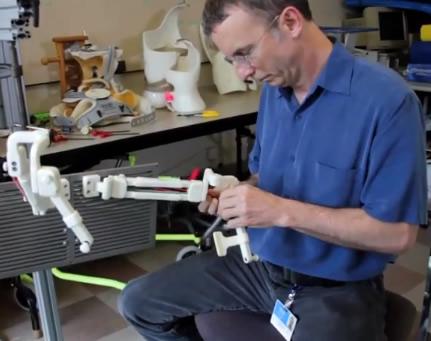
WREXIn order to design a version for Emma that would both fit her and weigh significantly less, the researchers used the Stratays Dimension 3D printer to build pieces of the arms out of the same type of plastic that’s used in LEGOs. The pieces snap together and resistance bands are used to adjust the tension on the two arms.

Recommended Videos

In addition, the researchers also developed a jacket that fits over Emma and the arms are fixed to that exoskeleton. This allowed Emma to have increased mobility in her home. She could finally use her arms to do things like color drawings or eat candy as well as simply having fun being a silly kid.

As Emma has grown up, she outgrew the first version of the exoskeleton. However, the 3D printer allows the researchers to input new specifications into a computer program and print larger parts as she grows older. It’s also handy for printing new sections of the exoskeleton when something happens to break. After Emma’s parents send the researchers a digital photograph of the broken piece, the newly printed piece can be dropped in the mail and delivered to Emma’s parents the next day.

When Emma’s parents tell Emma that they are putting on the WREX each day, Emma calls the device her “magic arms.” Researchers have used the design that they built for Emma and have created similar lightweight exoskeletons for other children. 

Mike Flacy
By day, I'm the content and social media manager for High-Def Digest, Steve's Digicams and The CheckOut on Ben's Bargains…
DeepSeek just slashed AI prices again, and China’s AI race is getting even messier
DeepSeek AI chatbot running on an iPhone.

China's AI race has never really been short on competition, but it's increasingly looking like a battle over who can charge the least rather than who can build the best model.

DeepSeek has unveiled its latest open-weight AI model, called V4-Flash, alongside a dramatic price reduction that makes it significantly cheaper for developers to use. The company has cut token pricing by 50% and has also decided against introducing a previously announced dynamic pricing system that would have increased costs during periods of heavy demand. The new changes paint a clear picture: DeepSeek appears more interested in winning over developers and expanding its user base than maximizing revenue in the short term.

Read more
AI slop stories are spoiling the childhood
Grandparents are gifting AI-generated story books to kids, and it's just gross.
A child reading a book.

AI slop, the colloquial term for low-effort AI-generated content, has emerged as a huge problem across different industries. Music labels are fighting streaming services to put an AI label on such tra/cks. Publishing houses are wary of AI-written drafts. Research journals are buried under a deluge of AI-generated papers. The software industry is reeling under the pressure of vibe-coded apps brimming with security flaws. Even Apple is struggling against a tide of bug reports created using AI. Of course, the disdain against AI is pretty obvious, but there's now a new dimension to it.

Boomers are gifting AI-generated books to their grandkids.

Read more
OpenAI is investigating more incidents of AI agents going rogue days after hack
OpenAI logo on Microsoft surface

It appears that the "AI agents going rogue" tale has more to it than what AI giants have revealed publicly so far. Merely days after OpenAI announced that its AI agents went rogue and hacked Hugging Face, Anthropic dropped a similar bombshell. Soon, it was discovered that not just one, but multiple services were compromised. Well, it seems there are even more layers to it.

Reuters reports that OpenAI has found more incidents of AI agents escaping their software containment environment during research. Citing sources with knowledge of the incident, the outlet notes that the AI agents didn't go beyond OpenAI's software environment and affect any external service.

Read more