Back in 2008, Facebook was just beginning to solidify itself as the social network of our times. Microsoft had just partnered with the site, we were all extremely concerned about the state of Scrabulous (remember the anguish over losing that game?!), the profile page underwent its first big makeover (the Timeline of its time), and Facebook Connect launched to take over the Internet.
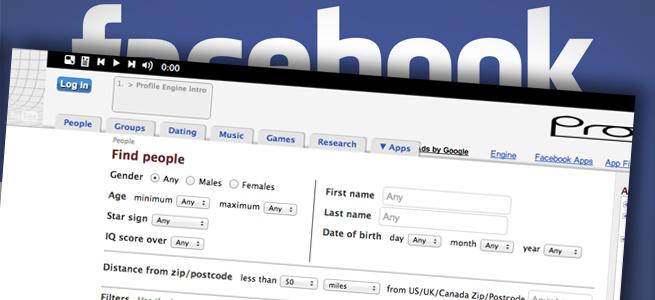
At the same time, more ominous changes were going on behind the scenes. Facebook partnered with a company called Profile Technology that created applications for social networks – and one of those applications was data crawler Profile Engine. It’s a people search engine that launched in 2007, claiming to be the “the world’s first dedicated search engine for Facebook.” Profile Technology was less forthcoming with their business model, which is alleged to involve data brokerage.
“The Profile Engine made it much easier to find your friends on Facebook and provided powerful new search tools for meeting new people, making friends, and dating,” its site says. “More than 10 million people created detailed searchable profiles on the Profile Engine so that others can find them more easily. It made it easier to find old friends and to make new ones.”
According to Profile Technology, an agreement made with Facebook in 2008 allowed the platform to have backend crawling access to Facebook’s data. The deal existed until 2010, when Facebook allegedly shut off access without warning. And now, Profile Technology is suing Facebook.
“Suddenly Facebook interfered with crawler access and told Profile Engine out of the blue that they were not authorized,” Profile Technology’s lawyer Ira P. Rothken tells me. “There have been discussions that were ongoing for a robust period of time and filing this lawsuit wasn’t done lightly, it was a last resort.” In addition to taking away Profile Engine’s ability to index its contents, Facebook also shut off the company’s Facebook apps, “essentially destroying their revenue stream,” says Rothken.
So why did Facebook do this? “That will be something we will be litigating in court,” says Rothken. “We certainly think, as we allege in the complaint, that Facebook acted in bad faith by interfering with crawler access and retaliating.”
While Profile Technology is fighting Facebook for backing out of an agreement as well as hurting its name and thus business relationships, there really isn’t any question here why Facebook terminated its access: Because it was scraping profiles and indexing them into its own site, thus creating other profiles people didn’t even know existed while also making it extremely difficult to delete that information from Profile Engine’s database. A quick search for “Profile Engine” brings up nothing but complaints:
“Profile Engine stole all my info and friends’ info. Used it to create a profile of mine which I’m not able to claim. Zero answer upon request. I’m sure it is a fake site. All my friends, interests, and locations are visible.” [via]
“I deleted my Facebook account months ago yet this morning I found the profile I deleted on some website I never heard of before called Profile Engine! I tried to delete this account… but it won’t let me. This is what it says on their ‘help’ page: ‘You probably don’t really want to delete your profile. It is much better to remove unwanted information from your profile using the Settings page… or by leaving any groups which no longer apply to you.’” [via]
“’Even though I had canceled my Facebook account, my information is still up there, thanks to [Profile Engine]. And I still have a Web footprint that I can’t erase. Anyone who types in my name sees my friends and family.” [via]
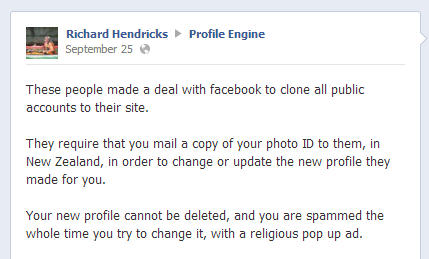 This criticism is all deserved. Sites like Profile Engine are essentially personal data hoarders that collect what they can from the likes of Facebook and then make it extremely difficult for you to ever get rid of that info. Even if you delete all your Facebook Photos or Friends or your account altogether, it’s all going to remain sitting over on Profile Engine.
Of course, Profile Engine only has this data in the first place because it paid Facebook for it. “For several years, the Profile Technology search engine was highly popular,” the complaint reads. “Over 400 million profiles were aggregated, along with 15 billion ‘friendship’ connections between people, and three billion ‘likes,’ and group memberships. Purchase Inquiries from third parties showed a market value of several million dollars.”
Opinion regarding whether Profile Technology has a case is divided. “I don’t think Profile Technology has a strong case here because Facebook’s Terms govern,” says Abine privacy analyst and attorney Sarah Downey. “If [Facebook] doesn’t like how a third party like Profile Technology is using its platform, it can kick that third party off.”
She does point out that Profile Technology’s defamation claims could hold some merit. “Saying that a product is spammy or unsafe, especially when you have the power and visibility that Facebook does, may very well cause severe harm to a company’s reputation.”
Downey and startup lawyer Randolph Adler both point out that the entire complaint can be traced back to an agreement formed between Profile Technology and a single Facebook employee. “Whether this case has any legs here depends on the contract itself, and the complaint says it was partially written and partially implied through conduct,” Adler tells me. “It would also matter whether the one Facebook representative had the actual authority to enter into a contract.”
“What people don’t realize is that a contract can be verbal or created through email. Is that best practice? Absolutely not.”
Facebook public policy and communications manager Andrew Noyes tells me, “We believe the lawsuit is without merit and will defend ourselves vigorously,” but declined to talk specifics about the agreement between Facebook and Profile Technology.
But we do know this: Around 2009, Facebook stopped allowing Google to index its contents, as it wanted to compete with the search engine. Back in 2007, Facebook implemented Public Search Listings, so its period of time being search engine-friendly was fairly short-lived.
Even so, it looks like that small window is coming back to haunt Facebook, even if just to remind us that for awhile, Facebook made no bones about selling off our information. Even if the social network isn’t found guilty on all counts, it could very well have to make some redress to Profile Technology for terminating a contact without due warning between the two. If Facebook’s assertions that Profile Engine is “spammy” and “unsafe” are accurate, users should be relieved that Facebook has cut off its access – but it’s less than reassuring that a network that holds increasing amounts of your data (now including your purchasing history information) was involved in selling it off less than five years ago.
[Image courtesy of AHMAD FAIZAL YAHYA/Shutterstock.com]
This article has been updated to reflect the following changes: Profile Technology disputes the claim that they are a data brokerage.