
  1. Home
  2. Space
  3. News

How to watch Saturday’s partial solar eclipse

Add as a preferred source on Google
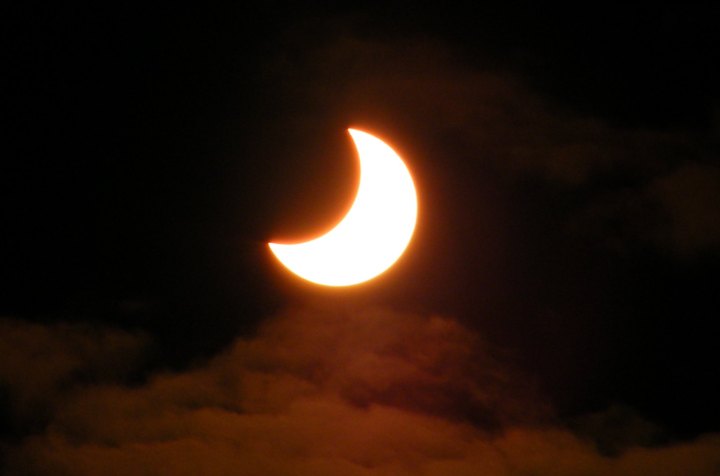
A partial solar eclipse.
David Paleino/Creative Commons

The moon will be passing in front of the sun on Saturday in a phenomenon known as a “partial solar eclipse.”

As the name suggests, it means that unlike a total solar eclipse, a part of the sun will still be visible, but the spectacle is still worth enjoying if you’re in a location from where it can be viewed.

Recommended Videos

Those places include parts of North America, Europe, Africa, northern Asia, small parts of South America, throughout Greenland and Iceland, as well as much of the Atlantic and Arctic oceans.

“In much of the Americas, including the northeastern United States, the partial solar eclipse will already be in progress during sunrise,” NASA says on its website. “In western Europe and northwestern Africa, the eclipse will begin in the mid-to-late morning. In eastern Europe and northern Asia, most or all of the eclipse will occur in the afternoon or early evening.”

And take note, if you do decide to watch this weekend’s partial solar eclipse, it’s essential that you use proper eye protection or an indirect viewing method to protect your eyes. NASA has a useful webpage about keeping your eyes safe during eclipses.

What to expect

Assuming that you get a clear view, you can expect to see the sun appear like a crescent — or as if a section has been removed from it — as the moon passes in front of it.

How to watch

Saturday’s partial solar eclipse will be viewable from states in the northeast of the U.S., specifically Connecticut, Delaware, Maine, Maryland, Massachusetts, New Hampshire, New Jersey, New York, North Carolina, Pennsylvania, Rhode Island, Vermont, Virginia, and West Virginia.

In the U.S and Canada, the partial eclipse will occur early in the morning during sunrise, so be sure to set your alarm.

For specific viewing times in the U.S., Canada, and other parts of the world, take a moment to check out NASA’s detailed breakdown, which also tells you how long the eclipse will last (from a couple of minutes to about an hour), and the percentage of the sun that will be covered by the moon, according to your location.

Trevor Mogg
Contributing Editor
Not so many moons ago, Trevor moved from one tea-loving island nation that drives on the left (Britain) to another (Japan)…
Virgin Galactic is charging $750,000 for three minutes of weightlessness, and nearly 700 people are already in the queue
Three minutes of floating, one very expensive ticket.
Virgin Galactic featured image

I’ll be honest with you. Three minutes of weightlessness for the price of a very nice house sounds absurd to me. Even so, hundreds of people have already lined up to experience it.

Most recently, Virgin Galactic unveiled Apeiron, the first spaceplane in its new Delta class. The company flew it from its Arizona factory to Spaceport America in New Mexico, where it will begin flight testing.

Read more
SpaceX Starship reaches orbit for the first time but its historic flight ends early
Starship reaches orbit for the first time and deploys 26 Starlink satellites before an early splashdown.
spacex-starship

After 13 suborbital test flights and more than $15 billion in development costs, SpaceX's Starship has finally reached orbit. The 407-foot megarocket, the most powerful ever built, lifted off from Starbase, Texas, on Monday and delivered its first real payload on it's 14th attempt. The celebration came with an asterisk, though, since SpaceX had to cut the planned 10-hour mission to roughly three hours.

https://twitter.com/SpaceX/status/2104601695711904180

Read more
Starship is finally going orbital, and SpaceX has picked September 22
Flight 14 is aiming for orbit, Starlink V3 deployment and a very long day in space.
Starship rocket.

SpaceX is finally ready to give Starship its biggest test yet. The company says the massive rocket's 14th test flight is scheduled for September 22, when it will attempt to put the upper stage into Earth orbit for the first time. The launch is currently pending regulatory approval, with a 75-minute window opening at 7:15 a.m. CT.

Starship has 26 Starlink satellites to deliver

Read more