
  1. Home
  2. Computing
  3. Legacy Archives

Computing pioneer Douglas Engelbart dead at 88

Add as a preferred source on Google
Douglas Engelbart "Mother of all Demos"
Image used with permission by copyright holder

Douglas Engelbart died at his home in California on July 3. He was 88 years of age. Engelbart may be best known as the inventor of the computer mouse — initially called “the bug,” what we now know as a mouse was a clunky wooden box with wheels — but Engelbart’s influence on modern computing was much more profound. He was one of the first people to realize the massive impact computing would have on modern society, and he opened the doors to the graphical user interfaces, hypertext, and online collaboration — what we would call the Internet today.
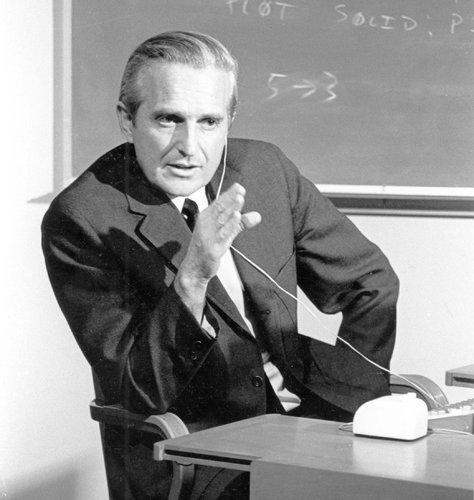
Douglas Engelbart SRI 1968
Image used with permission by copyright holder

In 1945, Engelbart was stationed in the Philippines as a radar technician when he read Vannevar Bush’s famous article “As We May Think,” which posited the idea of the “memex,” a kind of collective memory system that would make information and knowledge more accessible. Engelbart eventually made the concept his life’s work, leading him to a position at SRI where he received funding to create the Augmentation Research Center (ARC). At ARC, Engelbart led his own lab developing the oN-Line System (NLS), a collaboration and information retrieval system that foreshadowed much of modern computing. NLS had a bitmapped graphical display, hypertext, a mouse, and online collaboration tools — a radical notion in days when computers were isolated, monolithic machines used by one person at a time.

Recommended Videos

In December 1968, Engelbart demonstrated NLS before a stunned gathering of the world’s leading computer scientists and researchers in a presentation that’s still called “the mother of all demos.” He sat on stage with a keyboard, a mouse, a chording keypad, and a 20-foot high screen image projected behind him. Much of the technology was vaporware — including the early video conferencing it demonstrated — but it was the inspiration that sparked developments at Xerox PARC and the Stanford Artificial Intelligence Laboratory that, more than a decade and a half later, lead to the Apple Macintosh and Microsoft Windows.

Most people know that the forerunner of the modern Internet was ARPAnet, a Defense Department project to interconnect research labs and universities. What few people remember is that ARPAnet was built to support Engelbart’s Augment NLS system, and “Genie,” a computer running NLS at ARC, was the first host connected to the network.

Engelbart drifted away from the limelight after ARC was disbanded in the 1970s and much of its staff (including Engelbart) hired by Tymshare, eventually acquired by McDonnell Douglas. However, by the time Engelbart retired in 1986, he was being broadly recognized for his contributions to computing technology, and (among other honors) was presented the prestigious National Medal of Technology and the Turing Award.

Engelbart was one of the first to realize how computing technology could impact society, and continued to advocate “boostrapping” technologies that could augment humanity’s collective intelligence for the rest of his life.

Engelbart leaves behind his wife, four children, and nine grandchildren.

Geoff Duncan
Former Contributor
Geoff Duncan writes, programs, edits, plays music, and delights in making software misbehave. He's probably the only member…
Google Earth’s AI misadventure lasted only a day. It was a tale of dangerous ignorance.
Nuclear reactors, tanks, and historical destruction on a life-like satellite map? Yeah, that's bad.
Nano Banana AI image generator representation.

Technology behemoths are clearly not reading the room, or they are just moving faster than they should when it comes to AI deployment. Google has already stuffed its Gemini AI in every corner of its software stack, from Android to daily productivity tools like Gmail that are used by hundreds of millions of users every day. AI is everywhere. Not all of it is bad, mind you. But in a few places, it just feels forced.

In its latest AI-fication experiment, the company targeted Google Earth. The idea was to let the audience use its Nano Banana 2 AI image generator and make images that can be placed on the map view. On paper, it's a cool idea. What would the Colosseum of Rome look like in your urban neighborhood? Yeah, fun stuff like that.

Read more
AMD is apparently gearing up to raise GPU prices right after Nvidia’s steep hike
AMD has reportedly told AIB partners about a price hike that goes into effect in. August.
AMD RX 7800

AMD is next in line to raise the asking price of its Radeon GPUs, merely days after the news of a similar hike coming for Nvidia graphics cards started making waves. As per ChannelGate on Weibo (h/t VideoCardz), AMD has informed its board partners that the price of GPU and memory bundles will go up by at least 10% in August.

Is a similar price hike coming for standalone graphics cards? I won't be surprised if that happens. The situation is so bad that AMD is planning to bring back graphics cards with 4GB of onboard memory. AMD just introduced the RX 9050 GPU, which costs $279. Notably, it's just $20 less than the RX 9060 XT that offers double the graphics memory.

Read more
Microsoft will make Windows work well with just 8GB RAM. We desperately need it
The dream of a reliable and affordable Windows laptop hinges on the next milestone at Microsoft.
Surface laptop on wooden table

The year 2026 has marked a huge course correction for Microsoft after years of frustrating users with plenty of confusing processes, unoptimized UI elements, and just the generous bloatware that can bring any Windows system to a crawl. Microsoft has finally shifted into a new phase. From fixing the right-click behavior to speeding up the Search system, the company has fixed plenty of papercuts.

The next major milestone is making Windows 11 run smoothly on Windows PCs with just 8GB of RAM. That directly means entry-level and budget laptops will at least get the basics right, even if that means sacrificing the on-device AI bells and whistles. Let's face it. The increasingly AI-first approach to computing on a Windows 11 machine is a little too taxing on the hardware at hand.

Read more