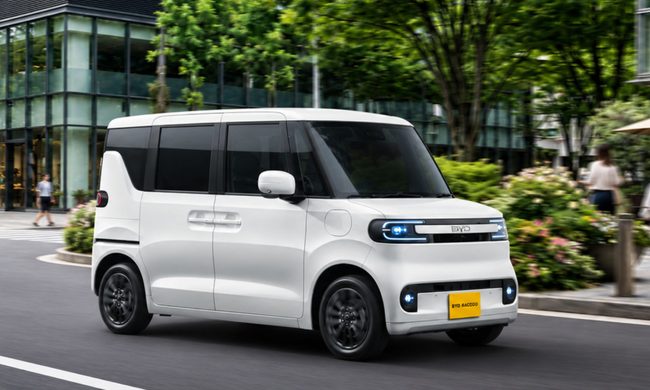
Wuling has launched the updated 2026 Hongguang Mini EV in China, and it’s exactly the kind of car that makes US buyers crave Chinese EVs. Priced between 44,800 and 54,800 yuan (roughly $6,500 to $8,000), this tiny four-door, four-seater is back with a fresh look, a smarter cabin, and a range that’s finally worth talking about.
Does the design look good?
Not going to lie, the 2026 Hongguang Mini seems to have taken a lot of inspiration from the Mini Cooper, bringing over the iconic name, the same small car design with circular headlights, and the compact style.
That being said, it also features subtle design changes that set it apart. Where the Mini Cooper keeps things sleek and sporty, the Hongguang Mini leans into a boxier, more upright shape that Wuling calls “sweet square.” The result is a car that looks friendlier than its British counterpart.

The clover-style wheels and dual-tone body also give it a personality of its own, even if the circular headlights are clearly paying homage to an icon. I would say that the car genuinely looks good, and for the price it’s asking, there’s nothing like this out there.
The redesign also brings three new paint options that use an eight-layer process, and you can spec it with a dual-tone body. At 3,268mm long, it’s still tiny, but it’s grown just enough to feel a little more substantial than before.

The interior gets a proper refresh, too. There’s a dual-tone cabin, a 10.1-inch touchscreen with a cleaner interface, and a column-mounted gear selector that frees up center console space.
What about the range?
As reported by CarNewsChina, the 2026 Hongguang Mini EV offers two range options: 205 km (127 miles) and 301 km (187 miles) as measured on China’s CLTC cycle. Do note that the real-world range typically sits lower.
| Car model | Price (Yuan) | Price (USD – approx.) |
| 205 km Advanced | 44,800 | $6,500 |
| 205 km Premium | 49,800 | $7,300 |
| 301 km Advanced | 49,800 | $7,300 |
| 301 km Premium | 54,800 | $8,000 |
It also supports DC fast charging, which can top it from 30% to 80% in 35 minutes, which is respectable for a car at this price. It’s nothing compared to the new fast charging standards set by modern Chinese EVs, but you are getting more than you pay for.
The 30 kW motor is unchanged, so don’t expect it to be quick. But at under $8,000, the Hongguang Mini EV isn’t trying to be a performance car. It’s trying to be useful, and by most measures, it succeeds.