1. Home
  2. Cars
  3. News

Tesla’s Cybercab has entered production. Let’s hope it can actually drive itself this time

Tesla has crossed the manufacturing finish line on the Cybercab, but the autonomous driving race it needs to win is still very much in progress.

Add as a preferred source on Google
Tesla Cybercab at night
Tesla

Tesla has a long history of announcing things before they are ready. On April 24, 2026, Elon Musk posted a POV video of a steering-wheel-free Cybercab rolling out of Gigafactory Texas, and the internet seems to have lost its mind. 

Musk has confirmed that the volume manufacturing of the autonomous robotaxi has begun. However, the company still has to figure out the harder part. 

Cybercab has started production pic.twitter.com/MAeswanf96

— Elon Musk (@elonmusk) April 24, 2026

What exactly has Tesla built?

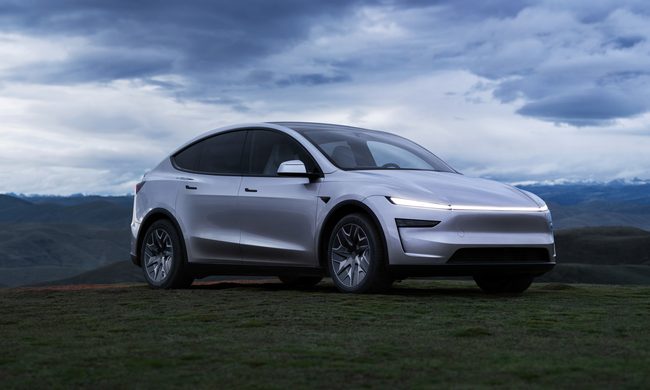
For those catching up, the Cybercab is a two-seat car featuring Tesla’s Full Self-Driving neural network. It’s intentionally built without a steering wheel or pedal. In place of side mirrors, the car features all-around cameras. 

Recommended Videos

First production units of the Cybercab rolled off the assembly line in February 2026. However, continuous-volume manufacturing began in April 2026. Pricing, on the other hand, is expected to come in under $30,000, which would position the car as an affordable entry in the robotaxi network. 

So, what’s the catch?

Cybercab’s existence is built on one thing: its ability to drive itself. However, Tesla hasn’t fully solved that (yet). The automaker’s current supervised robotaxi fleet crashes at around four times the rate of human drivers, which is about one incident per 57,000 miles rather than one per 229,000 miles. 

Musk has himself admitted that the software can sometimes get cars “scared to move” or stuck in infinite loops. For now, unsupervised FSD for consumer vehicles has been pushed to the fourth quarter of 2026, a deadline that is currently being treated with utmost caution. 

The product milestone has been announced at a moment when Tesla’s global sales have slumped for the second consecutive year. The Cybercab, for now, is the company’s biggest bet for turning things around. But even so, making it work autonomously and safely is the one part that millions of commuters actually care about.

Shikhar Mehrotra
For more than five years, Shikhar has consistently simplified developments in the field of consumer tech and presented them…
Tesla’s hidden door problem might end up fixing every car in America
This could permanently change how emergency exits are designed in American passenger vehicles.
Tesla Model Y Long Wheelbase Featured

Tesla's electronic door handles have been a safety talking point for years, mostly on Reddit threads and EV forums where people debate whether sleek design is worth the tradeoff when a car is on fire and power is out. 

Now the US government has formally weighed in (via The Washington Post). The outcome, I’d say, is bigger than most people think.

Read more
Ford’s UEV platform will feature Apple Maps built in
The integration will run through Apple's new MapKit for Automotive SDK and skip CarPlay's phone-mirroring approach.
Car, Transportation, Vehicle

Ford's upcoming budget electric vehicle won't force you to choose between a built-in map and one borrowed from your phone. Apple announced today that Ford's Universal Electric Vehicle (UEV) platform will ship with Apple Maps running natively on the car's screens. The feature will arrive in 2027 through Apple's new MapKit for Automotive SDK, a toolkit that lets automakers build Apple Maps straight into their dashboards.

An infotainment system that doesn't need your phone plugged in

Read more
WhatsApp’s new in-car experience is built around hands-free control
CarPlay and Android Auto users can now hear and reply to messages, view call history, and reach favorite contacts without touching their phone.
WhatsApp new CarPlay experience featured

Meta is overhauling how WhatsApp works in the car, giving CarPlay and Android Auto users a lot more to do than just sending texts and making calls. The company announced the change in a newsroom post today, alongside several other updates rolling out to the messaging app.

WhatsApp finally works hands-free in the car

Read more