  1. Home
  2. Cars
  3. Photo Galleries
  4. Legacy Archives

Who needs windows? Elemental’s RP1 is a track toy that rolls with supercars

Add as a preferred source on Google

Following a tease earlier this month, the Elemental RP1 track car will slither into the public view at the 2014 Goodwood Festival of Speed later this week.

The RP1 is a purpose-built track toy in the vein of the BAC Mono or KTM X-Bow, so it’s not surprising that there isn’t much more to it than what was revealed in the teaser images. The finished product looks pretty menacing, but there’s not really enough bodywork for any real “styling.” Who needs side windows, anyway?

The real purpose of the RP1 isn’t to look good, it’s to go fast, and it should be pretty good at that. The car will be powered by a 2.0-liter turbocharged Ford EcoBoost four-cylinder engine, producing 280 horsepower. If Elemental can hit its target weight of just 992 pounds, that would give the RP1 a power-to-weight ratio of around 500 hp per ton. That’s supercar stuff.

If that sounds like too much performance (is there such a things?) Ford’s 1.0-liter EcoBoost triple and a 999-cc Honda motorcycle engine will reportedly be offered as well.
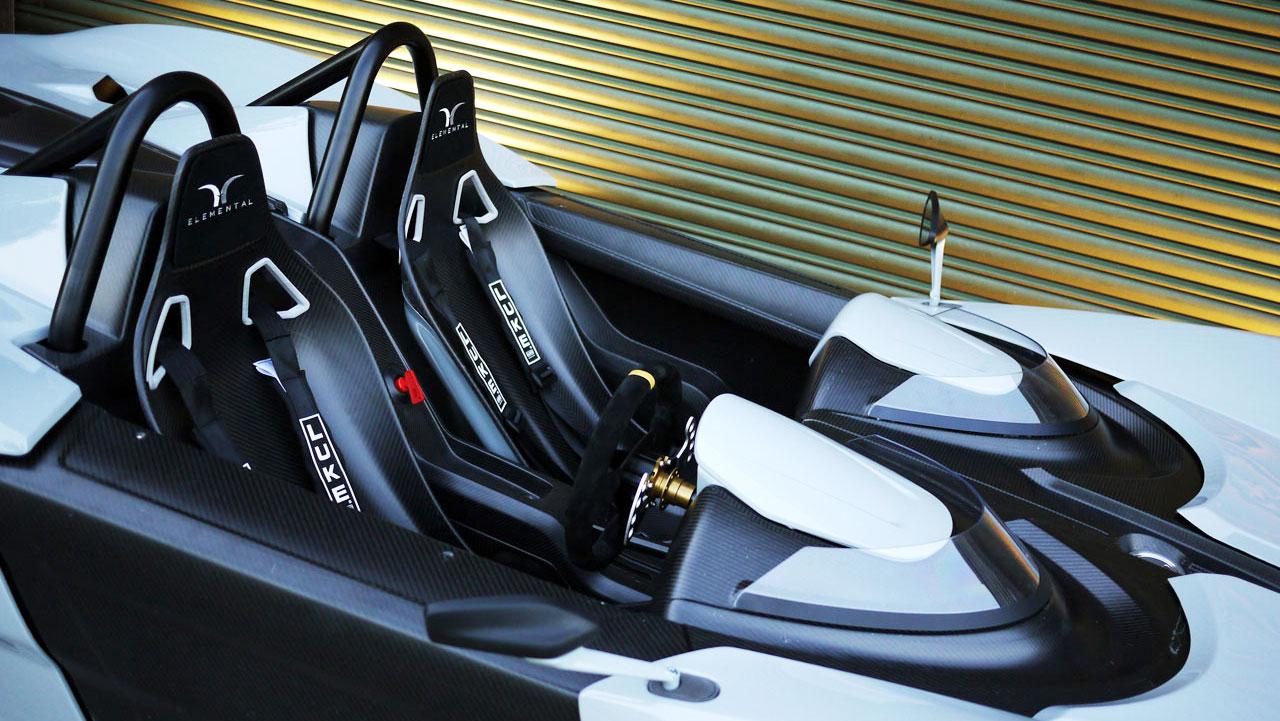
2015 Elemental RP1
Image used with permission by copyright holder

A lightweight chassis and perky powertrain aren’t the only features that help prepare the RP1 for the track. It also features fully-adjustable suspension, and and aerodynamics package that can generate 440 pounds of downforce at 100 mph, according to Elemental.

Should that not be enough to keep the RP1 stuck to the track, the body panels were also designed to be easily removed and replaced, making repairs a relative breeze.

The RP1 is expected to start production next year, although a specific launch date and pricing haven’t been announced.

Stephen Edelstein
Stephen is a freelance automotive journalist covering all things cars. He likes anything with four wheels, from classic cars…
Volvo is rolling out Apple Music to over 2 million cars with a simple OTA update
Your Volvo may soon get Apple Music without needing CarPlay
Interior view of the 2024 Volvo EX90.

The line between your smartphone and your car continues to blur. Volvo has announced that it is rolling out an over-the-air software update that brings Apple Music directly to the infotainment systems of more than 2 million vehicles worldwide. Instead of relying on Apple CarPlay or plugging in an iPhone, eligible drivers will be able to stream music natively from their car's built-in system, making Apple Music another integrated feature of Volvo's software experience.

The update is arriving for a wide range of Volvo models, including the EX90, ES90, XC90, S90, V90, XC60, S60, V60, XC40, EX40 and EC40, covering model year 2020 onwards. Availability, however, may vary depending on the vehicle.

Read more
Chery’s latest EV packs flagship tech for the price of a base Tesla, but you can’t buy it
Here's everything packed into Exeed's 2027 Exlantix ES, from its 27-sensor autonomous driving suite to its 860 km range, all starting under $31,000.
Car, Transportation, Vehicle

Chery's premium arm just dropped a sedan that makes you wonder why American EVs cost twice as much for half the tech.

Exeed's 2027 Exlantix ES ships with a driver-assist system called Falcon 700. It is built around an Nvidia Orin-Y chip and a genuinely stacked sensor suite.

Read more
A new AI model wants self-driving cars to think before they swerve
Forget guessing games, this self-driving AI actually shows its work.
Self driving car

Self-driving cars have gotten pretty good at driving. The harder problem is teaching them to drive safely in situations nobody planned for. We have heard horror stories of self-driving cars, behaving erratically in emergency situations, often times delaying first responders from reaching the scene.

A team at Seoul National University, led by professor Jun Won Choi from the Department of Electrical and Computer Engineering, thinks they have cracked part of that puzzle with a new AI model called SafeDrive. The research was recently selected as a highlight paper at CVPR 2026, a distinction that goes only to roughly 3% of all submissions.

Read more