1. Home
  2. Cars
  3. News

To improve its interiors, Ford will implement eye trackers and brain scanners into R&D

Add as a preferred source on Google

When it comes to cars, emotional connections can be made just as easily from the inside as they can from the outside. The bodywork of Italian supercars might inspire more bedroom posters, but there’s nothing like a comfy cabin to make you feel right at home.

Ford acknowledges this, and that’s why the company is experimenting with new research techniques to measure emotional responses to interior designs.

Recommended Videos

It’s not all questionnaires and surveys though. Ford will employ modern biometric technology like eye trackers and EEG scanners to measure brain activity and time spent looking at particular areas. People often do this without realizing it, and Ford is confident that the scientific data will help its designers craft clearer, more intuitive cockpits during testing.

“Vehicle interiors have witnessed one of the biggest evolutions across the history of cars in recent years,” said Raj Nair, Ford’s VP of Product Development. “Not only have we introduced a great deal of useful new technology into our cars and trucks, we consistently are adding better materials, improved design and increased features across the board, from high-end vehicles to entry-level segments.”

“All of this leads to a focus on design languages that not only convey the right messages, but deliver on an enhanced user experience,” he continued.

The first step is determining eye motion path, done with an optical tracker, to identify a person’s eye movement over time. From this information, Ford can theorize about first impressions and where the driver’s priorities lie. Eye tracking can also record the amount of fixation on particular gauges, displays, colors, materials, and contour lines.

The next way the brand can improve is by measuring emotional responses with EEG devices. With this data, Ford can place heavily stylized elements in one place, while utilitarian functions can go elsewhere. EEGs can also be helpful to recognize excitement, calm, attraction, and repulsion reactions.

The first car to employ this unique design philosophy was the GT supercar, which is set to go on sale next year.

Andrew Hard
Andrew first started writing in middle school and hasn't put the pen down since. Whether it's technology, music, sports, or…
Volvo is rolling out Apple Music to over 2 million cars with a simple OTA update
Your Volvo may soon get Apple Music without needing CarPlay
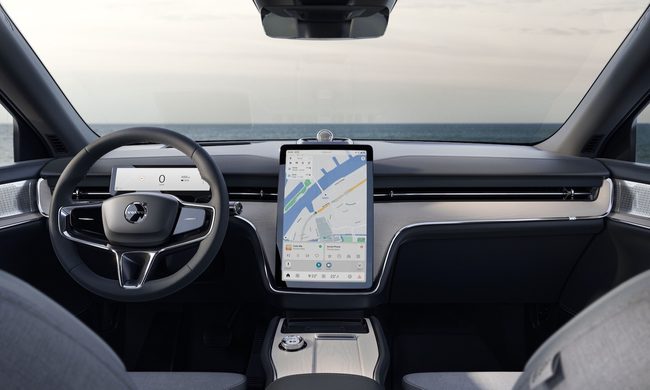
Interior view of the 2024 Volvo EX90.

The line between your smartphone and your car continues to blur. Volvo has announced that it is rolling out an over-the-air software update that brings Apple Music directly to the infotainment systems of more than 2 million vehicles worldwide. Instead of relying on Apple CarPlay or plugging in an iPhone, eligible drivers will be able to stream music natively from their car's built-in system, making Apple Music another integrated feature of Volvo's software experience.

The update is arriving for a wide range of Volvo models, including the EX90, ES90, XC90, S90, V90, XC60, S60, V60, XC40, EX40 and EC40, covering model year 2020 onwards. Availability, however, may vary depending on the vehicle.

Read more
Chery’s latest EV packs flagship tech for the price of a base Tesla, but you can’t buy it
Here's everything packed into Exeed's 2027 Exlantix ES, from its 27-sensor autonomous driving suite to its 860 km range, all starting under $31,000.
Car, Transportation, Vehicle

Chery's premium arm just dropped a sedan that makes you wonder why American EVs cost twice as much for half the tech.

Exeed's 2027 Exlantix ES ships with a driver-assist system called Falcon 700. It is built around an Nvidia Orin-Y chip and a genuinely stacked sensor suite.

Read more
A new AI model wants self-driving cars to think before they swerve
Forget guessing games, this self-driving AI actually shows its work.
Self driving car

Self-driving cars have gotten pretty good at driving. The harder problem is teaching them to drive safely in situations nobody planned for. We have heard horror stories of self-driving cars, behaving erratically in emergency situations, often times delaying first responders from reaching the scene.

A team at Seoul National University, led by professor Jun Won Choi from the Department of Electrical and Computer Engineering, thinks they have cracked part of that puzzle with a new AI model called SafeDrive. The research was recently selected as a highlight paper at CVPR 2026, a distinction that goes only to roughly 3% of all submissions.

Read more