1. Home
  2. Cars
  3. Photo Galleries
  4. News

Tuner Startech sends off the Land Rover Defender with limited-edition Sixty8 model

Add as a preferred source on Google

Last year, Land Rover announced plans to commemorate the end of the Defender’s long production run with three Final Edition models called Autobiography, Heritage, and Adventure, respectively. German tuner Startech also wants to pay homage to the Defender, and it has introduced a special edition model that’s billed as a final farewell to the iconic off-roader.

The custom Defender is called Sixty8, a number chosen because the very first Land Rover Series was introduced 68 years ago. It gets Startech’s 3.1 vintage design appearance package, which adds a new grille whose design is inspired by the one found on the Series 3 that was built from 1974 to 1983. The Sixty8 also gets a beefy skid plate up front, a two-tone black and gray paint job, 18-inch alloy wheels that look like period-correct steel wheels, and model-specific emblems all around.

Startech has done its best to mask the Defender’s purely utilitarian roots by sprucing up the cockpit with quilted leather upholstery on the seats and on the door panels, Alcantara on the headliner, sport seats, a new three-spoke steering wheel, and metal pedal caps. An Alpine infotainment system brings the Defender into the modern era with 3D navigation, a DVD player, a rear-view camera, Bluetooth connectivity, and an SD card slot.

The modifications don’t extend to the engine bay, meaning the Sixty8 is powered by a stock Defender-sourced 2.2-liter four-cylinder turbodiesel engine that makes 120 horsepower  and a generous 360 foot-pounds of torque. The oil-burner spins all four wheels via a six-speed manual transmission and a permanent all-wheel drive system.

And as its name further implies, production of the Sixty8 will be limited to just 68 examples. On sale now worldwide, Startech’s homage to the Land Rover Defender carries a base price of €67,990 (about  $75,000), while opting for the seven-seater model bumps the price tag up to €69,000 (roughly $76,300).

Ronan Glon
Ronan Glon is an American automotive and tech journalist based in southern France. As a long-time contributor to Digital…
Volvo is rolling out Apple Music to over 2 million cars with a simple OTA update
Your Volvo may soon get Apple Music without needing CarPlay
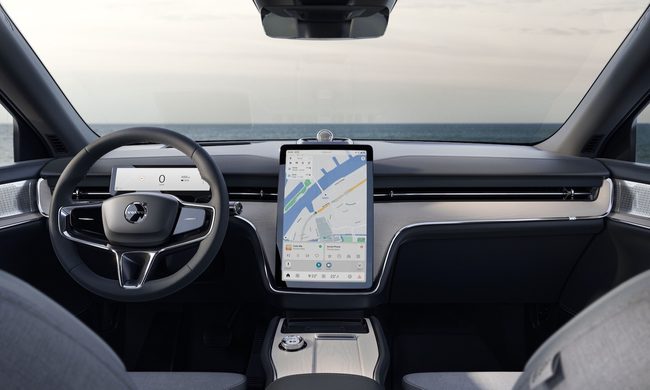
Interior view of the 2024 Volvo EX90.

The line between your smartphone and your car continues to blur. Volvo has announced that it is rolling out an over-the-air software update that brings Apple Music directly to the infotainment systems of more than 2 million vehicles worldwide. Instead of relying on Apple CarPlay or plugging in an iPhone, eligible drivers will be able to stream music natively from their car's built-in system, making Apple Music another integrated feature of Volvo's software experience.

The update is arriving for a wide range of Volvo models, including the EX90, ES90, XC90, S90, V90, XC60, S60, V60, XC40, EX40 and EC40, covering model year 2020 onwards. Availability, however, may vary depending on the vehicle.

Read more
Chery’s latest EV packs flagship tech for the price of a base Tesla, but you can’t buy it
Here's everything packed into Exeed's 2027 Exlantix ES, from its 27-sensor autonomous driving suite to its 860 km range, all starting under $31,000.
Car, Transportation, Vehicle

Chery's premium arm just dropped a sedan that makes you wonder why American EVs cost twice as much for half the tech.

Exeed's 2027 Exlantix ES ships with a driver-assist system called Falcon 700. It is built around an Nvidia Orin-Y chip and a genuinely stacked sensor suite.

Read more
A new AI model wants self-driving cars to think before they swerve
Forget guessing games, this self-driving AI actually shows its work.
Self driving car

Self-driving cars have gotten pretty good at driving. The harder problem is teaching them to drive safely in situations nobody planned for. We have heard horror stories of self-driving cars, behaving erratically in emergency situations, often times delaying first responders from reaching the scene.

A team at Seoul National University, led by professor Jun Won Choi from the Department of Electrical and Computer Engineering, thinks they have cracked part of that puzzle with a new AI model called SafeDrive. The research was recently selected as a highlight paper at CVPR 2026, a distinction that goes only to roughly 3% of all submissions.

Read more