  1. Home
  2. Cars
  3. News

The 2017 Kia Sportage will sport a distinctly German face

Add as a preferred source on Google

The Kia Sportage will be all-new for the 2017 model year, and ahead of its debut at the Frankfurt Motor Show in September, Kia has released a trio of teaser images to preview the fourth-generation crossover.

While the current iteration looks essentially like a smaller Sorento, the new version appears to sport a distinctly German face in the style of the Porsche Macan or Cayenne. The brand’s trademark “tiger-nose” grill is prominently featured on the smooth renderings, as are sleek taillights, LED headlights, and massive alloy wheels. According to the manufacturer, the bold styling “represents the future face of Kia.”

Recommended Videos

Kia has also circulated sketches of the interior, which the automaker promises will be its most “refined high-quality cabin yet.” The stylish renderings show a flat-bottom steering wheel, bucket-style front seats, and a high-contrast color scheme, but as we all know, conceptual drawings are conceptual drawings, so many of these elements are unlikely to make it to the production line.

Thankfully, we’ve gotten ahold of some spy shots of an undisguised prototype (below), courtesy of the Bobaedream Facebook page. Taken in Korea, the images show a front end that’s very similar to the teaser photos, but the proportions and body contours are much more conventional.

As for the bits underneath the skin, the 2017 Sportage will share its platform with the Hyundai Tucson and is expected to offer several powertrain options. The current model gives buyers a choice between a 2.4-liter naturally aspirated four-cylinder with 182 horsepower and 177 pound-feet of torque and a turbocharged 2.0-liter with 260 hp and 268 lb-ft. As with the Tucson, the naturally aspirated four-banger will likely be replaced with a boosted 1.6-liter with around 175 and 195 lb-ft.

More details are on the way, so stay tuned as we inch closer to the crossover’s public debut on September 17.

Andrew Hard
Andrew first started writing in middle school and hasn't put the pen down since. Whether it's technology, music, sports, or…
Volvo is rolling out Apple Music to over 2 million cars with a simple OTA update
Your Volvo may soon get Apple Music without needing CarPlay
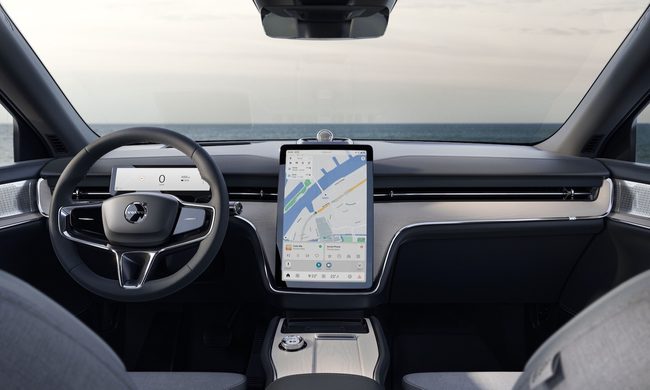
Interior view of the 2024 Volvo EX90.

The line between your smartphone and your car continues to blur. Volvo has announced that it is rolling out an over-the-air software update that brings Apple Music directly to the infotainment systems of more than 2 million vehicles worldwide. Instead of relying on Apple CarPlay or plugging in an iPhone, eligible drivers will be able to stream music natively from their car's built-in system, making Apple Music another integrated feature of Volvo's software experience.

The update is arriving for a wide range of Volvo models, including the EX90, ES90, XC90, S90, V90, XC60, S60, V60, XC40, EX40 and EC40, covering model year 2020 onwards. Availability, however, may vary depending on the vehicle.

Read more
Chery’s latest EV packs flagship tech for the price of a base Tesla, but you can’t buy it
Here's everything packed into Exeed's 2027 Exlantix ES, from its 27-sensor autonomous driving suite to its 860 km range, all starting under $31,000.
Car, Transportation, Vehicle

Chery's premium arm just dropped a sedan that makes you wonder why American EVs cost twice as much for half the tech.

Exeed's 2027 Exlantix ES ships with a driver-assist system called Falcon 700. It is built around an Nvidia Orin-Y chip and a genuinely stacked sensor suite.

Read more
A new AI model wants self-driving cars to think before they swerve
Forget guessing games, this self-driving AI actually shows its work.
Self driving car

Self-driving cars have gotten pretty good at driving. The harder problem is teaching them to drive safely in situations nobody planned for. We have heard horror stories of self-driving cars, behaving erratically in emergency situations, often times delaying first responders from reaching the scene.

A team at Seoul National University, led by professor Jun Won Choi from the Department of Electrical and Computer Engineering, thinks they have cracked part of that puzzle with a new AI model called SafeDrive. The research was recently selected as a highlight paper at CVPR 2026, a distinction that goes only to roughly 3% of all submissions.

Read more