  1. Home
  2. Emerging Tech
  3. News

Russian scientists have figured out how to 3D print working thyroid glands for mice

Add as a preferred source on Google

The budding industry of 3D bioprinting took a massive leap forward last week after a Russian bioprinting company announced a series of successful tests on a 3D-printed mouse thyroid. Speaking at the Biofabrication 2015 conference in Utrecht, Netherlands, 3D Bioprinting Solutions head of research Vladimir Mironov officially presented the highly anticipated results, shedding light on the company’s production process.

During Mironov’s presentation, he revealed that the company’s 3D-printed organ was able to restore thyroid function in mice with hypothyroidism — a condition in which the animal’s thyroid gland doesn’t produce enough hormones. Though the test subject was merely a mouse, the structure of the implanted organ accurately corresponded to the normal formation of a typical mouse thyroid. This revolutionary feat puts 3D Bioprinting Solutions at the forefront of bioprinting technology, despite its relatively short tenure as a company.
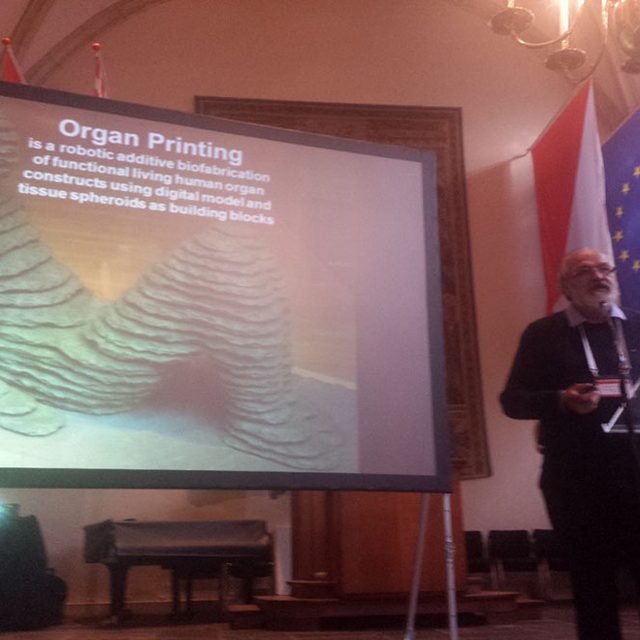
Mironov speaking at Biofabrication 2015
Mironov speaking at Biofabrication 2015 3D Bioprinting Solutions

Using the Russian bioprinter FABION, the organization constructed the mouse organ last March (video posted above), with several scientific laboratories keeping a keen on the research in the event of its success. As reported by Russia Beyond the Headlines, successful testing may push those labs to begin manufacturing actual human thyroid glands.

Recommended Videos

“The reports presented in Utrecht indicate rapid development of this field attracting specialists from different disciplines,” says 3D Bioprinting Solutions Executive Director Yusef Khesuani. “Bioprinting is [a] multidisciplinary technology, and our work would have never been possible without our highly professional team and cooperation with both Russian and foreign laboratories.”

Though it’s clear the next step for 3D Bioprinting Solutions is to consider testing 3D-printed thyroids on human subjects, no official announcement was made regarding the matter. With many bioprinting firms hard at work successfully recreating cells and organs by way of 3D printing, it likely won’t be long before the medical field begins using this revolutionary technology for everyday surgeries.

Rick Stella
Former Associate Editor, Outdoor
Rick became enamored with technology the moment his parents got him an original NES for Christmas in 1991. And as they say…
Google’s new AI gives robots better balance, smarter hands, and teamwork capabilities
Google just made robots a lot less clumsy and a lot more helpful.
Gemini robotics 2.0

Google DeepMind just brought sci-fi robots closer to reality, and it is very exciting. Building on its original Gemini Robotics model, the company has introduced Gemini Robotics 2, an AI system designed to help robots think, move, and even work together. Unlike most robots today, which rely on pre-programmed routines or someone controlling them remotely, this new system lets robots figure things out on their own when situations get unpredictable.

Can robots finally handle whole-body tasks?

Read more
Remember Samsung’s Ballie home robot? It may finally be inching closer to reality
Leaked app wireframes give the strongest hint yet that Samsung's Ballie home robot, first shown at CES 2020, might still be headed toward an actual release.
Samsung Ballie robot in a room next to a dog feeder.

Samsung's rolling home robot has been the industry's longest-running "will it ever actually ship" joke, and I'll admit I'd mostly given up on it. Now, there's finally a glimmer of hope.

Samsung first unveiled Ballie as a concept at CES 2020. Then, it showed it as a significantly upgraded version four years later. However, the company never confirmed a release date or committed to releasing it at all. 

Read more
Polar is yet another AI browser, but it goes beyond just automating the mundane web chores
Polar wants to turn your browser into an AI-powered productivity tool
Polar AI browser

The AI browser race is entering a new phase. After spending much of 2025 trying to reinvent web search with built-in chatbots, startups are increasingly shifting their attention toward browser agents that can automate repetitive work instead of simply answering questions. The latest company to embrace that transition is Polar, a startup founded by former Perplexity engineer Kevin Zhang, which has raised $5.7 million in seed funding led by Madrona.

Unlike the first generation of AI browsers that targeted everyday consumers, Polar is designed specifically for knowledge workers. Its premise is straightforward: instead of replacing Google Search, the browser aims to eliminate repetitive tasks that professionals perform across dozens of browser tabs every day.

Read more