  1. Home
  2. Cars
  3. Emerging Tech
  4. News

With some help from CGI, the shape-shifting Blackbird can look like any car

Add as a preferred source on Google

When CGI rose to prominence in the late 1970s, it changed the way we looked at film forever. Movies like Star Wars, Alien, and TRON led us to ask questions like, “Are the images we’re seeing on screen actually real?” From that moment on, the lines between fiction and reality were blurred.

CGI isn’t always used to depict psychedelic landscapes or space battles, though, as the technology has countless more subtle uses. In advertising, for instance, companies use CGI to render environmental backdrops and even simulate their own products, but pretty soon, they might not even need those.

Recommended Videos

Visual effects company The Mill has officially debuted The Blackbird, a fully adjustable vehicle rig designed specifically for car commercials and automotive video content. The Blackbird can increase its length by 4 feet and expand widthwise by 10 inches — and, using CGI, it can be re-skinned to look like just about anything. The suspension and wheels can be altered as well, and even the electric motor can be programmed to emulate the driving characteristics of a particular automobile.

The Mill Blackbird
Image used with permission by copyright holder

The goal, The Mill says, is to streamline and simplify automotive video production, as vehicle availability and constant model year revisions make filming car advertisements very expensive and time-consuming. By using a stand-in, automakers can digitally render their products over the Blackbird’s frame but still benefit from authentic ground shadows and realistic physics.

Mounted atop the car is an array of cameras and laser scanners, which work together to capture high-definition environmental data. That information can prove invaluable when assembling the final video cut, and the same technology integrates perfectly for virtual reality applications.

As the name would suggest, the road-going Blackbird was built in the same hangar as the SR-71 Blackbird spy plane. In total, the project took two years to complete.

Andrew Hard
Andrew first started writing in middle school and hasn't put the pen down since. Whether it's technology, music, sports, or…
Volvo is rolling out Apple Music to over 2 million cars with a simple OTA update
Your Volvo may soon get Apple Music without needing CarPlay
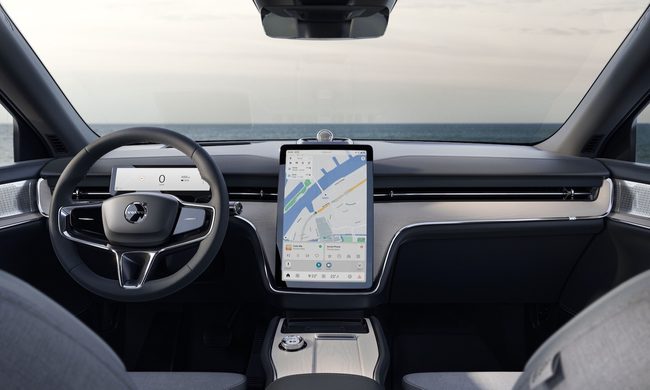
Interior view of the 2024 Volvo EX90.

The line between your smartphone and your car continues to blur. Volvo has announced that it is rolling out an over-the-air software update that brings Apple Music directly to the infotainment systems of more than 2 million vehicles worldwide. Instead of relying on Apple CarPlay or plugging in an iPhone, eligible drivers will be able to stream music natively from their car's built-in system, making Apple Music another integrated feature of Volvo's software experience.

The update is arriving for a wide range of Volvo models, including the EX90, ES90, XC90, S90, V90, XC60, S60, V60, XC40, EX40 and EC40, covering model year 2020 onwards. Availability, however, may vary depending on the vehicle.

Read more
Chery’s latest EV packs flagship tech for the price of a base Tesla, but you can’t buy it
Here's everything packed into Exeed's 2027 Exlantix ES, from its 27-sensor autonomous driving suite to its 860 km range, all starting under $31,000.
Car, Transportation, Vehicle

Chery's premium arm just dropped a sedan that makes you wonder why American EVs cost twice as much for half the tech.

Exeed's 2027 Exlantix ES ships with a driver-assist system called Falcon 700. It is built around an Nvidia Orin-Y chip and a genuinely stacked sensor suite.

Read more
A new AI model wants self-driving cars to think before they swerve
Forget guessing games, this self-driving AI actually shows its work.
Self driving car

Self-driving cars have gotten pretty good at driving. The harder problem is teaching them to drive safely in situations nobody planned for. We have heard horror stories of self-driving cars, behaving erratically in emergency situations, often times delaying first responders from reaching the scene.

A team at Seoul National University, led by professor Jun Won Choi from the Department of Electrical and Computer Engineering, thinks they have cracked part of that puzzle with a new AI model called SafeDrive. The research was recently selected as a highlight paper at CVPR 2026, a distinction that goes only to roughly 3% of all submissions.

Read more