  1. Home
  2. Cars
  3. News

Need to tow? Volkswagen’s updated Amarok offers more power than ever

Add as a preferred source on Google

The mid-size pickup truck segment in Europe is growing at an unprecedented pace. Volkswagen is preparing for the arrival of new entrants like Renault and PSA Peugeot-Citroën by updating the rugged Amarok.

The visual updates made to the Amarok are more evolutionary than revolutionary, which is consistent with what we’ve come to expect from Volkswagen in recent years. Eagle-eyed observers will notice the truck receives redesigned headlights, a revised lower bumper with honeycomb inserts, and new-look alloy wheel designs. The cabin benefits from a new dashboard, but we’ll have to take Volkswagen’s word on that until official pictures are released.

Recommended Videos

Bigger changes are found by popping the hood. Up until now, the Amarok has exclusively been offered with four-cylinder engines. The Wolfsburg-based carmaker has however managed to shoehorn a 3.0-liter TDI V6 in the truck’s engine bay, giving it more power to tow, haul, or simply go off the beaten path. The six-cylinder is offered with either 163, 204, or 224 horsepower.

The Amarok’s other gasoline- and diesel-burning engines carry on without any major modifications. Most models are offered with either a manual transmission or an eight-speed automatic, and both rear- and four-wheel drive variants are available. The Amarok can tow nearly 8,000 pounds in its most capable configuration when it’s properly equipped.

The updated Volkswagen Amarok will go on sale across Europe starting in September. At launch, buyers will be able to order a limited-edition model called Aventura (pictured) that features a more premium appearance characterized by a body-colored sports bar in the bed and chromed bumpers on both ends. The Aventura will carry a small premium over the standard Amarok, though pricing information hasn’t been published yet.

Read more: Volkswagen Amarok driven in Belgium

Bad news, Volkswagen aficionados: we’re still not getting the Amarok in the United States because it wasn’t designed with our regulations in mind. However, there’s a chance we could see the next-generation model on our shores when it arrives before the turn of the decade.

Ronan Glon
Ronan Glon is an American automotive and tech journalist based in southern France. As a long-time contributor to Digital…
Volvo is rolling out Apple Music to over 2 million cars with a simple OTA update
Your Volvo may soon get Apple Music without needing CarPlay
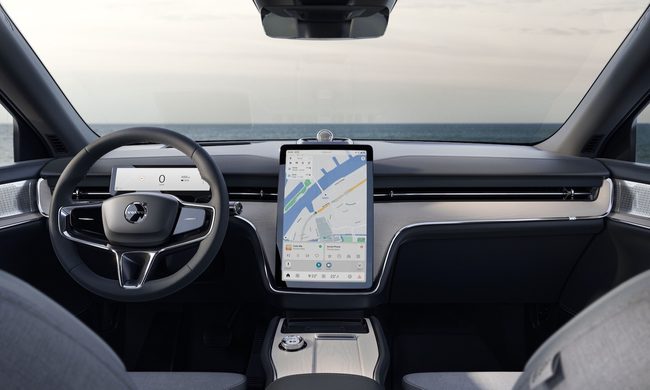
Interior view of the 2024 Volvo EX90.

The line between your smartphone and your car continues to blur. Volvo has announced that it is rolling out an over-the-air software update that brings Apple Music directly to the infotainment systems of more than 2 million vehicles worldwide. Instead of relying on Apple CarPlay or plugging in an iPhone, eligible drivers will be able to stream music natively from their car's built-in system, making Apple Music another integrated feature of Volvo's software experience.

The update is arriving for a wide range of Volvo models, including the EX90, ES90, XC90, S90, V90, XC60, S60, V60, XC40, EX40 and EC40, covering model year 2020 onwards. Availability, however, may vary depending on the vehicle.

Read more
Chery’s latest EV packs flagship tech for the price of a base Tesla, but you can’t buy it
Here's everything packed into Exeed's 2027 Exlantix ES, from its 27-sensor autonomous driving suite to its 860 km range, all starting under $31,000.
Car, Transportation, Vehicle

Chery's premium arm just dropped a sedan that makes you wonder why American EVs cost twice as much for half the tech.

Exeed's 2027 Exlantix ES ships with a driver-assist system called Falcon 700. It is built around an Nvidia Orin-Y chip and a genuinely stacked sensor suite.

Read more
A new AI model wants self-driving cars to think before they swerve
Forget guessing games, this self-driving AI actually shows its work.
Self driving car

Self-driving cars have gotten pretty good at driving. The harder problem is teaching them to drive safely in situations nobody planned for. We have heard horror stories of self-driving cars, behaving erratically in emergency situations, often times delaying first responders from reaching the scene.

A team at Seoul National University, led by professor Jun Won Choi from the Department of Electrical and Computer Engineering, thinks they have cracked part of that puzzle with a new AI model called SafeDrive. The research was recently selected as a highlight paper at CVPR 2026, a distinction that goes only to roughly 3% of all submissions.

Read more