  1. Home
  2. Cars
  3. Emerging Tech
  4. Legacy Archives

It takes two: BMW and Toyota reportedly working on a hybrid supercar

Add as a preferred source on Google

It’s no secret that BMW and Toyota are working together, but the exact fruits of their combined labors haven’t emerged yet.

Last year, the two companies signed a memorandum of understanding that laid the foundation for collaboration on hybrids, hydrogen fuel cells, and even a sports car.

Recommended Videos

There was some disagreement on how to proceed with that last item, but Australia’s Motoring reports that BMW and Toyota finally have a game plan: a hybrid supercar.

Motoring recently spotted a BMW i8 at Toyota’s proving ground near Mt. Fuji, reportedly undergoing emissions and durability testing. It claims this is a prelude to a joint supercar  development program.

Such a program would give Toyota – the carmaker that popularized hybrids in the first place – a hybrid successor to the Lexus LFA. Toyota wouldn’t just have a new halo model, it would have one with hybrid technology that could be more easily connected to its mainstream models. The marketing department will be happy, at least.

BMW could potentially leverage the platform to build a car that slots above the i8 in its lineup, offering true supercar performance. While the i8 was designed to balance performance and economy, BMW has toyed with the idea of building a more performance-oriented car.
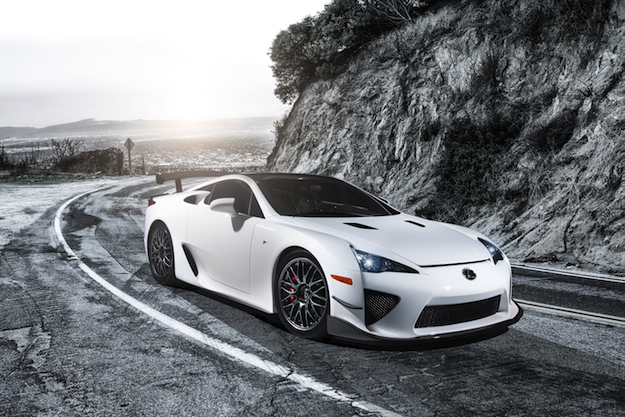
Lexus LFA
Image used with permission by copyright holder

Whatever badge the final product wears, it will arrive just in time to do battle with a slew of hybrid supercars, such as the Ferrari LaFerrari, McLaren P1, and Porsche 918 Spyder.

On a slightly lower rung of the supercar ladder, the next Acura NSX will also be a hybrid, and Nissan is reportedly planning on putting a hybrid powertrain in the next-generation GT-R.

Neither company has confirmed the hybrid supercar plan, so it’s hard to say exactly what the car would be like.

Both BMW and Toyota have significant experience with carbon fiber; the BMW i3 has a carbon fiber-reinforced plastic chassis, and Toyota developed a carbon fiber chassis for the LFA.

If both companies play to their strengths, it seems logical that BMW would supply the gasoline engine, while Toyota would build the rest of the hybrid powertrain around it. The 4.4-liter V8 from the M5 would be a good starting point, but for now that’s pure speculation.

Would you buy a hybrid supercar produced by a globe-spanning corporate partnership? Tell us in the comments.

Stephen Edelstein
Stephen is a freelance automotive journalist covering all things cars. He likes anything with four wheels, from classic cars…
This sleek Chinese EV pairs supercar styling with three AI brains
The Xpeng L03 is an AI supercomputer disguised as a stylish family SUV
Xpeng L03

Xpeng’s latest electric vehicle carries enough processing power to make the term "smart car" actually sound more realistic than it actually is. The new Xpeng L03 debuted simultaneously in Europe and China on July 16, with the company presenting it across 65 markets. Available as a fully electric vehicle and an L03 Power X range-extender, the coupe-SUV is Xpeng’s most internationally focused model so far. Market-specific prices and sales dates remain unannounced.

Three AI chips and Google Maps built right in

Read more
A new sodium battery posts wild four-minute charging numbers, but don’t expect it in an EV yet
The breakthrough could improve fast charging and battery life, but the study hasn’t demonstrated those results in a production-sized pack
EV Charger

A new sodium-metal battery has posted a charging number that makes today’s EVs look painfully slow. In laboratory testing, the cell operated at a 15C rate, equivalent to completing a charge or discharge in roughly four minutes.

That doesn’t mean researchers plugged in an electric car and watched it fill up before the driver finished buying coffee. The result came from a small experimental cell using a new quasi-solid electrolyte, while the larger pouch-cell prototype delivered far less dramatic performance.

Read more
The Apple Car may be dead, but it became the foundation of Apple Intelligence
A decade of work on a canceled car project reportedly laid the groundwork for Apple Intelligence.
Apple Intelligence in Apple Car

The Apple Car may have never left the garage, but it apparently gave birth to Apple's AI ambitions. According to Bloomberg's Mark Gurman, Apple's canceled autonomous vehicle project, one that consumed more than a decade of work and over $10 billion before being scrapped in 2024, ended up laying the technological foundation for Apple Intelligence. In a rather ironic twist, one of Apple's most expensive failures may also become one of its most important long-term investments.

The Apple Car forced Apple to think like an AI company

Read more