  1. Home
  2. Cars
  3. Legacy Archives

Cannonball Run and common sense record shattered in less than 29 hours

Add as a preferred source on Google

Burt Reynolds would be rolling over in his grave…if he were dead…and if he weren’t planning on being frozen for the enjoyment of future generations of bleached blonde beach bunnies. That’s because the Cannonball Run record for driving coast to coast just got smashed.

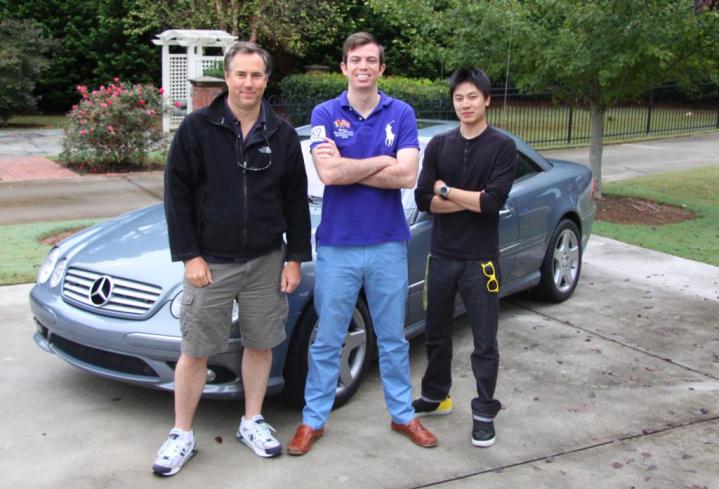
According to CNN, Atlanta native Ed Boilan managed to drive from Red Ball Garage in New York City to the Portofino Hotel in Redondo Beach, California in 28 hours, 50 minutes and about 30 seconds. 

Recommended Videos

Apparently Boilan had been obsessed with the idea of the Cannonball run since high school and had even interviewed Brock Yates – one of the original participants – in the Sea to Shining Sea Memorial Trophy Dash for a school project.

Boilan perhaps should have listened to Yates’ opening lines in the film wherein he referred to his exploits on Cannonball Run, “You all are certainly the most distinguished group of highway scofflaws and degenerates ever gathered together in one place.” 

That may not be an exaggeration because to accomplish this feat Boilan, his co-driver Dave Black, and assistant Dan Huang, averaged 98 mph including the 40 minutes they spent stopped. Averaging a reckless driving charge for almost 28 hours is no mean feat, and certainly one to proudly recount to your grandchildren from the visiting room of your local penitentiary.

The car itself may not have been completely legal for the drive either. To reduce the amount of time spent stopped at filling stations, the Mercedes CL55 AMG was fitted with an additional 44 gallons of fuel tanks mounted in the trunk. 

To avoid getting caught by the police, Boilan employed police scanners, laser jammers, radar detectors, and a kill switch on the rear lights. He also commissioned a radar jammer, though it wasn’t delivered in time for the run. 

And if adding enough stealth technology to blow through the average third-world air defense network wasn’t enough, Boilan spent $9,000 in maintenance and upgrades on his rolling felony. 

All this, and a good helping of luck, was enough to break the previous record set in 2006 by a modified M5 by over two hours.

Thankfully no one was hurt, and, fortunately for Boilan, the only time they got pulled over was turning the wrong way down a one-way street shortly before they set off.

If that officer had known what they were attempting, Boilan and his comrades would have been lucky if they didn’t wind up wearing automotive boots, instead they just got a stern warning. 

So just remember kids: It’s always okay to put other people’s safety at risk if you are inspired by lunatics from the ‘70s and a bad Burt Reynolds movie. 

(Main photo credit: CNN)

Peter Braun
Former Digital Trends Contributor
Peter is a freelance contributor to Digital Trends and almost a lawyer. He has loved thinking, writing and talking about cars…
Chery’s latest EV packs flagship tech for the price of a base Tesla, but you can’t buy it
Here's everything packed into Exeed's 2027 Exlantix ES, from its 27-sensor autonomous driving suite to its 860 km range, all starting under $31,000.
Car, Transportation, Vehicle

Chery's premium arm just dropped a sedan that makes you wonder why American EVs cost twice as much for half the tech.

Exeed's 2027 Exlantix ES ships with a driver-assist system called Falcon 700. It is built around an Nvidia Orin-Y chip and a genuinely stacked sensor suite.

Read more
A new AI model wants self-driving cars to think before they swerve
Forget guessing games, this self-driving AI actually shows its work.
Self driving car

Self-driving cars have gotten pretty good at driving. The harder problem is teaching them to drive safely in situations nobody planned for. We have heard horror stories of self-driving cars, behaving erratically in emergency situations, often times delaying first responders from reaching the scene.

A team at Seoul National University, led by professor Jun Won Choi from the Department of Electrical and Computer Engineering, thinks they have cracked part of that puzzle with a new AI model called SafeDrive. The research was recently selected as a highlight paper at CVPR 2026, a distinction that goes only to roughly 3% of all submissions.

Read more
Your next car’s software update could become its biggest security risk
Your next car could receive updates like your smartphone. That's also becoming a cybersecurity nightmare.
OTA technology allows manufacturers to remotely deliver software updates.

Modern cars are no longer machines that stay the same after they leave the showroom. Increasingly, they're becoming software-defined vehicles that receive new features, bug fixes, and security patches wirelessly, much like smartphones. But while over-the-air (OTA) updates have made vehicle maintenance easier and cheaper, cybersecurity experts are warning that the same technology could also become one of the automotive industry's biggest security challenges.

Researchers and policymakers are now calling for stronger oversight as connected vehicles become increasingly dependent on remote software updates. Their concern isn't just about hackers stealing personal data. It's about someone potentially interfering with the operation of a moving vehicle.

Read more