  1. Home
  2. Cars
  3. Photo Galleries
  4. Legacy Archives

Munich’s featherweight ‘Visio.M’ EV only needs 20 horsepower to go 100 miles

Add as a preferred source on Google

Unless you’re behind the wheel of a Tesla P85D, Audi R8 etron, or a Tecnicar Lavinia, life as an EV owner is pretty far away from the edge.

Most electrics are typically designed for economy, not performance, and despite the abilities of the aforementioned speedsters, they’re often labeled as boring.

The Technical University of Munich (TUM) is trying to change that, and to do so, the school’s researchers have released an electric car called the Visio.M.

Don’t worry, it’s not a sentient humanoid bent on destruction, but instead a stylish people mover with a unique design philosophy.

The loveably modern Visio.M is propelled by an electric motor and 13.5 kWh lithium-ion battery that produces just 20 horsepower. That may sound like the number sheet for something out of the 1920s, but the TUM product weighs just 992 pounds without a battery, or about 45% of the 2016 Mazda MX-5’s curb weight.

How is this accomplished? The passenger compartment was constructed from carbon fiber-reinforced plastic, for one, and aluminum is used where heavier bracing is required. Furthermore, all of the windows are made from specially-coated polycarbonate, which is highly resistant to scratching and weathering.

The Visio.M’s light weight means the electric motor is never really strained, giving the car a range of up to 99.4 miles. That’s pretty impressive for non-Tesla EVs, and the stylish compact can reach speeds of up to 75 mph. It can also recharge in “three to four hours” from a 230-Volt socket.

Related: Kia’s electrified Soul is a low-key EV and a lot of fun, if you can find one

The urban EV’s press release makes no direct mention of this, but the Visio.M is actually a collaborative project between TUM and a variety of European companies like BMW, Daimler, and Siemens. We first reported on this in February 2013.

The car is currently being displayed at Munich’s eCarTec conference, which runs until October 23rd.

Andrew Hard
Andrew first started writing in middle school and hasn't put the pen down since. Whether it's technology, music, sports, or…
Volvo is rolling out Apple Music to over 2 million cars with a simple OTA update
Your Volvo may soon get Apple Music without needing CarPlay
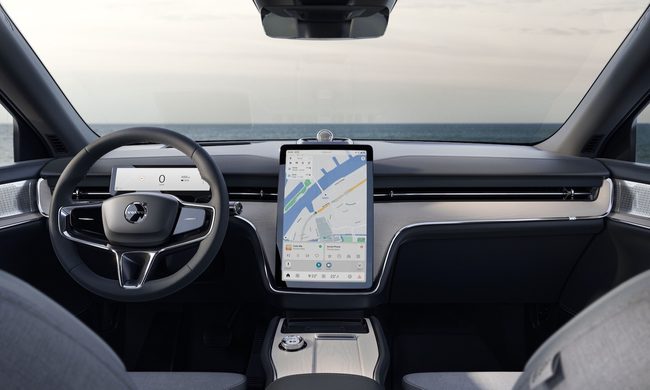
Interior view of the 2024 Volvo EX90.

The line between your smartphone and your car continues to blur. Volvo has announced that it is rolling out an over-the-air software update that brings Apple Music directly to the infotainment systems of more than 2 million vehicles worldwide. Instead of relying on Apple CarPlay or plugging in an iPhone, eligible drivers will be able to stream music natively from their car's built-in system, making Apple Music another integrated feature of Volvo's software experience.

The update is arriving for a wide range of Volvo models, including the EX90, ES90, XC90, S90, V90, XC60, S60, V60, XC40, EX40 and EC40, covering model year 2020 onwards. Availability, however, may vary depending on the vehicle.

Read more
Chery’s latest EV packs flagship tech for the price of a base Tesla, but you can’t buy it
Here's everything packed into Exeed's 2027 Exlantix ES, from its 27-sensor autonomous driving suite to its 860 km range, all starting under $31,000.
Car, Transportation, Vehicle

Chery's premium arm just dropped a sedan that makes you wonder why American EVs cost twice as much for half the tech.

Exeed's 2027 Exlantix ES ships with a driver-assist system called Falcon 700. It is built around an Nvidia Orin-Y chip and a genuinely stacked sensor suite.

Read more
A new AI model wants self-driving cars to think before they swerve
Forget guessing games, this self-driving AI actually shows its work.
Self driving car

Self-driving cars have gotten pretty good at driving. The harder problem is teaching them to drive safely in situations nobody planned for. We have heard horror stories of self-driving cars, behaving erratically in emergency situations, often times delaying first responders from reaching the scene.

A team at Seoul National University, led by professor Jun Won Choi from the Department of Electrical and Computer Engineering, thinks they have cracked part of that puzzle with a new AI model called SafeDrive. The research was recently selected as a highlight paper at CVPR 2026, a distinction that goes only to roughly 3% of all submissions.

Read more