  1. Home
  2. Cars
  3. Photo Galleries
  4. News

Stealth aircraft inspiration aside, the Rolls-Royce ‘Nighthawk’ is here to be noticed

Add as a preferred source on Google

How do you make one the most extravagant specimens of British luxury more American? Rolls Royce, with its limited ‘Nighthawk’ edition of the Phantom Drophead Coupé, looks to answer that very question.

No, there isn’t an LS3 or HEMI in the engine compartment, and you won’t find American flag livery draped throughout the cabin. The Nighthawk was created exclusively for North American customers though, and the alterations are noteworthy.

Rolls-Royce says that the bespoke model, of which only nine will be built, is “inspired by stealth technology in modern aerospace development.” As such, the Nighthawk wears Diamond Black Metallic paint with a Matt Diamond Black hood. The lines are sleek and smooth, and there’s even radar-absorbent material surrounding the windshield.

Furthering its clandestine design, the Phantom is accented with carbon fiber throughout the Hotspur Red and Black interior. The naked weave is prominently featured on the dash, highlighted with brilliant red textiles throughout.

Clearly, this isn’t your average Rolls-Royce Phantom, if there is such a thing. The cabin looks more like a tuner car than an opulent luxury mobile, and we’re not sure what that says about the automaker’s opinion of Americans.

According to Rolls-Royce, the normal Phantom is “inspired by the J-class racing yachts of 1930s” with the result being a car that “epitomizes romantic, performance motoring.”

Is that ethos present here? We’re not so sure, but perhaps that’s the point.

Under the hood, the 6.75-liter V12 from the standard Drophead produces 454 horsepower and 541 pound-feet of torque. That’s good for a sprint to 60 mph in 5.6 seconds, with a combover-ruffling top speed of 150 mph.

How much will the Nighthawk cost? The automaker didn’t say, but the regular Phantom Drophead Coupé runs an exorbitant $464,600. As the saying goes, if you have to ask, you probably can’t afford it.

Andrew Hard
Andrew first started writing in middle school and hasn't put the pen down since. Whether it's technology, music, sports, or…
Volvo is rolling out Apple Music to over 2 million cars with a simple OTA update
Your Volvo may soon get Apple Music without needing CarPlay
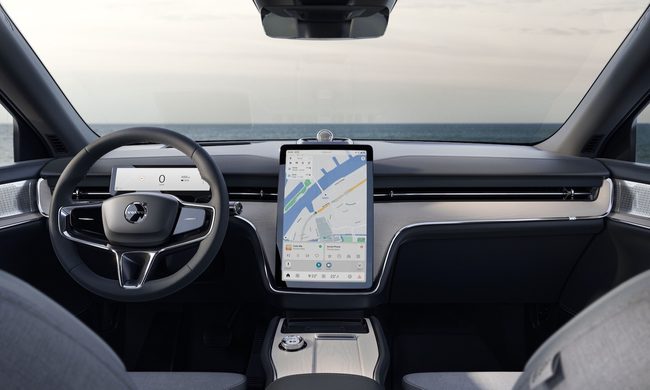
Interior view of the 2024 Volvo EX90.

The line between your smartphone and your car continues to blur. Volvo has announced that it is rolling out an over-the-air software update that brings Apple Music directly to the infotainment systems of more than 2 million vehicles worldwide. Instead of relying on Apple CarPlay or plugging in an iPhone, eligible drivers will be able to stream music natively from their car's built-in system, making Apple Music another integrated feature of Volvo's software experience.

The update is arriving for a wide range of Volvo models, including the EX90, ES90, XC90, S90, V90, XC60, S60, V60, XC40, EX40 and EC40, covering model year 2020 onwards. Availability, however, may vary depending on the vehicle.

Read more
Chery’s latest EV packs flagship tech for the price of a base Tesla, but you can’t buy it
Here's everything packed into Exeed's 2027 Exlantix ES, from its 27-sensor autonomous driving suite to its 860 km range, all starting under $31,000.
Car, Transportation, Vehicle

Chery's premium arm just dropped a sedan that makes you wonder why American EVs cost twice as much for half the tech.

Exeed's 2027 Exlantix ES ships with a driver-assist system called Falcon 700. It is built around an Nvidia Orin-Y chip and a genuinely stacked sensor suite.

Read more
A new AI model wants self-driving cars to think before they swerve
Forget guessing games, this self-driving AI actually shows its work.
Self driving car

Self-driving cars have gotten pretty good at driving. The harder problem is teaching them to drive safely in situations nobody planned for. We have heard horror stories of self-driving cars, behaving erratically in emergency situations, often times delaying first responders from reaching the scene.

A team at Seoul National University, led by professor Jun Won Choi from the Department of Electrical and Computer Engineering, thinks they have cracked part of that puzzle with a new AI model called SafeDrive. The research was recently selected as a highlight paper at CVPR 2026, a distinction that goes only to roughly 3% of all submissions.

Read more