1. Home
  2. Cars
  3. Photo Galleries
  4. Legacy Archives

The McLaren P1 performance figures are finally made public – and they’re almost too hot to handle

Add as a preferred source on Google

McLaren has been stringing us along the last several weeks, teasing tidbits of its new P1 supercar every few days. Today, however, is the last – and perhaps most exciting – of the releases: the performance figures.

We’ve told you about the carbon fiber construction and the new hybrid drivetrain but none of that painstaking detail meant much until we learned how fast it goes and how much it’ll cost. Both figures, it turns out, are staggering.

The McLaren P1, which will officially be unveiled to the world in Geneva next month, will cost $1.3-million. McLaren will only build 375 total units and brags that anytime one is seen on the streets, it’ll remain an unforgettable sight.

The 903 horsepower 3.8-liter twin turbocharged V8 along with its powerful electric motor pairing will push the P1 from 0-62 MPH in three seconds. The P1 will also hit 0-186 MPH in 17 seconds and onto an electronically limited top speed of 217 MPH. While these numbers are exciting to read and write about, we can’t even begin to fathom how these kinds of performance figures translate into real-world driving.

For straight-line performance, McLaren has included Formula One-inspired Drag Reduction System (DRS) technology onto the P1.

McLaren has made some special performance partnerships along the way, giving the P1 some distinctive performance components. The Pirelli tires have been specially designed alongside the P1 from the get-go. The P Zero Corsas ensure the P1 has exceptional grip in every environment.

Bringing the P1 to a quick stop are specially designed brakes from Akebono. The brake system features a new kind of carbon ceramic material that proves much stronger than conventional carbon ceramics.

Nick Jaynes
Former Automotive Editor
Nick Jaynes is the Automotive Editor for Digital Trends. He developed a passion for writing about cars working his way…
Order an Uber and a self-driving Mustang might show up
Electronics, Phone, Mobile Phone

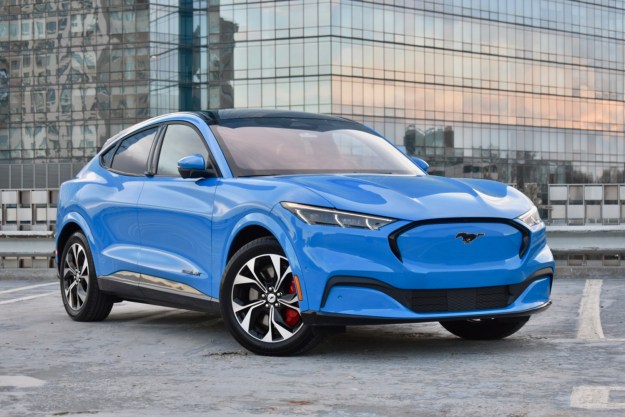
Ordering an Uber in London could come with a surprise today. Instead of a conventional car and driver pulling up, you might find a Ford Mustang Mach-E that can drive itself. Uber has launched London's first public robotaxi service in partnership with British autonomous driving company Wayve. The service is available through the Uber app, meaning you don't need to download anything new or book a special type of ride to try it.

There is one important caveat. Although the cars will handle the driving themselves, a trained safety operator will initially sit behind the wheel, ready to intervene if necessary. Fully driverless rides are planned for a later stage. The launch fleet consists of electric Mustang Mach-Es equipped with cameras, radar, and Wayve's AI Driver technology. These systems give the vehicle a 360-degree view of what's happening around it. And if anywhere can put that technology through its paces, London seems like a pretty good candidate.

Read more
Range Rover Electric arrives with 543hp, 600km range, and a starting price of the moon
The electric Range Rover is here, and your wallet may need CPR
Range Rover EV

The Range Rover has never been shy about luxury, size or price, and its first fully electric version is carrying that tradition into the EV era. Jaguar Land Rover’s (JLR) first battery-electric Range Rover is now open for orders, starting at £154,070, or about $208,420. That makes it one of the most expensive electric SUVs on the market.

The electric model costs almost £50,000 more than the standard combustion-engine Range Rover. It is priced in the same territory as the electric Mercedes-Benz G 580 and not far from ultra-luxury gasoline SUVs such as the Bentley Bentayga.

Read more
A solar ambulance has successfully tackled 500 miles of difficult terrain
Stella Juva

For years, solar-powered vehicles have largely lived in the world of prototypes, university projects and ambitious demonstrations. Now, one has completed the kind of test that matters far more than a flashy concept reveal: it drove hundreds of miles through difficult terrain while carrying medical equipment and generating enough electricity to operate independently.

Called Stella Juva, the vehicle was developed by Solar Team Eindhoven, a group of 23 students from Eindhoven University of Technology and two other educational institutions. According to a CNN report, the team describes it as the world's first solar ambulance. Unlike a conventional ambulance, however, Stella Juva is designed less to rush patients to hospitals and more to bring medical care to people who cannot easily reach it.

Read more