1. Home
  2. Cars
  3. Legacy Archives

Tire-shredding gas sipper: 2015 Dodge Challenger Hellcat earns 22 mpg highway

Add as a preferred source on Google

11.2 seconds on the track, 22 mpg on the way home. Not bad.

With news that will appease nearly any dragstrip commuter, Dodge has released the official fuel economy ratings for the 2015 Dodge Challenger Hellcat. The supercharged, 6.2-liter, 707-horsespower V8 manages 22 mpg on the highway, while returning 13 mpg in the city.

Recommended Videos

These impressive stats are achieved the with Hellcat-exclusive TorqueFlite eight-speed auto. With the six-speed manual, highway fuel consumption rating drops by 1 mpg.

These numbers are impressive for such a bulky engine, but remember, the 707-horsepower HEMI will grow quite a thirst when you put your foot down. At full throttle, the blown V8 will drink an astonishing 1.5 gallons of fuel per minute.

However, despite looking like a brute from some angles, the Hellcat’s V8 is actually 91% new and pretty sophisticated.

The supercharged HEMI features a forged-steel crankshaft, heat-treated aluminum-alloy cylinder heads, and induction-hardened bearings, steps that are absolutely necessary for an engine of its caliber.

To keep everything frosty, the Challenger’s supercharger is equipped with a dual exchange cooling circuit that sits apart from the car’s enormous radiator.

For comparison’s sake, the 2015 Corvette Stingray returns 29 mpg highway with its 6.2-liter, 460-hp LT1 V8. The economy numbers for the supercharged, 650-hp Corvette Z06 haven’t been released yet, but chances are they will dip close to the Challenger’s 22-mpg rating.

Related: Why Dodge’s Hellcats should make the Germans very, very nervous

Expect similar numbers for the Dodge Charger Hellcat, because at 4560 pounds, the sedan is only about 100 lbs heavier than its Challenger brethren.

Despite being slightly heavier, though, Dodge claims that the Charger is actually .2 seconds quicker in the quarter-mile than the Challenger at 11.0 seconds flat. Supposedly the 100 extra pounds help the muscle car gain traction off the line.

So, in Dodge’s case, more is less?

Andrew Hard
Andrew first started writing in middle school and hasn't put the pen down since. Whether it's technology, music, sports, or…
Volvo is rolling out Apple Music to over 2 million cars with a simple OTA update
Your Volvo may soon get Apple Music without needing CarPlay
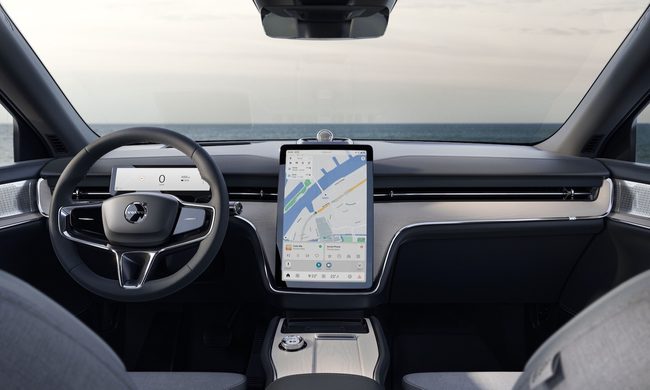
Interior view of the 2024 Volvo EX90.

The line between your smartphone and your car continues to blur. Volvo has announced that it is rolling out an over-the-air software update that brings Apple Music directly to the infotainment systems of more than 2 million vehicles worldwide. Instead of relying on Apple CarPlay or plugging in an iPhone, eligible drivers will be able to stream music natively from their car's built-in system, making Apple Music another integrated feature of Volvo's software experience.

The update is arriving for a wide range of Volvo models, including the EX90, ES90, XC90, S90, V90, XC60, S60, V60, XC40, EX40 and EC40, covering model year 2020 onwards. Availability, however, may vary depending on the vehicle.

Read more
Chery’s latest EV packs flagship tech for the price of a base Tesla, but you can’t buy it
Here's everything packed into Exeed's 2027 Exlantix ES, from its 27-sensor autonomous driving suite to its 860 km range, all starting under $31,000.
Car, Transportation, Vehicle

Chery's premium arm just dropped a sedan that makes you wonder why American EVs cost twice as much for half the tech.

Exeed's 2027 Exlantix ES ships with a driver-assist system called Falcon 700. It is built around an Nvidia Orin-Y chip and a genuinely stacked sensor suite.

Read more
A new AI model wants self-driving cars to think before they swerve
Forget guessing games, this self-driving AI actually shows its work.
Self driving car

Self-driving cars have gotten pretty good at driving. The harder problem is teaching them to drive safely in situations nobody planned for. We have heard horror stories of self-driving cars, behaving erratically in emergency situations, often times delaying first responders from reaching the scene.

A team at Seoul National University, led by professor Jun Won Choi from the Department of Electrical and Computer Engineering, thinks they have cracked part of that puzzle with a new AI model called SafeDrive. The research was recently selected as a highlight paper at CVPR 2026, a distinction that goes only to roughly 3% of all submissions.

Read more