
The iPad suddenly has competitors.
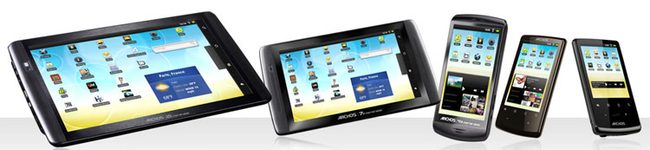
At the IFA show this week in Berlin, Samsung announced its 7-inch Galaxy Tab, and Toshiba its Folio 100 (which won’t be coming to the U.S. for a while, if at all). Back in the U.S., Archos unveiled not one but five tablets — actually three small Android multimedia players and two tablets, with 7- and 10.1-inch screens.
Smartly, Archos has avoided the whole “iPad-killer” nonsense, a complete media creation. No executive at any of these Android tab makers — with the possible exception of Google itself — suffers any delusions about competing with Apple, the tech equivalent of bringing a butter knife to a gunfight.
By offering a full line of tabs (or however you want to classify the smaller versions), however, Archos hopes to offer a wide range of across-the-board alternatives to more budget-conscious, Apple-phobic, non-gearhead consumers.
There will be five Archos Android tab models:
- 28 (the model number indicates the screen size), $100, with 4GB
- 32, $150, with 8GB of memory, a 1.3-megapixel camera and VGA video recorder
- 43, $200, the nearest competitor to the new iPod Touches, with 16 GB, a microSD slot, HDMI mini out, HD video recording and a 2-megapixel still camera, running an 800MHz processor
- 70, $275 for 16GB of flash, $350 with a 250GB hard drive
- 10, actually a 10.1-inch screen, $300 for 8 GB, $350 for 16GB

Both the larger tabs have multi-touch screens, microSD slots, HDMI mini jacks, and front-facing cameras with video chat software coming later (Skype video compatible, but not Skype video).
All five models offer 16:9 screens, Wi-Fi (b, g, n) connectivity but no 3G, accelerometers, and auto 360 degree orientation, just like the iPad. All will be upgradable at some point soon to Froyo, the next-gen Android OS featuring a righteous voice-control capability.
The 28 is available for pre-order now; all the other models will be available by the end of this month or the beginning of October.
At 16 ounces, the 10, Archos’ iPad killer (there, I’ve said it) is shocking light compared to iPad’s 24-ounce heft, but feels firm thanks to a stainless steel frame. All the 16:9 screens are far better suited for video watching — you lose screen real estate when watching a widescreen movie on the iPad — but they become disconcerting long, like legal paper, for book reading.
Archos also falls behind on the cameras. None of the models offer cams competitive with the iPod’s excellent (and soon to be upgraded) 5-megapixel imager.
But all Android tabs will suffer in comparison with the iPad. True, each offers apparent spec advantages compared to the iPad at a lower price. But touting spec superiority is a losing game in the tablet wars. It’s all about the apps.
Archos has it’s own app store, listing apps compatible and approved for use with the five Archos tabs. It offers around 5,000 to start, a mere fraction of the total Android app universe. By comparison, there are 25,000 iPad-specific apps, and of course all iPod apps run on iPad.
For more casual users, Archos and other tab makers will offer a necessary set of apps, but long-term, I suspect this tab-specific app limitation will initially cripple all the iPad killer wannabees.


