  1. Home
  2. Computing
  3. News

You’ll soon be able to control your Chromebook with just your face

Add as a preferred source on Google
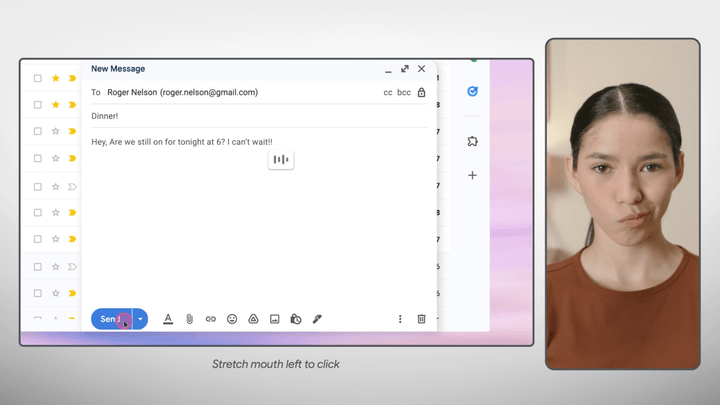
Project Gameface being used to write an email.
Google

Chromebooks have AI too. Google’s recent comments on its AI advances arrived between Microsoft’s big Copilot+ announcement and the forthcoming Apple AI news. In addition to outlining a few new AI features that are now available for Google’s Chromebook Plus line of laptops, Google previewed a fascinating feature coming later that would let you control the entirety of your Chromebook with just your face.

Using computer vision and the webcam built into your Chromebook, you’ll soon be able to talk to it, move your face, and make hand gestures to control your Chromebook. Google calls it Project Gameface, and it’s being built right into ChromeOS. The feature was originally announced via a blog post on May 10, and is aimed at creating a “hands-free, AI-powered gaming mouse,” but now it’s being expanded and is officially coming to Chromebooks.

In settings, you can set specific head movements and facial gestures captured from the camera to do things like left click, reset the cursor to center, scroll with the mouse, activate the keyboard, and more. The types of facial gestures you can use, meanwhile, include opening your mouth, smiling, looking in different directions, or raising the eyebrows. You can even customize a “gesture size,” to be even more inclusive of the specific needs of users.
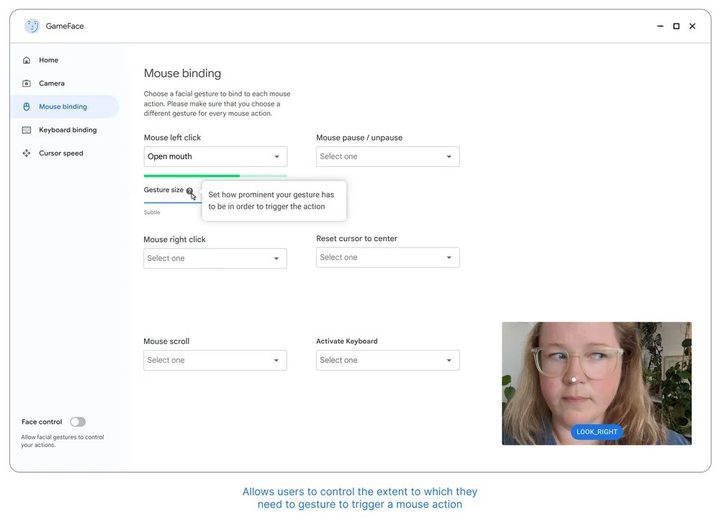
A screenshot of the settings open for Project Gameface.
Google
Google seems to be adding gestures into the mix, and now you’ll be able to accomplish many more tasks with Project Gameface. According to the update, you’ll be able to do things like send emails, use apps, and browse the web without touching your keyboard or screen. If you can do all that, we have to assume Google has added even more ways of controlling the device. It also doesn’t require downloading software and should — in theory — work across apps, services, and websites.

Google admits that it’s still “early in this project,” so we don’t yet know when this feature will roll out.

Interestingly, Apple recently announced eye tracking for the iPad as a similar way to improve accessibility and allow for a more hands-free ways of interacting with devices.

Beyond updates to Project Gameface, Google has announced it’s also working on a few other upcoming AI features. With Gemini right on the device, you’ll soon be able to do live translate and transcriptions from videos and video calls. Gemini will also be able to do something called “Help me read and understand,” which is a way of getting summaries of or asking questions about particular articles or pages. Lastly, you’ll be able to log into your Chromebook and get prompted to pick things up where you left off, with all opened apps and websites grouped together just as they were in just one click.

These new features would, in theory, need to be run on a device’s neural processing unit (NPU), which very few new Chromebooks actually have.


Luke Larsen
Former Senior Editor, Computing
Luke Larsen is the Senior Editor of Computing, managing all content covering laptops, monitors, PC hardware, Macs, and more.
MIT researchers found a new Spectre attack that can slip past Intel and AMD defenses
AMD Ryzen CPU inside a socket installed on a motherboard

Spectre has been haunting CPU security since 2018, and MIT researchers have now found another way to make it misbehave. The new TONTOU attack can bypass some of the defenses Intel and AMD have added over the years by exploiting a tiny gap in how those protections work. The research comes from Daniël Trujillo and Mengjia Yan at MIT's Computer Science and Artificial Intelligence Laboratory (CSAIL). Their findings show that even after a processor wipes or isolates information used by its branch predictor, there can be a brief window before that information is actually used. TONTOU, short for Time-of-Neutralization to Time-of-Use, attacks precisely that gap.

The tiny gap that TONTOU exploits

Read more
Microsoft accidentally gave Windows 11 users another OneDrive app, and you can’t easily remove it
Microsoft says the wider-than-intended rollout was an accident, but removing the app currently means removing OneDrive too.
Microsoft OneDrive Featured Graphic

Windows 11 users have been getting a new OneDrive app whether they asked for it or not. The problem? Microsoft says it wasn't supposed to happen. Microsoft has confirmed that its OneDrive Photos app was rolled out to Windows 11 PCs more broadly than intended, including enterprise machines where the app isn't even designed to work. The company says it is now working on a fix, but there's an awkward catch: users currently can't uninstall OneDrive Photos without removing the main OneDrive app too.

So, what exactly got installed?

Read more
Apple Reminders sucked for project management until I learned this feature
Your checklist deserves better. Here's how to turn Reminders into a proper Kanban board.
Apple reminders on Mac

For the longest time, I used Apple Reminders only for capturing quick tasks. Thanks to its Siri integration, Reminders let me add tasks quickly so nothing would fall through the cracks. However, when it came to managing big projects, I always moved to a more powerful task manager like OmniFocus or Things 3. 

That changed the day I stumbled onto the Column view. Apple added this feature with the iOS 17 and macOS Sonoma updates, and somehow I completely missed it. But once I discovered and got the hang of it, Reminders finally started to feel like a real project management tool instead of a glorified sticky note.

Read more