1. Home
  2. Computing
  3. Gaming
  4. News

Razer’s latest ‘Blade’ boasts cutting-edge hardware and a 4K Display

Add as a preferred source on Google

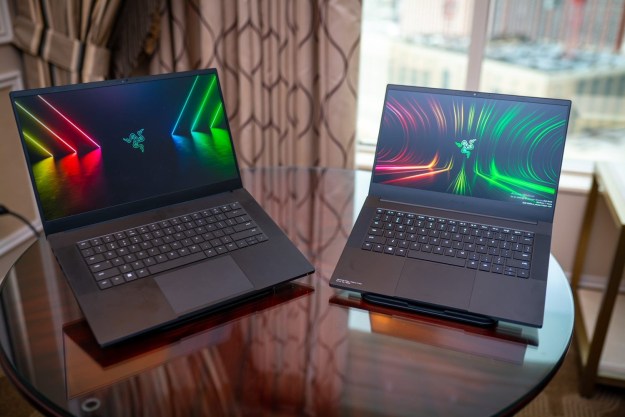
Razer unveiled the 2017 update to its popular Razer Blade lineup on Monday and the new notebooks are just packed to the gills with high-end hardware. The new 14-inch Razer Blades come in two flavors, starting at $1,900 and both boast seventh-generation Intel i7 quad-core processors alongside a powerful Nvidia GeForce GTX 1060 GPU.

The 1080p model is slated to hit the Razer online store on Monday and other select retailers on February 20, while the 4K touchscreen model will likely be hitting store shelves sometime in the second quarter of 2017.

Recommended Videos

Razer Blade (2017)

Razer Blade 2017
Image used with permission by copyright holder
Dimensions  13.6 x 9.3 x .70 (inches)
Weight  4.10 lbs (1080p), 4.30 lbs (4K)
Processor  Seventh-generation Intel Core i7-7700HQ quad-core (2.8GHz)
Graphics Card Nvidia GeForce GTX 1060 6GB
RAM  16GB
Display  14-inch 1080p, or 14-inch 4K Touch Screen
Resolution  1920 x 1080 or 3840 x 2160
Storage 256GB SSD, 512GB SSD, or 1TB SSD
Ports  3x USB 3.0, 1x Thunderbolt 3 (USB Type-C), 1x HDMI 2.0, 3.5mm jack
Webcam  2.0MP
Operating System Windows 10
Battery  70 watt-hours
Price $1,900 (1080p), $2,750 (4K)
Review Coming Soon

This release follows on the heels of a banner year for Razer, according to CEO Min-Liang Tan.

“More users embraced this flagship computer model in 2016 than ever before. Beyond gaming it has been really gratifying to see people enjoying the power and portability of the Blade for video editing, music creation, and software development,” Tan said.

The new 14-inch Razer Blade has some big shoes to fill. though. The 2016 Blade was one of our favorite gaming notebooks of 2016 with its unique blend of style, portability, and performance. Packing that GTX 10-series, alongside a seventh-generation Kaby Lake quad-core processor, it will very likely run circles around the 2016 model when it comes to performance.

That said, those high-end components might come with an unseen cost. The 2017 models feature more horsepower, but they still rely on the same size battery, so it will remain to be seen if the new model is an overall improvement over the 2016 model.

Jaina Grey
Former Digital Trends Contributor
Jaina Grey is a Seattle-based journalist with over a decade of experience covering technology, coffee, gaming, and AI. Her…
Meta’s detection tool fails to identify photos generated by its own Muse Image AI
Meta has created an invisible watermarking tool called Content Seal that is embedded in all images generated by the Muse Image AI.
Meta AI identification tool.

Earlier this week, Meta announced two new AI products, namely, Muse Image and Muse Video. As the name suggests, these are generative AI tools for making photos and video clips using natural language text prompts. Soon after their rollout commenced, these tools sparked controversy because Meta had automatically opted in Instagram users, allowing others to use their publicly posted media and convert them into remixed AI content. But it appears that Meta courted another loss on its side of the court.

What's the problem?

Read more
Your Google AI Studio apps can finally have polished, presentable web links
AI Studio web apps can now use personalized subdomains
google ai studio logos

Google AI Studio has made building a web app surprisingly easy. You can describe what you want, refine the design through prompts, and publish the result without setting up a traditional development environment. An awkward point of friction comes after deployment, when the finished app still has to live behind a long, forgettable Cloud Run link.

Google is now cleaning up that final step. AI Studio lets you assign a deployed web app a personalized address under the “ai.studio” domain, such as “your-app-name.ai.studio.” A recognizable URL should make the project look more presentable in a portfolio, client demo, social post, or internal project page.

Read more
You can now check if a Google ad was made using AI
Google will auto-label its own AI ads, but third-party AI ads still rely on advertisers to come clean.
google-ads-ai-label

Ever looked at an ad and wondered if a real person made it or if it was AI generated in seconds? Google is now giving you a way to find out.

The company just announced a new AI transparency label that tells you whether an ad was created or edited using generative AI tools. The label lives inside Google's My Ad Center, and it is rolling out across Google Search, YouTube, and Discover globally.

Read more