
Graphics developer Nvidia is gearing up for the all-important end-of-year holiday buying season, announcing seven new GeForce 400M series of notebook graphics processors designed to boost graphics, entertainment, and even Web-browsing performance, plus save battery power with Nvidia’s Optimus technology that shuts off the GPU when they’re not needed. The GeForce 400M processors are Nvidia’s first mobile chips based on the company’s Fermi architecture—and the new chips can also support 3D stereoscopic imagery, so notebook users will have even more reasons to buy 3D displays and shutter glasses.
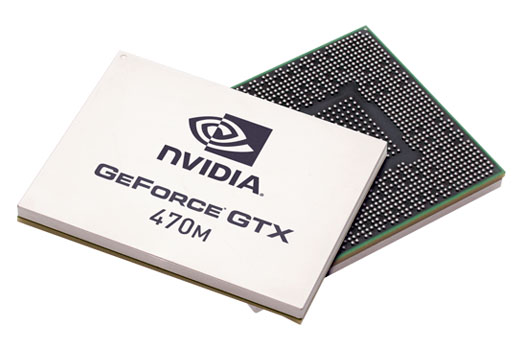
“The GeForce 400M Series takes the award-winning Fermi architecture across a complete line-up of DirectX 11 GPUs for notebook,” said Nvidia’s general manager for notebook GPUs Rene Haas, in a statement. “Coupled with Optimus technology, 400M Series notebook GPUs deliver great performance for visual computing applications when you need it, and great battery life when you don’t.”
The entire GeForce 400M line will offer support for Nvidia’s 3D Vision technology, so they can support 3D gaming and Blu-ray media when coupled with a 3D-capable display and Nvidia’s shutter glasses—Aver and Asus have already announced forthcoming entertainment computers with 3D Vision support. The chips also support PhysX, CUDA support for GPU-computing applications, and support for Nvidia 3DTV Play, which enables users to connect a notebook with 3D Vision technology to a 3D-capable HDTV. The systems also feature Nvidia’s Optimus technology, which enables the chips to seamlessly shut down and hand over graphics processing to a computer’s integrated graphics system, which are typically a lot less powerful but also consume far less battery power.
Computer makers like Dell, Acer, Asus, Lenovo, Samsung, and Toshiba have all announced they will offer products with GeForce 400M graphics support, and Nvidia says additional OEMs should come on board soon. The graphics systems won’t be available at retail; instead, the only way to set hands on them is to buy a new computer with GeForce 400M graphics pre-installed. Nvidia plans to offer the GeForce GT 445M, GT 435M, GT 425M, GT 420M and GT 415M for “performance users,” while high-end gaming and entertainment notebooks can step up to the GeForce GTX 470M and GTX 460M. No pricing information was disclosed.


