  1. Home
  2. Emerging Tech
  3. News

Dark matter galaxy crashed into the Milky Way, causing the ripples in its disk

Add as a preferred source on Google

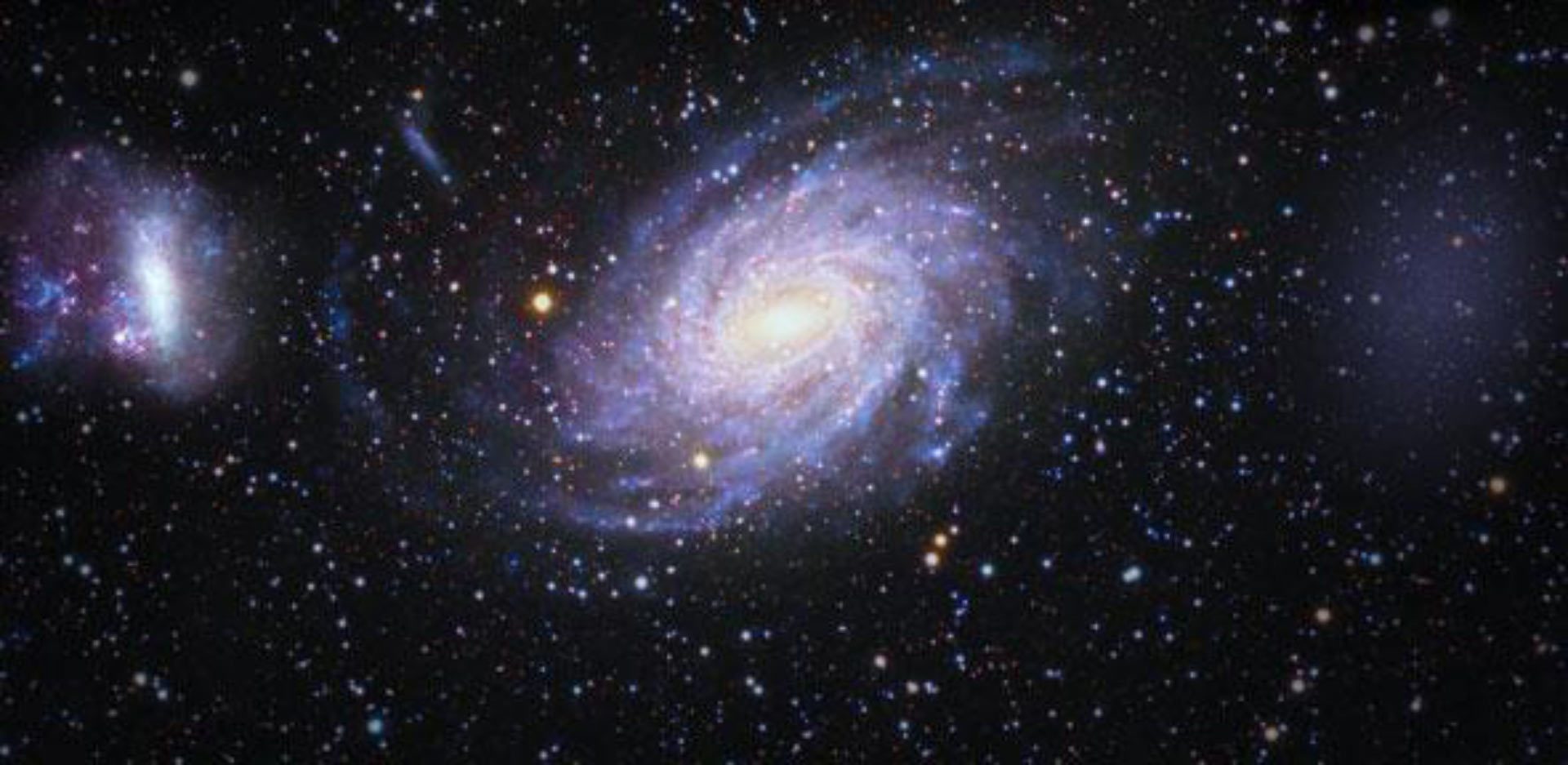
Left to right: the Large Magellanic Cloud, the Milky Way Galaxy, and Antlia 2. V. Belokurov / Marcus and Gail Davies / Robert Gendler.

New research suggests that hundreds of millions of years ago the Milky Way collided with Antlia 2, a nearby dwarf galaxy. This collision caused ripples in the edge of the disk of gas around the Milky Way which we still observe today.

Recommended Videos

Antlia 2 is about one third the size of the Milky Way, and is believed to be the galaxy dominated by dark matter which astronomers predicted to exist back in 2009. Its location matches the predictions but it was only discovered in 2018 because it has very low density and gives off very little light.

The new data shows that based on Antlia 2’s trajectory, it would have collided with the Milky Way and caused the ripples in its gas disk.

“The discovery could help develop methods to hunt for dark galaxies and ultimately solve the long-standing puzzle of what dark matter is,” astrophysicist Sukanya Chakrabarti, lead author of the study, said in a statement.

Dark matter is a type of subatomic particle which is theorized to exist in order to explain the mass of galaxies. Given the way that galaxies move and interact, scientists believe they must be heavier than the amount of regular matter within them would suggest. They created the theoretical dark matter particle to explain where all this extra mass comes from.

But despite many experimental attempts to locate dark matter, such a particle has never been observed. Instead, researchers rely on indirect evidence of dark matter such as observing the distribution of starlight within galaxy clusters.

“We don’t understand what the nature of the dark matter particle is, but if you believe you know how much dark matter there is, then what’s left undetermined is the variation of density with radius,” Chakrabarti explained in the statement.

“If Antlia 2 is the dwarf galaxy we predicted, you know what its orbit had to be. You know it had to come close to the galactic disc. That sets stringent constraints, therefore, on not just on the mass, but also its density profile. That means that ultimately you could use Antlia 2 as a unique laboratory to learn about the nature of dark matter.”

The paper is available on pre-publication archive arXiv and will be published in the journal Astrophysical Journal Letters.

Georgina Torbet
Georgina has been the space writer at Digital Trends space writer for six years, covering human space exploration, planetary…
Starlink V5 is here, and it’s lighter, smarter, and far more efficient
The next-generation satellite internet kit promises improved efficiency while maintaining high-speed connectivity.
Starlink V4 vs V5

Not every hardware upgrade needs to be about speed. With Starlink V5, SpaceX is betting that a lighter design and lower power consumption matter just as much. The company has officially introduced its next-generation Starlink V5 kit, featuring a smaller and lighter design with significantly improved power efficiency.

Smaller, lighter, and far more efficient

Read more
Frontier joins the Starlink club with high-speed in-flight internet
The carrier plans to roll out SpaceX's satellite-powered Wi-Fi across its fleet starting in 2027.
Frontier Starlink partnership featured

If there's one thing budget airlines aren't exactly known for, it's great onboard Wi-Fi. In Frontier Airlines' case, it hasn't offered in-flight internet at all. That's about to change. Frontier Airlines has announced a partnership with SpaceX's Starlink to bring high-speed, low-latency internet across its fleet. Installations will begin in early 2027, making Frontier the first ultra-low-cost carrier in the United States to adopt Starlink's satellite-powered connectivity.

Streaming, browsing, and even gaming at 35,000 feet

Read more
OpenAI’s first hardware product sounds more like a companion than a speaker
The AI company is reportedly building a mobile home device that understands context and proactively helps users.
OpenAI press image

For months, rumors have suggested that OpenAI's first hardware product could be a wearable AI device, or perhaps even the beginning of its long-term smartphone ambitions. As it turns out, the company's first gadget may be something far simpler, yet arguably far more ambitious. It will help control smart-home appliances, play media, answer questions, respond to messages, and tap into the range of capabilities offered by OpenAI's ChatGPT, according to people familiar with the matter.

OpenAI's first AI device could end up being a speaker, following plenty of hype that the company is actually working on a wearable AI device and might even launch a smartphone down the road. According to a Bloomberg report, the speaker will serve as a human-like AI companion that will integrate directly with the smart home ecosystem.

Read more