  1. Home
  2. Emerging Tech
  3. News

High-res thermal cameras used in ’Planet Earth II’ now found in British tanks

Add as a preferred source on Google
Image used with permission by copyright holder

The British Army’s tanks are getting a tech upgrade — and it’s courtesy of some of the same gadgetry that previously helped bring David Attenborough’s jaw-dropping series of Planet Earth II wildlife documentaries to life.

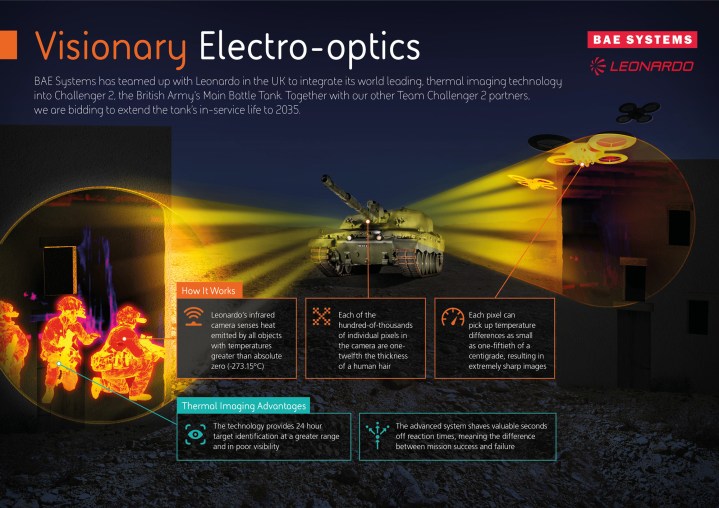
Developed by the U.K.-based engineering company Leonardo as part of a bid by defense-focused multinational company BAE Systems, the new “electro-optic technology” is described as the most capable night vision tech on the market. Capable of sensing the heat emitted by all objects with temperatures in excess of absolute zero, the advanced thermal imaging technology can detect tiny temperature differences as small as 1/50th of a centigrade. The images produced are also impressively high resolution, with each pixel measuring just 1/12th the thickness of a human hair.

Recommended Videos

This results in some impressive visuals, as seen in Planet Earth II’s memorable scenes showing a leopard’s nocturnal hunt, right down to the movement of individual hairs on the animal’s body. The technology has also been used for sports broadcasting, assisting cricket umpires in telling whether a ball has hit the batsman, pad or ball by examining the temperature change caused by the friction of individual impacts.

In terms of military application, this tech could help shave seconds off reaction times in a hostile situation, something thatcould change the outcome of a skirmish involving tanks. Leonardo’s thermal imaging tech has already been proven in combat, when it helped Chinook Helicopters to fly undetected through mountain valleys in Afghanistan — even in poor weather conditions.

“The employment of Leonardo’s thermal imaging technology within the Challenger 2 Life Extension Program will ensure that the British Army’s Main Battle Tank will provide the crew with the best possible imaging capability,” Ray Hopkins, a vice president of systems engineering at Leonardo, told Digital Trends. “This will provide the crew with a 24-hour ability to detect, identify, and engage threats at longer ranges, with greater accuracy, in a solution that is supportable for the remaining operational life of the Main Battle Tank.”

The technology can be retrofitted onto existing tanks, thereby greatly enhancing their life span. This is different from some of the previous BAE Systems projects we’ve covered — which have tended to focus on more futuristic, long-term sci-fi technologies, such as drones that can be “grown” in vats of chemicals or submarines that can be piloted using virtual reality.


Luke Dormehl
I'm a UK-based tech writer covering Cool Tech at Digital Trends. I've also written for Fast Company, Wired, the Guardian…
Anker just exposed a big problem with portable power stations
Appliance, Device, Electrical Device

When you're shopping for a portable power station, there's one number that's almost impossible to ignore: battery capacity. A 2 kWh battery should give you roughly 2 kWh of usable power, right? Unfortunately, things aren't quite that simple. Anker SOLIX has published new efficiency data for its S Series portable power stations, and it's putting the spotlight on something that doesn't get nearly as much attention as capacity: how much of the energy stored inside the battery actually makes it to your devices.

According to Anker, portable power stations are commonly advertised with efficiency figures measured under relatively heavy loads, where they can reach roughly 89% to 92% efficiency. But that's not necessarily how most people use one during an outage. Think about what you'd actually plug in. A Wi-Fi router might sip power continuously, a refrigerator switches its compressor on and off throughout the day, and a CPAP machine could run overnight. Together, those devices may draw just a fraction of what a large power station is capable of supplying. And that's where efficiency can start slipping.

Read more
OpenAI’s first gadget sounds like a tiny expressive AI companion
The device will have a doughnut-shaped body, built-in cameras, and moving parts
OpenAI press image

For months, reports have suggested that OpenAI’s first hardware product would be a screen-free smart speaker designed to act more like an AI companion. We already knew it could understand its surroundings, be carried around the home, and proactively help users. A new Bloomberg report now gives us a clearer picture of what the device may actually look like.

As per the report, OpenAI’s first gadget will be shaped like a doughnut and measure about the same size as a hockey puck. You will be able to carry it between rooms or leave it nearby on whatever surface is convenient. The device is expected to be on the expensive side, as the company has pondered pricing it around $300 to $400. A release is currently planned for 2027.

Read more
Google Antigravity just built an AI translator that works without the internet
Electrical Device, Switch, Robot

Google has shown off a new AI project that could make language barriers a little less intimidating, and it doesn't need an internet connection to do it. The company has introduced the Gemma Translator, a compact prototype built in collaboration with Antigravity. Unlike most AI translation tools that rely on cloud processing, this device runs entirely offline using Gemma 4 E2B, Google's lightweight open model. Everything happens locally on the device, making it both portable and independent of an internet connection. The prototype is powered by a Raspberry Pi 5 and includes a microphone and speaker inside a custom 3D-printed enclosure, creating a self-contained translator you can carry almost anywhere.

AI translation, without the cloud

Read more