  1. Home
  2. Emerging Tech
  3. News

No salt, no problem: Electric fork simulates salty flavors with electric currents

Add as a preferred source on Google

Who needs salt when you have electricity? That’s the proposition of the “electric flavoring fork” created by a researcher in Japan to make meals more palatable for people who need to stick to low-salt or no-salt diets.

The prototype fork, developed by Hiromi Nakamura of Rekimoto Lab at the University of Tokyo, comprises a handle that houses a rechargeable battery and electric circuit, according to Nikkei Technology. When a user places the head of the fork on their tongue, they can press a button on the handle to deliver one of three levels of electric current, which replicates varying degrees of saltiness.

Recommended Videos

Spices like pepper and garlic help the fork to deliver saltiness rather than sour and metallic tastes, according to Nikkei Technology.
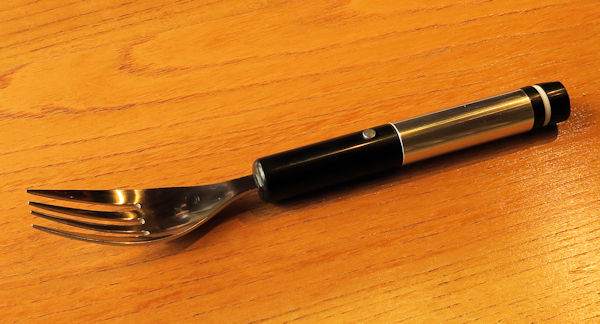
“When I increased current level by using a rotary switch on the back of the fork, a metallic taste started to become stronger than the salty taste,” wrote the online publication’s reporter, who was eating salt-free tonkatsu (pork cutlet). “On the other hand, it is reportedly difficult to emphasize a sweet taste or juicy flavor.”

The prototype fork, which is not waterproof, was created for less than $18, not accounting for the cost of the fork. The device’s rechargeable battery lasts six hours per charge.

This isn’t the first time Nakamura has shown how electricity can simulate saltiness and sweetness: In 2012, she showed off the application of electricity to affect tastes at the Computer Human Interaction Conference in Austin, Texas, and brought an earlier version of the “electric flavoring fork” there. The latest iteration is less unwieldy than a prototype shown earlier this year and is the result of six years of development.


Jason Hahn
Former Contributor
Jason Hahn is a part-time freelance writer based in New Jersey. He earned his master's degree in journalism at Northwestern…
The IFA 2026 Publisher Award Winners Bring Fresh Ideas to Everyday Tech
From Smarter Entry to Screen-Free Wellness, These IFA 2026 Winners Do Things Differently
IFA 2026 Publisher Awards

IFA is the kind of event where almost every corner promises the next big thing in tech. Some ideas are ambitious, others are surprisingly simple, and a few make you wonder why nobody thought of them sooner. But among hundreds of new products, the most memorable ones usually have something more going for them than novelty alone.

This year’s IFA Publisher Award winners are a good example. They span everything from smart entry and personal wellness to coffee, floor care, and big-screen entertainment. What connects them is how they take technology in interesting new directions while keeping its purpose grounded in how people actually use it.

Read more
Luka’s new AI drawing projector puts kids in charge of the creativity
Luka Kids has unveiled an AI-powered drawing projector at IFA 2026 that turns children’s ideas into outlines they can trace, color, and build upon themselves.
Pen, Child, Female

AI toys for kids can be a tricky proposition. Give the technology too much control, and it risks doing the fun and potentially the learning for them. Luka Kids is taking a different approach with its new Drawing Projector, which uses AI to get children started but still expects them to pick up a pencil and do the rest.

Unveiled at IFA 2026, the Luka Kids Drawing Projector lets a child describe a character, story, or idea out loud. AI then turns that prompt into a simple outline and projects it onto a sheet of paper, ready to be traced, colored, changed, or expanded however they like. There are also 384 templates available at launch for kids who don't know where to start. Importantly, these aren't meant to be finished pieces of artwork. The outlines deliberately leave space for children to add their own details and ideas.

Read more
You could be visiting a poor doctor because AI is filling the web with fake online reviews
Real patients rarely share detailed medical stories publicly, and fake reviews are exploiting exactly that silence.
Logo, Text

If you've ever picked a doctor based on online reviews, a new study from Simon Fraser University has some bad news for you. 

Apparently, fake clinician reviews generated without using AI read more believable than genuine ones.

Read more