  1. Home
  2. Emerging Tech
  3. News

Space telescope to probe the mysteries of dark energy and dark matter

Add as a preferred source on Google

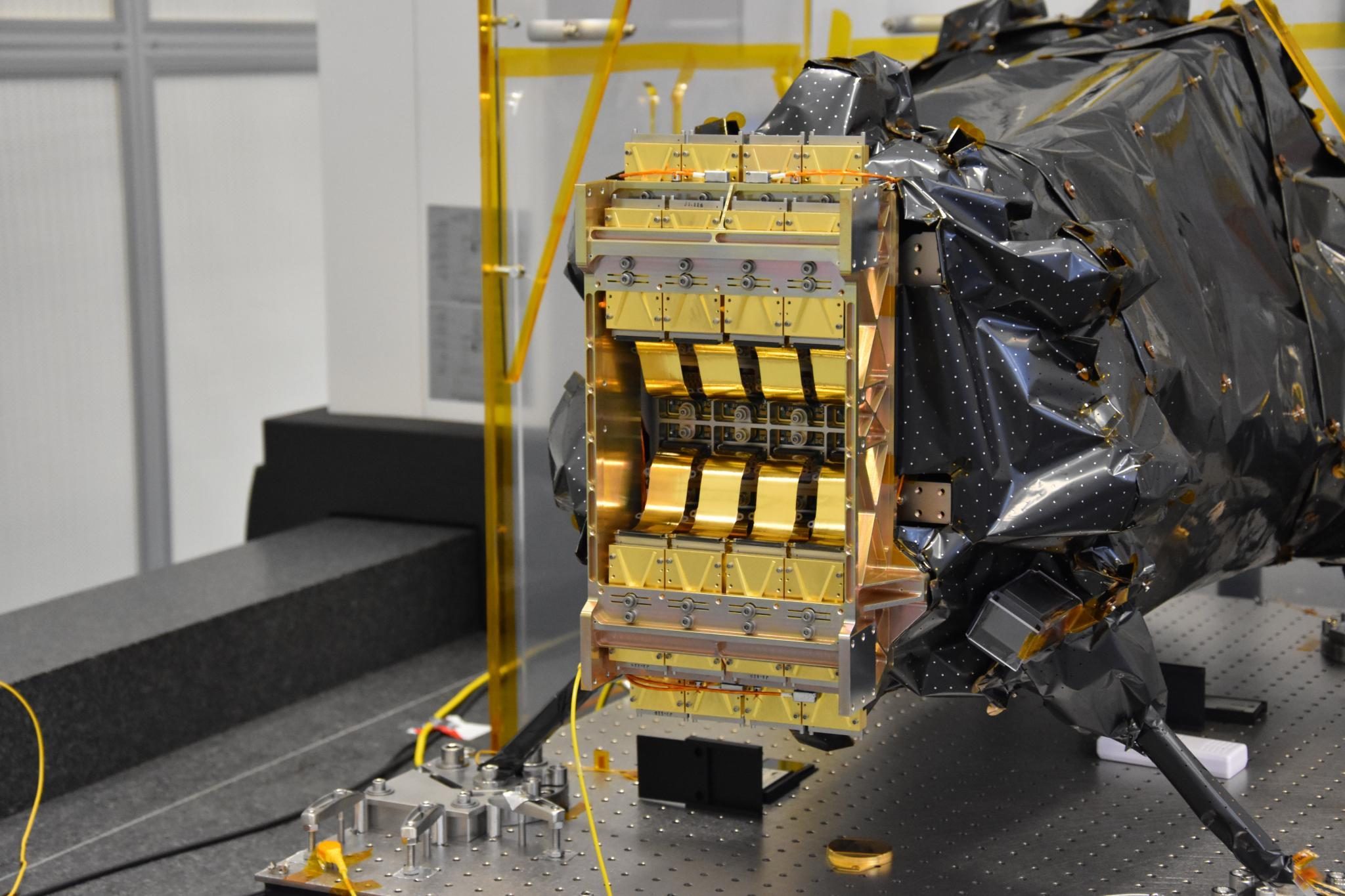
The cryogenic (cold) portion of the Euclid space telescope’s Near Infrared Spectrometer and Photometer (NISP) instrument. NASA led the procurement and delivery of the detectors for the NISP instrument. The gold-coated hardware is the 16 sensor-chip electronics integrated with the infrared sensors. Euclid Consortium/CPPM/LAM

Two of the biggest mysteries in astronomy are dark matter and dark energy. But soon a project from the European Space Agency (ESA), the Euclid mission, will attempt to unravel some of the puzzles over these forces.

Recommended Videos

Dark energy is a force theorized to exist to explain the movements of distant galaxies. When astronomers observe far-off galaxies, they see that they are speeding away from us at a greater speed than would be expected. The universe itself is expanding and is doing so at a faster and faster rate. But we still don’t know why this is, so theorists named the mysterious force affecting the universe dark energy. It is believed that 68% of the universe is composed of dark energy.

To understand more about this phenomenon, the ESA is constructing the Euclid space telescope to perform a survey of billions of distant galaxies, observing their movements. The hope is that with a large sample of galaxies to observe, scientists will be able to narrow down the possible explanations for dark energy.

Euclid will investigate dark matter as well — the theorized particle which makes up roughly 80% of the matter in the universe and which explains the movements of the stars. Dark matter can’t be seen, so Euclid will look for the effects of its gravity on the distant galaxies instead.

In order to create Euclid, the ESA is getting some help from NASA to build highly sensitive components. NASA engineers designed and built 20 pieces of sensor-chip electronics (SCEs) hardware for the telescope which must operate in the freezing temperatures of space, at minus 213 degrees Fahrenheit (minus 136 degrees Celsius). In the image above you can see the gold sensor chips which have been integrated with the infrared sensors.

“Even under the best of circumstances, it is extremely challenging to design and build very sensitive and complex electronics that function reliably at very cold operating temperatures,” Moshe Pniel, the U.S. project manager for Euclid at JPL, who led the team that delivered the sensor-chip electronics, said in a statement. “This truly remarkable team, spread across two NASA centers, accomplished this task under intense schedule pressure and international attention.”

The Euclid telescope is scheduled for launch on a Soyuz ST 2-1b rocket from Europe’s Spaceport in French Guiana in June 2022.

Georgina Torbet
Georgina has been the space writer at Digital Trends space writer for six years, covering human space exploration, planetary…
AI can’t tell if you’re gay or straight, but it thinks it knows what both look like
AI knows it shouldn't judge a face, but apparently, drawing one is a different story.
Emilia Clarke AI generated stock image. Gemini / Nano Banana is on the left

We've all been told not to judge a book by its cover, and you'd think AI would follow that rule, too. Ask an AI chatbot to guess someone's sexual orientation just by looking at their face, and it'll likely tell you that there's no reliable way to know. But what happens when you ask that same model to change someone's appearance to match a particular sexual orientation? Well, that's where things get uncomfortable.

A new study, accepted for presentation at the 2026 Conference on Empirical Methods in Natural Language Processing, found that AI models from OpenAI and Google can be inconsistent when handling sensitive personal characteristics. They might refuse to make assumptions about someone based on their appearance, but when asked to generate those same assumptions visually, the results tell a very different story.

Read more
A clinical study with Google’s special chatbot shows a strong future for AI in healthcare
Google’s medical AI could give doctors a useful second set of eyes
Google Articulate Medical Intelligence Explorer chatbot

AI is a useful tool for handling many tasks in private as well as professional settings, but medical advice, especially diagnosis, is one area where I generally draw the line. General-purpose chatbots tend to sound confident and convincing while giving medical advice, even when they are wrong, as studies have previously found.

That being said, Google's new research points to a much more convincing use for AI in healthcare. Its Articulate Medical Intelligence Explorer chatbot, or AMIE for short, could help prepare both sides before the appointment even begins.

Read more
Relaxation music had one job in this pain study, and favorite songs did it better
Patients who chose their music reported less pain after an IV insertion
Book, Publication, Indoors

Patients’ favorite songs helped ease pain after an IV insertion in a new study, while music specifically chosen for relaxation didn’t show a significant benefit. The soothing soundtrack could apparently use a second opinion.

Researchers at University Hospital Zürich studied 204 patients receiving an IV cannula before an MRI scan. Those listening to their chosen music reported less pain 30 seconds and two minutes after insertion. Across the full sample, the clearest relief came after the needle went in.

Read more