Until fairly recently, the dream of donning a headset and dropping into a virtual world belonged purely in the realms of science fiction, like Star Trek‘s Holodeck or The Lawnmower Man. Thanks to the work of companies like Oculus, HTC, and others, that’s no longer the case. But virtual reality’s history goes back a whole lot further than that — so without further ado, here are our picks for eight of the major landmarks in tech history that made the VR dream a virtual reality.
Sensorama (1957)
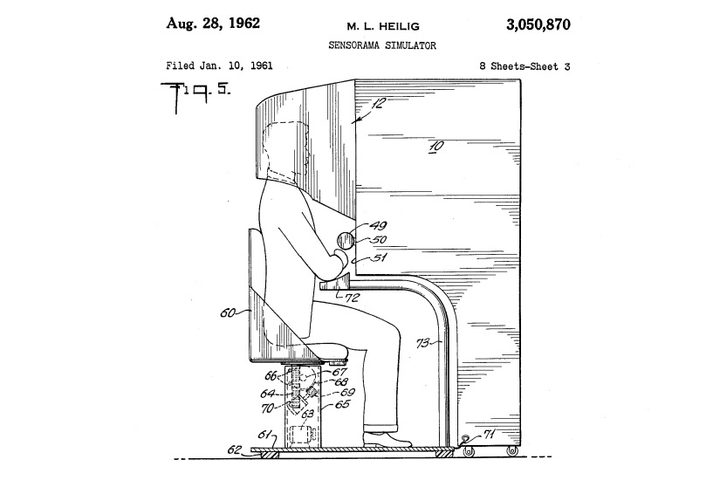
When you think about Hollywood movies in the 1950s, there’s a good chance that one of the first things that come to mind are the gimmicks. Modern widescreen, 3D stereoscopic movies, and even the ill-fated Smell-O-Vision arrived over a 10-year stretch of time. Filmmaker Morton Heilig took things even further, however.
In 1957, he invented a large booth-like machine called the Sensorama, which was intended to combine multiple technologies to give one to four people the illusion of being in a fully 3D immersive world — complete with smell, stereo sound, vibrations, and even atmospheric effects like wind in the hair. A few years later, in 1960, he honed a version of this idea into a patent for the world’s first head-mounted display, promising stereoscopic 3D images, wide vision, and true stereo sound.
Neither technology ever materialized in his lifetime, but they both helped lay the groundwork for the VR revolution to come.
The Sword of Damocles (1968)
The first actual VR head-mounted display (HMD) was created in 1968 by computer scientist Ivan Sutherland. Sutherland was one of the most important figures in the history of computer graphics, having developed the revolutionary “Sketchpad” software that paves the way for tools like Computer-Aided Design (CAD).
Sutherland’s HMD was a project he described as “the ultimate display.” It connected to a stereoscopic display from a computer program depicting simple virtual wireframe shapes, which changed perspective as the user moved his or her head. Because these are superimposed on top of a real background, this could also be seen as the birth of “augmented reality.”
However, it never developed into more than a lab project — possibly because the device’s weight required it to be suspended from the ceiling on a mechanical arm like a periscope. (Hence the “Sword of Damocles” name, a reference to the Roman myth about a sword which hangs above a person’s head to teach them responsibility.)
The Super Cockpit (1970s-80s)
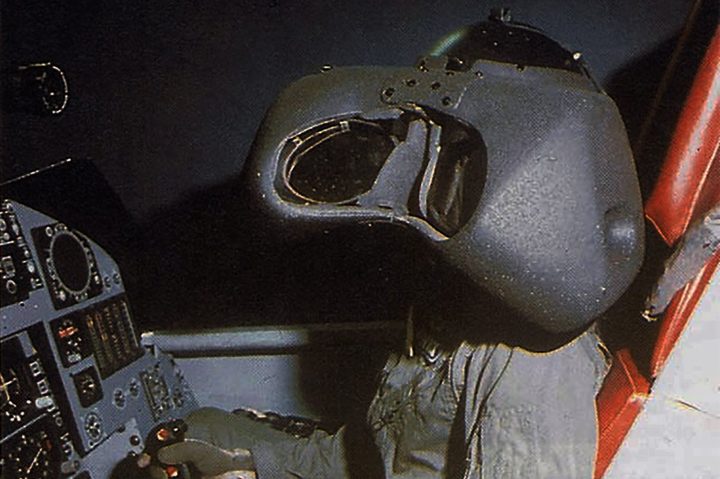
At around the same time that Ivan Sutherland was working on his “Sword of Damocles” project, a military engineer named Thomas Furness was busy developing an ambitious flight simulator project which eventually grows into something called the “Super Cockpit.”
Furness continued working on the project through the 1980s, with the result being a training cockpit able to project computer-generated 3D maps, infrared and radar imagery, as well as avionics data into a real-time 3D space. According to Furness, the project costs into the “hundreds of millions.” Way ahead of its time, the Super Cockpit allows a trainee pilot to control an aircraft using gestures, speech, and even eye movements.
The Aspen Movie Map (1978)
Developed by MIT in 1978, with a helping hand from DARPA, the Aspen Movie Map was basically a virtual reality take on Google Street View. Instead of the basic 3D graphics that could be created at the time, it used photographs taken from a car driving through Aspen, Colorado, giving the user an interactive first-person journey around the city.
Running it required several Laserdisc players, a computer, and a touch screen display. While there was no HMD component to the project, the Aspen Movie Map’s innovative use of first-person interactivity nevertheless represented a smart examination of how VR could be used to transport people to other places.
Making a name for itself (19??)

In the 1970s, computer artist Myron Krueger coined the term “artificial reality,” while most people consider the popularization of the term VR as we now know it to be due to computer scientist and artist Jaron Lanier in the 1980s.
Sega VR (1991)
One of the first companies to attempt to launch a VR headset was Sega, which planned Sega VR as an accessory for the Genesis. With development starting in 1991 and continuing for a couple years after, Sega VR was an attempt to squeeze more life out of the company’s 16-bit games console. The visor-like look owes a lot to RoboCop and The Day The Earth Stood Still, with a sleek black plastic design that concealed LCD displays, stereo headphones, and internal “inertial sensors” for tracking head movement.
“Sega VR will create the impression that you are exploring an alternate reality,” a press release stated. “As your eyes shift focus from one object to the next, the binocular parallax constantly changes to give you the impression of a three-dimensional world.” Unfortunately it was never released — with one (somewhat amusing) explanation being that Sega worried the virtual effect was too realistic, and people would wind up hurting themselves while immersed.
Despite this, Sega VR makes our list for being one of the first attempts at a mainstream consumer-facing virtual reality headset.
Enter Oculus (2010)
In 2010, 18-year-old entrepreneur Palmer Luckey created the first prototype of the Oculus Rift. Boasting a 90-degree field of view that hadn’t been seen previously in a consumer device, it raised $2.4 million on Kickstarter a couple years later, before the company was purchased by Facebook for $2 billion in 2014.
Luckey’s decision to sell the company before shipping any prototypes to Kickstarter backers stirred up controversy from early supporters.
Hitting the mainstream (2017)
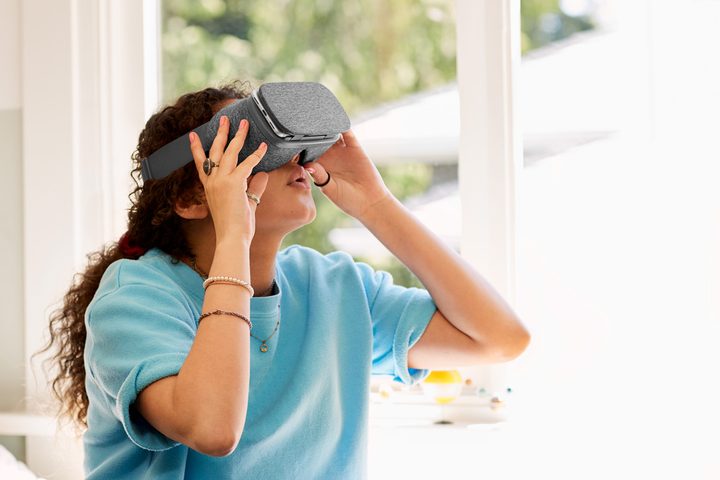
Here in 2017, hundreds of companies are working on their own VR headsets. These include market leaders such as HTC (makers of the HTC Vive), but also Google (with its enormously popular Google Cardboard), Apple, Amazon, Sony, Samsung, and others.
With plenty of marketplace competition, the addition of various innovative controllers for allowing interaction with the virtual world, and a wide range of intriguing use-cases for the technology, it seems that virtual reality’s time may finally have come at last.