  1. Home
  2. Emerging Tech
  3. News

Tiny drone uses A.I. to learn from nature’s best pilot, the hummingbird

Add as a preferred source on Google
Hummingbird Robots: Naturally Intriguing

One of nature’s most remarkable creations is the hummingbird, which flaps its wings up to 80 times per second and which can hover in place and fly in any direction. Now scientists have used machine learning algorithms to study the way these birds fly in order to replicate their abilities in drones.

Recommended Videos

The robot, developed by researchers at Purdue University, has artificial intelligence (A.I.) which learns from hummingbird simulations and applies its findings to the movements of its flexible flapping wings.

This is useful because of limitations on how small a drone can be made. When drones are shrunk to very small sizes, they cannot generate enough lift to move their weight. But hummingbirds move with a high angle of attack, meaning they move steeply through the air, and high lift, allowing them to use an unstable form of aerodynamics to stay aloft.

Copying the flight abilities of hummingbirds is a challenge scientists have been working on for many years. The latest research involved the researchers spending multiple summers observing hummingbirds in their natural habitats and translating their movements to computer algorithms. The robot could then learn from these algorithms and work out the most effective ways to use its wings.
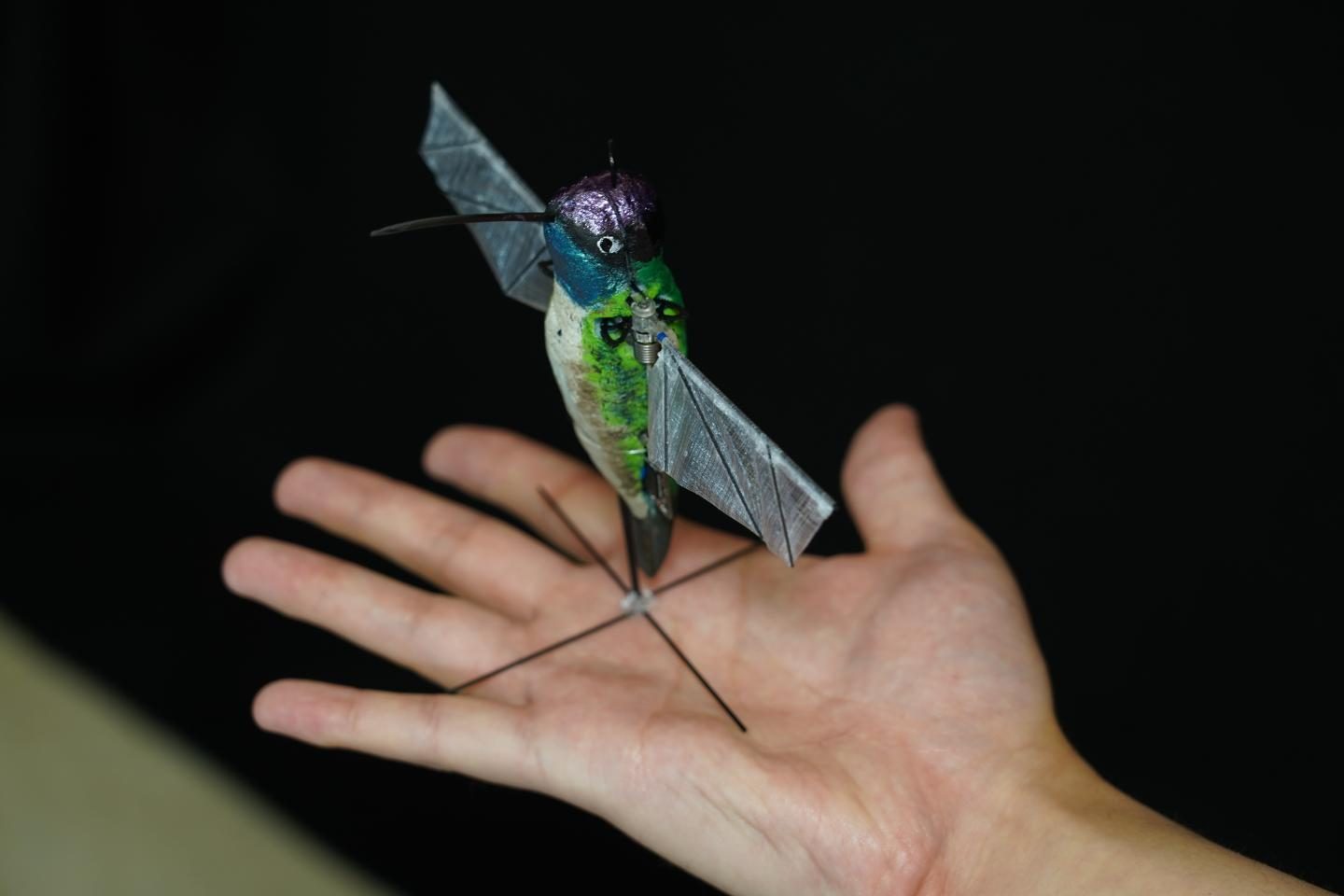
Purdue University researchers are building robotic hummingbirds that learn from computer simulations how to fly like a real hummingbird does. The robot is encased in a decorative shell. Purdue University photo/Jared Pike

The robot is made from carbon fiber and membranes which are cut with lasers, and its body is 3D-printed. This means the hummingbird robot weighs only 12 grams (less than half an ounce), and the researchers also created an insect-sized robot which weighed just 1 gram.

The small size and quiet operation of the robot makes it well suited for covert operations as well as search and rescue operations. It could even be used to study real hummingbirds up close in their natural environment.

As well as learning how to move efficiently, the robot also senses its environments by touching surfaces. It does not have visual sensors, but it uses changes in electrical current to track its movements around objects.

“The robot can essentially create a map without seeing its surroundings,” Xinyan Deng, an associate professor of mechanical engineering at Purdue University, explained in a statement. “This could be helpful in a situation when the robot might be searching for victims in a dark place — and it means one less sensor to add when we do give the robot the ability to see.”

A paper describing the robot is available to view on pre-publication archive arXiv and open-source simulations of the flapping wings are available on GitHub.

Georgina Torbet
Georgina has been the space writer at Digital Trends space writer for six years, covering human space exploration, planetary…
Checking body medication levels may now be as easy as sucking on a peach-flavoured lollipop
Forget the clinic swab; this lollipop wants a lick
Lollylab

Checking your body’s medication levels is usually no one’s idea of fun. Now researchers are trying to change that with Lollylab, a candy-coated, lollipop-like device that can collect saliva and measure levels of acetaminophen in under two minutes.

The prototype created by researchers whose work was published in ACS Sensors transforms a familiar object into a miniature testing device. In a pilot study, six adults ingested the peach-flavored Lollylab before and one hour after a standard 650-milligram dose of acetaminophen. The device repeatedly detected the pain reliever in their saliva, and participants reported it was more comfortable and easier to use than traditional saliva swabs.

Read more
A US state just approved an AI doctor. For now, it’ll only prescribe acne cures.
Aside from acne, Nolla's AI can also handle redness, fine lines and wrinkles, hyperpigmentation and dark spots, and under-eye bags.
Nolla Derm AI doctor app.

The first AI doctor is here. Despite all the skepticism and risks associated with AI models going haywire, the state of Utah just approved Nolla Health, a company that is providing an AI healthcare expert capable of writing prescriptions without any human in the chain. For now, it will only write acne prescriptions for Utah residents over 18 years of age, willing to pay a token monthly subscription fee that's lighter than your Spotify bill.

The big push here is that the Nolla Derm app will reduce the costs of medical consultation, save users the hassle of clinic visits, and take out the problem of waitlisting from the entire healthcare equation. “Unlike telehealth platforms that use AI only to collect information before handing patients off to clinicians, Nolla's AI system is designed to independently issue initial prescriptions within tightly defined, physician-approved treatment protocols,” writes the company. 

Read more
AI’s massive appetite could make cheap smartphones much harder to find
The smartphone aisle is getting pricier, and AI may be partly to blame.
Electronics, Mobile Phone, Phone

Buying a genuinely cheap smartphone could soon become a lot harder, and the reason has little to do with what’s happening inside the smartphone industry itself. The enormous amount of hardware being poured into AI data centers is pressuring global memory supplies. That has helped drive up the cost of making phones, and manufacturers appear increasingly reluctant to absorb those extra costs at the cheapest end of the market.

According to Counterpoint Research, prices of existing smartphones have increased by around 15% globally this year, while newly launched devices are roughly 25% more expensive than comparable models from last year. The impact hasn't been equal everywhere, either. Smartphone prices have climbed 21% in India and 19% across Asia-Pacific, compared with just 5% in the US.

Read more