  1. Home
  2. Emerging Tech
  3. Mobile
  4. Legacy Archives

You talkin’ to me? Software company designs mobile ads that talk back

Add as a preferred source on Google
talkingadsnuance
Image used with permission by copyright holder

Congratulations, world: You’ve successfully managed to avoid – or at least ignore – ads on your mobile device to a degree where advertising companies have to invent a new ways to bring some eyeballs back to the products they’re trying to sell. Of course, there’s a downside to this victory: In the future, you won’t just have to look elsewhere to avoid the ads of tomorrow – you’ll have to turn the sound off your device, as well.

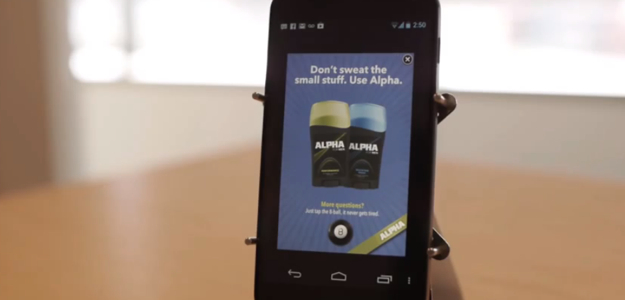
According to a report on AdWeek earlier this week, Nuance – a Burlington, MA software company – has come up with a novel new solution of how to convince potential customers to pay attention to their advertisements: Talk to them. And, yes, they mean that literally: They have created technology that will allow people to hold (admittedly limited) conversations with advertisements before the ads go in for the hard sell.

Recommended Videos

Discussing the need for this new approach, Nuance’s chief marketing officer Peter Mahoney said that, historically, “mobile advertising hasn’t worked well” because “engagement has been a challenge, and we think that’s where voice ads come in.” On the Nuance site, the company goes into more detail about its new idea. “Mobile devices are with us all the time, but there’s a specific time and place for rich media ad experiences,” the company explains. “Nuance Voice Ads solve that problem by changing the dynamic of the ad itself. Instead of trying to push information onto a limited screen, advertisers are now free to let the user pull information onto the screen using their voice.”

There’s even a proof of concept video to demonstrate how the voice ads would work. In the video, Nuance VP of advertising Mike McSherry has a conversation with a fake ad for a fake brand, Alpha deodorant, in which he asks a virtual eightball whether or not he should “buy that ring.” The conversation is short, and hardly complex – You get the idea that it’s so identikit that it would’ve had similar responses no matter what McSherry said. Still, there’s definitely an Siri-esque novelty appeal that most ads don’t have.

Telling potential advertisers that “it’s time to rethink engagement with consumers in the context of today’s technology,” Nuance points out with Mad Men Don Draper-style flair that “for decades, the industry has talked about listening to consumers, and giving brands a voice. With Nuance Voice Ads, these are no longer metaphors.” The question is, once the novelty of a talking ad wears off, are customers going to be so involved with this new format to make it worth the time and effort for companies to produce?

Graeme McMillan
Former Digital Trends Contributor
A transplant from the west coast of Scotland to the west coast of America, Graeme is a freelance writer with a taste for pop…
Home robots can already walk. The hard part is stopping them from crushing your glassware
1X’s NEO uses tactile sensing and force control to handle fragile objects, aiming at the kind of household work humanoids still struggle to do.
Baby, Person, Electronics

A robot can look convincing while walking across a stage and still be useless in a kitchen. Picking up a wet glass demands precision, quick corrections, and enough restraint to avoid squeezing too hard. 1X is tackling that problem with new tendon-driven hands for NEO, its humanoid home robot.

1X says each hand has 25 degrees of freedom, with 22 across the fingers and palm and another three in the wrist. Its joints can yield when pushed instead of staying rigid, giving NEO a better chance of handling household objects without treating every collision like a wrestling match.

Read more
This tiny gadget called Moodi could save your thumb during long reading sessions
This tiny remote thinks your finger deserves a vacation
DuRoBo Moodi

Digital reading has become more comfortable thanks to larger displays and e-paper screens, but one small annoyance remains: constantly reaching over to tap or swipe every page. DuRoBo believes it has a solution. The company has unveiled Moodi, its first Bluetooth page-turning remote, designed to make reading, browsing, and media control more comfortable across e-readers, tablets, and smartphones.

Unlike conventional page-turners that focus solely on e-books, Moodi doubles as a compact Bluetooth remote for scrolling through articles, controlling multimedia playback, and navigating long-form content. The device looks towards ergonomic accessories that aim to reduce repetitive hand movements during extended screen time.

Read more
Camera sensor breakthrough promises sharper images without hulking up your phone’s thickness
Camera sensors just got thinner. Your excuses for blurry photos didn't.
Representative Image

Researchers at Nagoya University have developed a new type of transparent optical sensor that could significantly reduce the size of camera sensors while improving image quality. Published in the journal ACS Nano, the study demonstrates how gallium-doped zinc oxide (GZO) nanosheets can detect red, green, and blue (RGB) light within a single pixel, potentially replacing the decades-old Bayer filter design used in nearly every digital camera today.

If commercialized, the technology could enable thinner smartphone cameras, higher-resolution medical imaging devices, and more compact sensors for automotive and aerospace applications, all while simplifying manufacturing.

Read more