 Anyone who has tried to get some shut-eye beside someone snoring like an elephant breaking wind every five seconds knows how it can totally ruin a night’s sleep.
In an attempt to put an end to your bedfellow’s rumblings, you may have administered a gentle nudge or swift kick, but the chances are it will only have resulted in temporary success, or possibly just an angry complaint.
In a worse case scenario, you may have been forced to retreat to another room, although the noise generated by some snorers can comfortably make its way down hallways and even through walls.
But don’t despair. Thanks to Japanese engineers, there may be another way. Dr. Kabe and his team from Tokyo’s Waseda University believe they have come up with a solution altogether more cuddly, more cute and less startling than a kick in the shin.
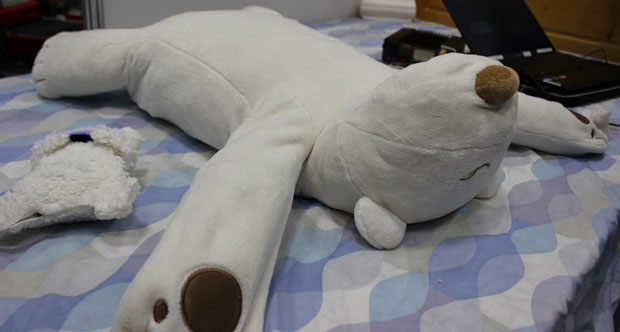
Say hello to Jukusuri-kun. Described by Japan Trends as “a robotic pillow-like device in the shape of a polar bear,” the furry creature is designed to prevent snoring and help those with sleep apnea syndrome.
As most snorers engage in the act while sleeping on their back, the idea is that when the rasping noises begin, the robotic bear will respond by gently stroking the perpetrator’s face. In theory, this should cause the snorer to turn onto their side, thereby stopping the noise. However, it’s also not too hard to imagine the stroking resulting in the bear being thrown across the room in a bleary-eyed hissy fit.
In order for the bear to work effectively, the snorer is also supposed to wear a furry pulse-oxygen meter on their hand while they sleep. According to research, the blood oxygen level drops in serious snorers. When this happens, the sensor will send a signal to the robotic bear, causing its hand to perform its hopefully helpful deed.
To further enhance the bear’s snore-detection capabilities, thereby reducing the chances of it performing a random stroke in the small hours, it has been fitted with a microphone designed to recognize the sound of a snore.
Jukusuri-kun isn’t available in stores yet, although if your partner is a snorer you could try following the bear’s example and stroke their face in the hope that it will get you a decent night’s sleep. Don’t expect miracles though.
Editors' Recommendations
- Meet the Xenobots: Living, biological machines that could revolutionize robotics
- Stanford’s shape-shifting ‘balloon animal’ robot could one day explore space
- This Google robot taught itself to walk, with no help whatsoever, in two hours
- Meet the robot helping doctors treat coronavirus patients
- Ballie is a rolling robot from Samsung that can help around the smart home