1. Home
  2. Emerging Tech
  3. News

KickStick is a skateboarding wizard staff that works like a motorized oar

Add as a preferred source on Google

Want to take to the sidewalk on your skateboard, powering yourself forward at hitherto unimaginable speeds by way of a motorized stick that makes you resemble the world’s most futuristic gondolier? Okay, so this incredibly specific fantasy doesn’t leave you with too many competing options — but it’s a market niche more than catered to by Rise Robotics’ new KickStick.

In short, the KickStick is basically a motor at the end of a stick — or to be more precise, a 3 horsepower, direct drive, in-hub brushless motor at the end of a staff. Used a bit like an oar, the stick features a motorized wheel on the end and a pressure-based throttle capable of pushing your skateboard up to 30 mph.

Recommended Videos

The best part? It’ll soon be available to the general public.
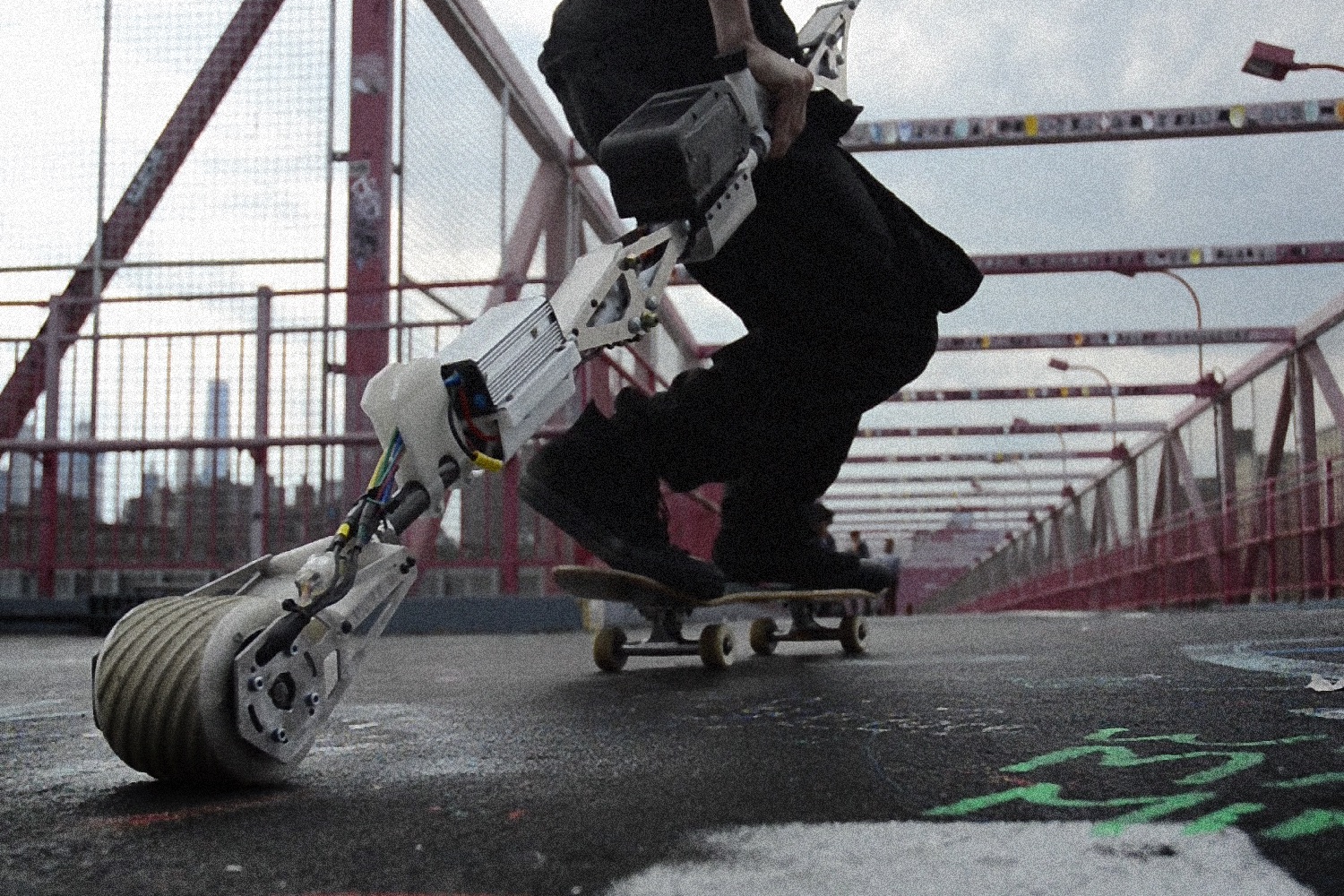
“The backstory behind KickStick was when Blake Sessions, our inventor here at Rise Robotics, was measuring the torque of a brushless motor by clamping it to a long rod he had laying around,” Kyle Dell’Aquila, industrial designer at Rise Robotics, told Digital Trends. “It turned into a joke about wizard staffs, and next thing we knew, we were playing on the street, catching eyes. This joke wouldn’t have been possible without the usage of 3D printers where we can build, race, and destroy as frequently as possible. We see the future Speed Racers of the world using 3D printers to race, just like how we are right now.”

Although Dell’Aquila acknowledges that the KickStick wasn’t designed with total seriousness in mind (perish the thought!), it’s certainly a pretty memorable hardware hack. “It is hard to exactly pinpoint the enigma of the KickStick as we use it on the street, but I imagine that it conjures up memories of science fiction with all the visible wires, hoses. and components, dangerous shredding with the guitar-like posture. and witchcraft with its staff-like nobility,” he said.

As to getting your hands on one, you can sign up to Rise Robotics’ Indiegogo prelaunch page here. Now if you’ll excuse us: it’s time to go dust off our skateboard in preparation!


Luke Dormehl
I'm a UK-based tech writer covering Cool Tech at Digital Trends. I've also written for Fast Company, Wired, the Guardian…
Students who use AI every day may be falling behind, while moderate users pull ahead
New global testing data suggests more AI in the classroom isn't automatically better.
Logo, Text

I assumed more AI access might help students learn faster. However, a new OECD study dispels that misconception for me and everyone else who gave their children a paid version of AI chatbots, thinking it would help them through their educational journey. 

According to PISA 2025 data from 760,000 students in 91 countries, students who use AI daily score meaningfully worse on standardized tests than their peers. The full picture is more complicated than a simple ban would fix.

Read more
XPENG just put its humanoid robot on the production line, and it walked itself out
IRON clocks in for its first shift
XPENG Iron

XPENG’s humanoid robot has officially joined the workforce, and it even got an employee badge. The Chinese automaker announced on September 8 that its next-generation IRON had completed assembly and autonomously walked off its newly commissioned humanoid robot production line in Guangzhou.

CEO He Xiaopeng then pinned a staff badge onto the robot, symbolically welcoming it to the XPENG team. It is a charming little ceremony for a machine that the company hopes will eventually become a regular part of everyday life. XPENG is moving IRON beyond R&D prototypes toward production-line manufacturing, applying the quality-control systems and manufacturing experience it has developed through its electric vehicle business.

Read more
An AI-designed drug might help slow aging, but we’re not there yet
The results hint at a possible anti-aging effect, but there’s still a long way to go before we know what it means.
medical test tubes

Rentosertib, a drug Insilico Medicine designed almost entirely using AI, was created to treat idiopathic pulmonary fibrosis, a disease that scars and stiffens the lungs over time. But fighting lung disease was only half the plan from the start.

According to a new study published in Nature Biotechnology, the drug's target was chosen specifically because it overlaps heavily with the biology of aging, and the whole trial was designed to test whether treating the lungs could also mean turning back the body's biological clock.

Read more