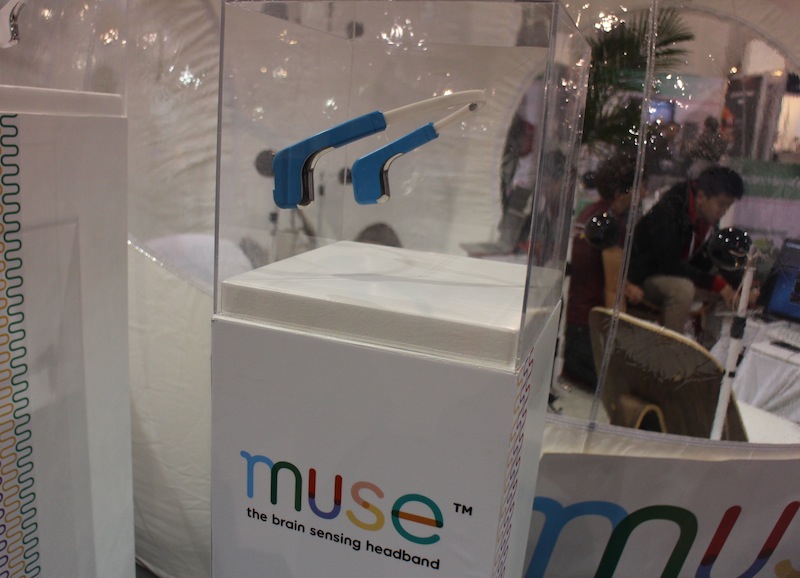
In the future, we’ll all be doing brain exercises that stem beyond your average Sudoku puzzles or memorization games. At this year’s CES, exhibitors want to get inside your head, and Muse brain-sensing headband aims to do just that while providing a place where you can measure concentration levels to train those membranes.
Unlike the simpler brain sensor headbands we’ve seen on the show floor this year, Muse’s gear features four EEG sensors and two ear conductors to get the most accurate read. The Bluetooth-transmitted data divides to two categories, Focus and Relaxation, and these levels are pretty self explanatory. When you’re sitting there and let your mind float to space, the blue relaxation percentage rises while the red focus level drops. Conversely, pay attention to what you’re looking at or who you’re talking to and the red lines jump up. We should also mention that the headband is extremely flexible and comfortable to wear, and after the first few seconds, you’ll barely even notice it’s there.
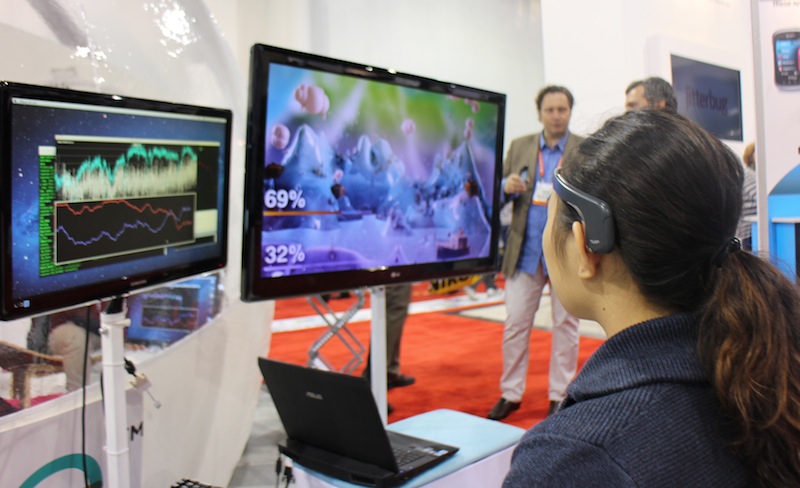 The sample game being demoed is a basic interface that required users to focus in order to move a moon over the sun to form an eclipse. For each successful attempt, you try to beat the pace from the last session to form patterns of how to relax and focus in a matter of seconds. Another game is audio-based; the more focused you are, the louder the music becomes. If you are relaxed, you”ll be treated with the calming sound of violin strings. The audio game seems significantly more difficult given how easily humans can get distracted by sound, and it’s certainly a novel take on how to help us learn to block white noise and cool down.
It’s a simple concept that aims to help people at home train their mental focus and help researchers learn more about how to diagnose and treat ADHD and stress-related patients. Theoretically, the more people learn to calm and concentrate their minds with frequent Muse exercises, the faster they are relived of anxiety, fear, and negative thoughts. Instead, users can become more productive, focused, and heighten their memory capacity. Because most of us can admit we’re perpetual procrastinators who easily forget what day of the week it is.
Muse originally began as an IndieGoGo project, and will complete its development this June, when the headband will be available for $200.