  1. Home
  2. Emerging Tech
  3. Legacy Archives

‘Mythbusters’ cannonball accidentally blasts through suburban home

Add as a preferred source on Google
mythbusters-cannonball
Image used with permission by copyright holder

Accidents happen, a lesson the crew of “Mythbusters” learned the hard way on Tuesday after one of their experiments resulted in a cannonball blasting clear through a house in Dublin, California, while the family was asleep inside.

The accidental wreckage didn’t stop there: After the cannonball smashed through the front door, bounced up the stairs, and exited through the wall of a bedroom where three members of the family were asleep, it bounced across a six-lane street, off the roof of another house, and went through the window of a minivan parked in a nearby driveway. This was at 4:15 in the afternoon, as kids were coming home from school. Amazingly, mercifully, no one was injured in the accident.

Recommended Videos

The cannonball was fired at the Alameda County Sheriff’s bomb range, and was supposed to go through a few water-filled barrels and then a concrete wall. Instead, it missed the barrels entirely, smashed through the concrete wall, bounced off the hillside in the back, and then flew 700 yards before finally going through the front door of the house.

The cannon has been used more than 50 times by the Mythbusters, without it careening through a suburban neighborhood.

“Crazy, crazy, crazy, crazy,” said Sgt. J.D. Nelson, a spokesman for the Alameda County Sheriff’s Department. “You wouldn’t think it was possible.” He added: “We had some tremendous bad luck and some tremendous good luck.”

Good luck, indeed. Jasbir Gill, the owner of the now-smashed minivan, said he was “in the van five minutes before this happened.” Gill said he simply wants his car fixed, and an apology from the show’s producers. Katherine Nelson, a publicist for Beyond Productions, which produces “Mythbusters” for Discovery Channel, said they are “currently assessing the situation and working with those whose property was affected.”

Watch a news report on the incident below:

Here, a map of the cannonball’s destructive path:
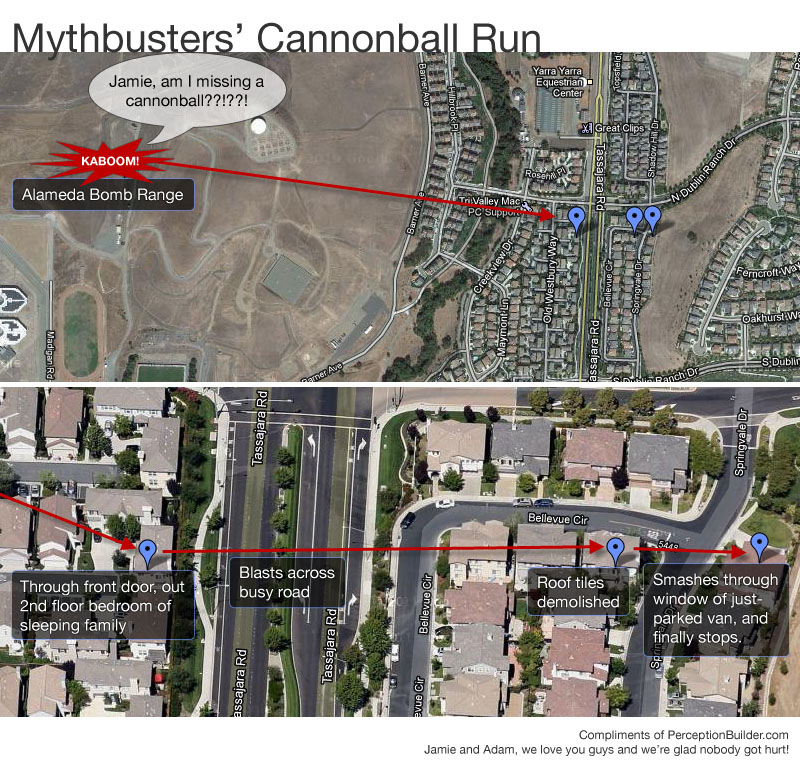
Mythbusters' Cannonball Run
Via: PerceptionBuilder.com

Andrew Couts
Features Editor for Digital Trends, Andrew Couts covers a wide swath of consumer technology topics, with particular focus on…
AI can’t tell if you’re gay or straight, but it thinks it knows what both look like
AI knows it shouldn't judge a face, but apparently, drawing one is a different story.
Emilia Clarke AI generated stock image. Gemini / Nano Banana is on the left

We've all been told not to judge a book by its cover, and you'd think AI would follow that rule, too. Ask an AI chatbot to guess someone's sexual orientation just by looking at their face, and it'll likely tell you that there's no reliable way to know. But what happens when you ask that same model to change someone's appearance to match a particular sexual orientation? Well, that's where things get uncomfortable.

A new study, accepted for presentation at the 2026 Conference on Empirical Methods in Natural Language Processing, found that AI models from OpenAI and Google can be inconsistent when handling sensitive personal characteristics. They might refuse to make assumptions about someone based on their appearance, but when asked to generate those same assumptions visually, the results tell a very different story.

Read more
A clinical study with Google’s special chatbot shows a strong future for AI in healthcare
Google’s medical AI could give doctors a useful second set of eyes
Google Articulate Medical Intelligence Explorer chatbot

AI is a useful tool for handling many tasks in private as well as professional settings, but medical advice, especially diagnosis, is one area where I generally draw the line. General-purpose chatbots tend to sound confident and convincing while giving medical advice, even when they are wrong, as studies have previously found.

That being said, Google's new research points to a much more convincing use for AI in healthcare. Its Articulate Medical Intelligence Explorer chatbot, or AMIE for short, could help prepare both sides before the appointment even begins.

Read more
Relaxation music had one job in this pain study, and favorite songs did it better
Patients who chose their music reported less pain after an IV insertion
Book, Publication, Indoors

Patients’ favorite songs helped ease pain after an IV insertion in a new study, while music specifically chosen for relaxation didn’t show a significant benefit. The soothing soundtrack could apparently use a second opinion.

Researchers at University Hospital Zürich studied 204 patients receiving an IV cannula before an MRI scan. Those listening to their chosen music reported less pain 30 seconds and two minutes after insertion. Across the full sample, the clearest relief came after the needle went in.

Read more