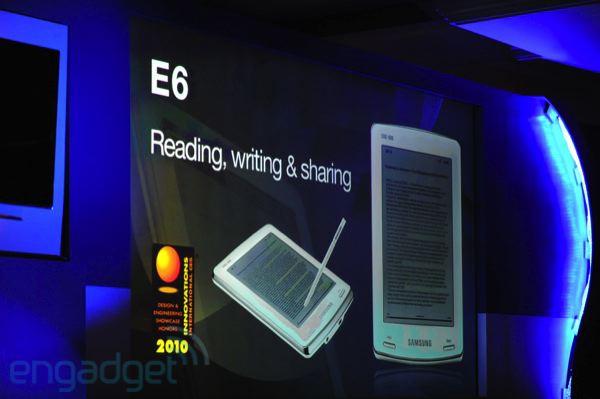
 Guess what America—you have more e-readers to choose from. Samsung Electronics America, Inc., unveiled its first e-book devices, with six-inch and ten-inch screen size offerings, at CES today. Samsung says it is raising the e-reader bar with these two new devices by upping the quality of writing capabilities for e-books, the E6 and E101. Samsung’s E6 and E101 allows users to write directly onto the display with a built-in electromagnetic resonance stylus pen so they can annotate their reading selections, calendars and to-do lists.
The E101 boasts a 10-inch screen, while the E6 features a more portable frame and a 6-inch screen. Samsung’s new e-books are not backlit, making the power consumption lower than that of other portable display devices. Samsung says, depending on the amount of daily use, you should only need four hours of charging to prepare the battery for up to two weeks of power.
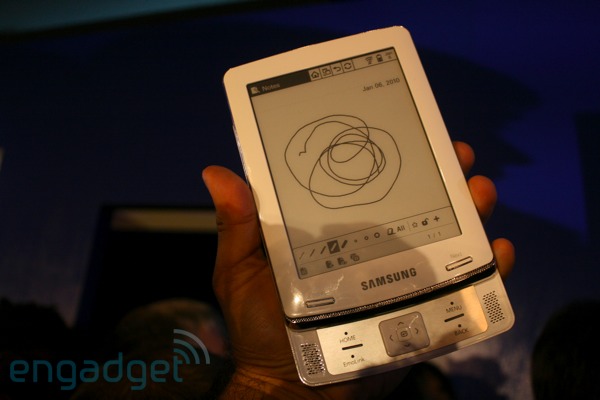 “We’ve used our expertise to create a high-quality e-book with today’s on-the-go consumer in mind,” said Young Bae, director of display marketing, Samsung Information Technology Division. “Samsung is addressing a common frustration that users experience with many of today’s digital readers with a stylus that allows them to annotate their favorite works or take notes. Coupled with wireless functionality that enables sharing of content, this is a truly multi-faceted device.”
Samsung says its e-books are also equipped with Wi-Fi and Bluetooth 2.0, allowing users to download content such as books and newspapers from a server wirelessly, as well as to share certain content with other devices. The Samsung E6 and E101 will be priced at $399 and $699, respectively. They will be available in early 2010.
[Images provided by Engadget]