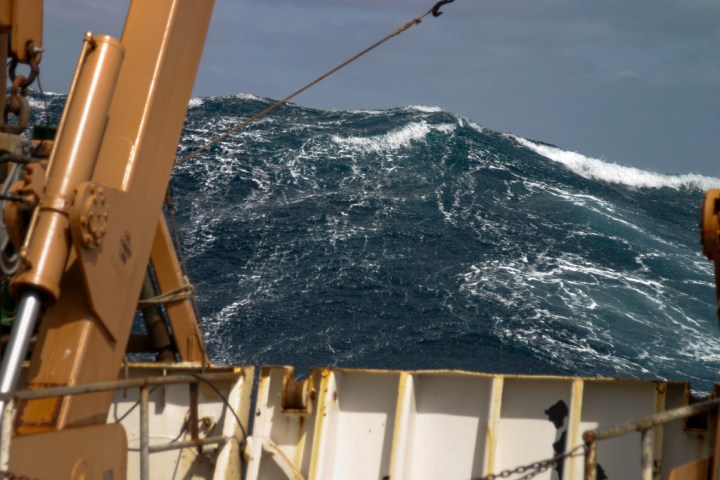
In fact, figuring out the math behind a particular type of freakish rogue wave, called the Draupner wave, is exactly what a team of scientists from the U.K., Australia, Belgium, and Italy has done in a new research project — which may just save lives one day.
“Forecasting rogue waves in the ocean is challenging and still an open mathematical and physical problem,” Dr. Davide Proment, a physicist from the U.K.’s University of East Anglia, who is a co-author on the paper, told Digital Trends. “There are some mathematical models that have let us make several improvements in the last few decades, but a full understanding of the mechanisms leading to rogue waves formation is still missing.”
Fortunately, they are here to help. Not only have they worked out the physics behind the problem in a way that could help us predict said waves, they have shown that they can be re-created in a laboratory wave machine.
Creating scaled-down waves in a wave machine isn’t new (heck, you probably did it in the bath as a kid!), but what is unique about this research is that the waves were able to be re-created in an annular tank using circular wind patterns. This is different to the mechanical paddles that are normally used to re-create waves in this setting. Such wind conditions are thankfully rare in the real world but do exist in places like Antarctica.
“To generate the waves we blew a constant wind and studied the growth and evolution of the waves during a two-hour time period,” Proment continued. “This type of measurement would be impossible in normal flume facilities. We measured the wave spectrum and studied its evolution over time. We also studied the probability of occurrence of waves higher than a certain value to understand how rogue waves, particularly high and steep compared to average waves, are likely to occur.”
It’s still early in the research process, but similar findings could one day allow us to take precautionary measures by predicting when such giant rogue may strike.
As for using the calculations to create a weaponized wave creator? You need some giant windmakers but we guess it’s theoretically possible. Which puts us firmly back in Roland Emmerich land.
Editors' Recommendations
- Earth’s oceans are full of old flip-flops. Scientists have a plan to fix that
- Is Planet Nine a miniature black hole? Scientists have a way to find out
- Scientists figure out why Venus’ atmosphere rotates 60x faster than the planet
- Scientists may have figured out how to make future beer even greater
- Jasco is behind a new line of GE Z-Wave smart home products