  1. Home
  2. Emerging Tech
  3. Health & Fitness
  4. Legacy Archives

Man versus machine: Table tennis champ to take on Ping-Pong-playing robot

Add as a preferred source on Google

Agilus the robot has balls – albeit of the Ping-Pong variety – as next month it’ll go up against German table tennis pro Timo Boll in a potentially dramatic man-against-machine sports-based face-off.

Built by German robot specialists Kuka Robotics – a firm which you may be surprised to learn has not been acquired by Google (though one can well imagine the Mountain View company buying its creation and sticking it in its Googleplex game room some time soon) – Ping-Pong-playing Agilus will battle against Boll on March 11 at a special event celebrating the opening of a new Kuka production plant in Shanghai.

Recommended Videos

According to the company’s website, Ping-Pong pro Boll is one of the world’s top players with several international trophies to his name. The left-hander is known as one of the game’s cleverest tacticians, though whether his talent is enough to outwit his robotic opponent remains to be seen.
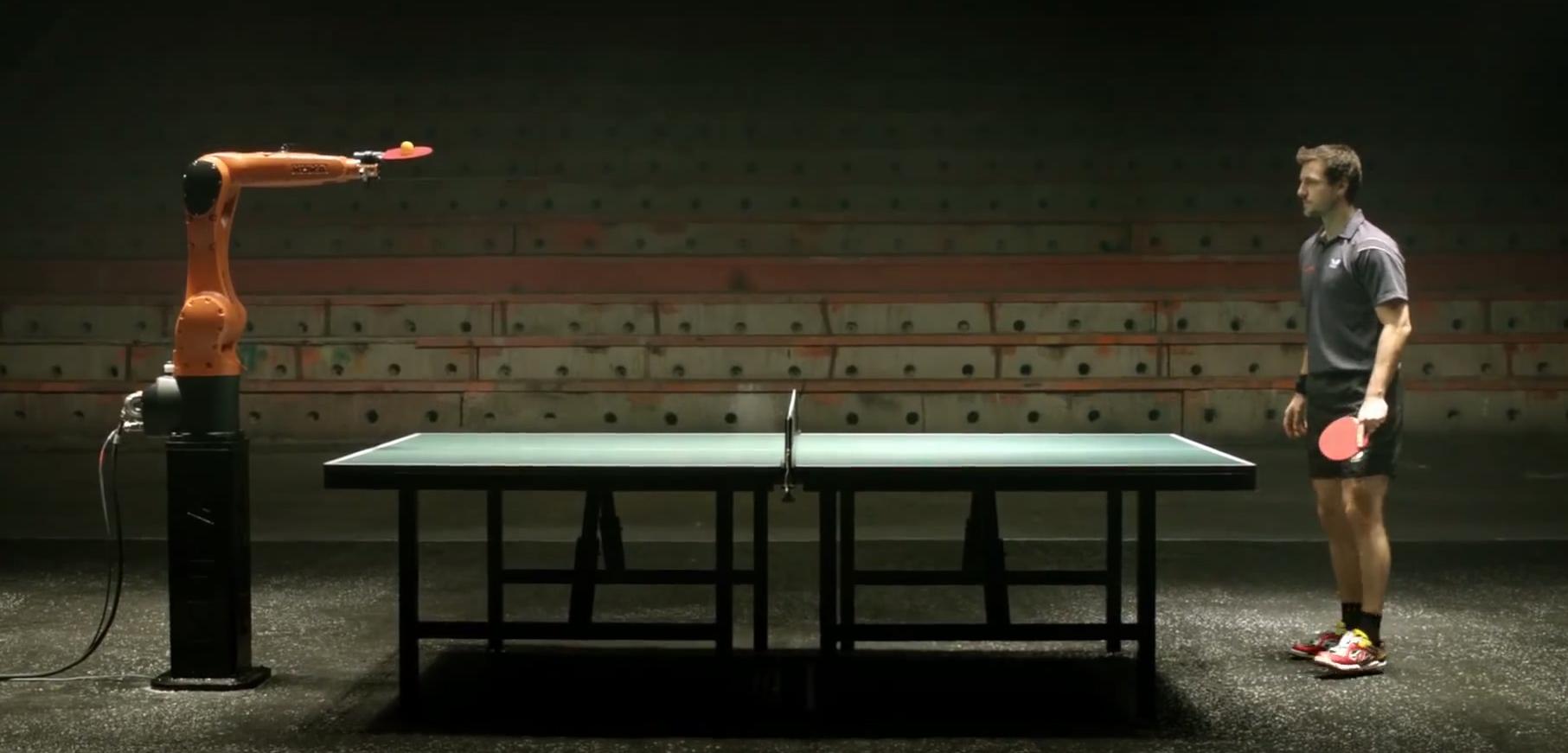
robot ping pong
Image used with permission by copyright holder

As for Agilus, we currently know nothing of its skill as a table tennis player as it’s usually hard at work in a factory, with little time for frivolous leisure activities involving bats and balls. It is, however, touted as “the fastest robot in the world,” suggesting Boll will have to be at the top of his game in order to secure victory over Agilus and to ensure other robots stop getting any highfalutin ideas about taking over the world.

To score a win, Bol may be tempted to play nothing but short, wide shots with massive backspin, with Agilus’s limited reach from a fixed base a definite shortcoming. As for Agilus, if it can just keep getting the ball back, the German player may become exhausted, disillusioned, or simply bored into making mistakes, handing a historic win to the robot community.

So who do you think’ll come out on top in this intriguing contest? The all-human all-parts-his-own Boll or the brainless bot with a bat?

Place your bets now.

Trevor Mogg
Contributing Editor
Not so many moons ago, Trevor moved from one tea-loving island nation that drives on the left (Britain) to another (Japan)…
Your next phone could get a smaller camera with sharper photos
Camera sensors just got thinner. Your excuses for blurry photos didn't.
Representative Image

Researchers at Nagoya University have developed a new type of transparent optical sensor that could significantly reduce the size of camera sensors while improving image quality. Published in the journal ACS Nano, the study demonstrates how gallium-doped zinc oxide (GZO) nanosheets can detect red, green, and blue (RGB) light within a single pixel, potentially replacing the decades-old Bayer filter design used in nearly every digital camera today.

If commercialized, the technology could enable thinner smartphone cameras, higher-resolution medical imaging devices, and more compact sensors for automotive and aerospace applications, all while simplifying manufacturing.

Read more
This new chip stacking technique could be the key to unlocking faster AI performance
Researchers solved the fragile chip stacking problem holding AI memory back, and the results are significant.
ai-chip-image

Every time you use ChatGPT or generate an image with AI, there is a memory chip working at extreme speed behind the scenes. However, that chip has a memory bottleneck problem, and a Korean research team may have just solved it.

Researchers at POSTECH (Pohang University of Science and Technology) developed a new way to stack more than 10 ultrathin semiconductor chips on top of each other, achieving a memory density roughly four times higher than the best commercial chips available today (via TechXplore).

Read more
ChatGPT can now finish what you started, and that’s a much bigger deal than it sounds
Man using ChatGPT on a laptop

Just a few minutes after unveiling its new GPT-5.6 family — Sol, Terra, and Luna — OpenAI is back with another announcement. This time, it's introducing ChatGPT Work, a new AI agent designed to do more than answer questions. Instead of helping with one task at a time, it can take on entire projects that span multiple apps, documents, and services.

If you've ever spent an afternoon jumping between different apps just to finish a single assignment, ChatGPT Work is trying to eliminate that back-and-forth. The idea is to describe the end goal and figure out the steps in between.

Read more