
  1. Home
  2. Emerging Tech
  3. Legacy Archives

Terminator-style vision gets closer with new ‘smart’ contact lenses

terminator-lens
Image used with permission by copyright holder

Scientists have successfully passed a government test of contact lenses that contain an electronic display on their surface, reports New Scientist. The test, which was conducted using rabbits, is the first step in the process of delivering Terminator-like augmented-reality to the masses.

“We have demonstrated the operation of a contact lens display powered by a remote radio-frequency transmitter in free space and on a live rabbit,” says the team of researchers, led by Babak Praviz of the University of Washington in Seattle. “This verifies that antennas, radio chips, control circuitry, and micrometer-scale light sources can be integrated into a contact lens and operated on live eyes.”
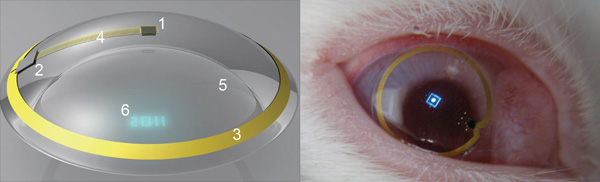
Rabbit's-eye
Image used with permission by copyright holder

For now, the contact lenses only contain a single pixel. But bio-engineers hope to expand the resolution of the displays, which will one day make it possible to view an array of information, from GPS navigation data to text messages and even video content, directly on a contact lens. The initial application, however, will likely be less for entertainment, and more for medical purposes, like the monitoring of health data for people who suffer from glaucoma and diabetes.

Recommended Videos

The lenses work like this: Information is transmitted from a radio source, which must be placed within two centimeters from the eye to avoid disruption of the signal caused by bodily fluids. The lens contains a 5-millimeter-long antenna capable of receiving the information from the radio transmitter. An LED pixel shows the data from the radio transmitter to the eye.

Despite the incredibly small number of pixels, the researchers say the lenses already have usable applications.

“A display with a single controllable pixel could be used in gaming, training, or giving warnings to the hearing impaired,” the researchers say.

During the 40-minute test, the display continued to perform well. And the lenses caused no injury to the rabbits.

Andrew Couts
Features Editor for Digital Trends, Andrew Couts covers a wide swath of consumer technology topics, with particular focus on…
Uber wants to drive you straight into ski season, literally
Book a ride, pack your gear, and let someone else brave the mountain roads.
Uber Ski Featured of 2 people skiing snow

What’s happened? As the winter season approaches, Uber has launched a dedicated service called Uber Ski aimed at simplifying transport to mountain resorts for skiers and snowboarders. The offering lets users reserve larger vehicles in advance, and even purchase lift-pass bundles via a partnership with Epic Pass operator Vail Resorts. Compared to the European Uber Ski rollout earlier this year, which focused mainly on gear-friendly transport between airports, train stations, and nearby slopes, the North American launch goes further. It bundles rides with lift-pass purchases, making it a full ski-trip package built for U.S. and Canadian resorts.

The vehicle options include Uber XL (fits two passengers with gear) and Uber XXL (fits four with equipment), and can be reserved up to 90 days in advance.

Read more
Grab This Professional Ionic Hair Dryer for Only $24.99
A salon style blowout at home for under $25.
NEXPURE 1800W Professional Ionic Blow Dryer

This post is brought to you in paid partnership with NEXPURE.

A good hair dryer should be fast, lightweight, and gentle enough not to fry your hair. The NEXPURE 1800W Professional Ionic Hair Dryer checks all those boxes. Right now, it is heavily discounted down to $24.99, a big drop from its usual $88.99 list price, which makes it one of the better value-focused hair tools you can pick up today.

Read more
ChatGPT finally fixes the em-dash habit, because punctuation matters
A small tweak that might make a big difference in how human your AI writing appears.
Chatbot on a smartphone.

What’s happened? One of the biggest problems with ChatGPT has now been fixed. Sam Altman announced via a X post that ChatGPT will now comply when users explicitly instruct it not to use em-dashes in the custom instructions tab. By adding a rule to the custom instructions to avoid using em-dashes, one can finally get ChatGPT to stop using them.

The update addresses a long-running complaint that ChatGPT’s heavy reliance on the em-dash made its output look "bot-written."

Read more