  1. Home
  2. Emerging Tech
  3. Social Media
  4. Web
  5. News

Travel vloggers detained in Iran for flying a drone without permission

Add as a preferred source on Google

Flying a drone without permission can get you into a lot of trouble these days, though the punishment varies from country to country.

You might get away with a stern word and a slapped wrist, but in a worst-case scenario, you could end up in the slammer.

Recommended Videos

Case in point: Two Aussie vloggers traveling from their homeland to the U.K. in a Toyota Landcruiser camper had their trip cut short when they were detained in Iran for apparently flying their drone there without a permit.

The arrest of Jolie King, who also holds a British passport, and Mark Firkin happened two months ago, though their ongoing detention has only come to light in the last few days.
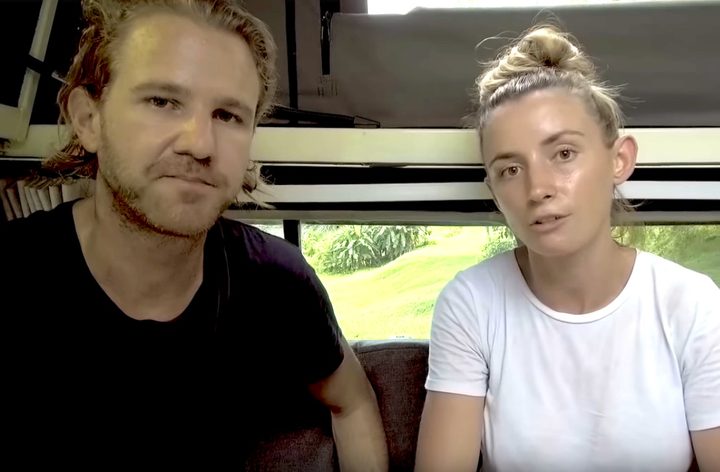
Vloggers Mark Firkin and Jolie King. The Way Overland

The couple quit their jobs in 2017 to begin their globe-trotting adventure, which they were documenting on their YouTube channel, The Way Overland. Their videos are peppered with drone footage taken in locations such as Bali, Java, Malaysia, Cambodia, India, and Pakistan.

On their Patreon page, the couple said they had decided to embark on “a life-changing adventure escaping from the daily 9-to-5 corporate grind, selling and packing up our lives to travel the world. We left Perth in July 2017 and will travel overland from Australia to the U.K. documenting our experiences through videos and photos. We hope to inspire others to pursue their dreams and perhaps wander down the road less traveled!”

But the trip of a lifetime came to an abrupt halt in Iran a couple of months ago when the pair were arrested for flying a drone near Tehran without permission, according to Pouria Zeraati, editor at the Persian-language broadcaster Manoto TV.

“The family says this was a misunderstanding and Jolie King and her fiancé Mark Firkin were unaware of the Iranian law which bans drone flights without a license,” Zeraati said in comments reported by the Guardian.

While the Iranian government is yet to publicly confirm the couple’s detention, the Australian government is reportedly already negotiating for the release of its nationals, though so far to no avail. Some reports suggest the Iranians could release the pair as part of a prisoner swap, though any such move is yet to be confirmed. The couple’s plight may be further complicated by increased tensions in recent months between Iran and the West.

Reactions on social media to the couple’s arrest have been mixed. Some have expressed hope for King and Firkin’s swift and safe release, while others have criticized them for flouting local laws in a country well-known for its strict penal code.

In a similar case earlier this year where a foreign national ended up in prison for flying a drone without permission, French tourist Arthur Desclaux was jailed in Myanmar for a month.

Trevor Mogg
Contributing Editor
Not so many moons ago, Trevor moved from one tea-loving island nation that drives on the left (Britain) to another (Japan)…
Your holiday photos could help scammers figure out exactly where you are
AI can extract surprisingly precise location clues from innocent-looking Instagram and Facebook posts, making phishing scams much more convincing.
Photo on a holiday during sunset

That innocent holiday snap might be doing more than showing everyone how good the weather is. A new scam highlighted by The Guardian shows how criminals can use AI to analyse photos posted on Instagram and Facebook, work out where they were taken, and then use that information to make phishing messages look frighteningly legitimate.

The trick is surprisingly simple. Imagine posting a few family photos from Porto without mentioning the city anywhere. A few days later, a text arrives claiming that your bank detected unusual card activity while you were travelling in Porto and asking you to verify your details through a link. Because the message contains a detail that only someone who knows about the trip should know, it suddenly feels much more convincing. Except the scammer may never have known about the trip at all. The photo told them.

Read more
Meta and Google just got beaten by an AI giant you might not expect
Alibaba's Qwen AI model running on an Android phone.

The AI race usually revolves around familiar names like OpenAI, Google, Meta, and Anthropic. But when it comes to models developers can actually download and build upon, another company has raced to the front — and by quite some distance. Alibaba says its Qwen family of open-weight AI models has crossed 3 billion downloads globally over the past six months. That puts Qwen ahead of some of the biggest names in AI, including models from Meta and Google.

The difference is especially striking in Hugging Face data for 2026. Google’s open models have recorded around 418 million downloads, while Meta sits at roughly 227 million, according to Hugging Face’s latest State of Open Models report. Qwen, meanwhile, is becoming much more than one popular model. Alibaba has released more than 460 Qwen models, and developers have created over 300,000 derivative models from them.

Read more
Meta promised to stop creepy AI glasses videos, but they’re still all over Instagram
Instagram app

Smart glasses can be genuinely useful, whether you’re taking a hands-free photo, listening to music, or asking an AI assistant about whatever is in front of you. Unfortunately, putting a camera on someone’s face also opens the door to some much less pleasant uses. That’s becoming a problem for Meta.

Instagram head Adam Mosseri said in July that the platform was working to remove videos in which people use Meta glasses to film and harass others secretly. However, a new Business Insider investigation suggests the cleanup isn’t going quite as smoothly as Meta might have hoped. The publication found dozens of pickup and prank videos still available on Instagram weeks after Mosseri’s comments. Some came from popular or verified creators, and several showed women being approached and recorded in public through Meta glasses.

Read more