Imagine for a moment what it’d be like if we resurrected gladiator fights in the modern day.
Not that American Gladiator, bodybuilders-shooting-tennis-balls-at-substitute-gym-teachers nonsense either. I’m talking proper Roman gladiator fights. Full contact, no-holds-barred, Russel-Crowe-style deathmatches broadcast on national TV.
Fat chance, right? The world we live in is much more civilized than the one the Romans inhabited, and that kind of brutality just isn’t considered a valid form of entertainment anymore. Nobody would stand for it.
“Our objective is to promote a new global combat sport, with weapons.”
In a nutshell, that’s exactly what Australian startup Unified Weapons Master wants to do. The company’s founders are on a mission to bring back weapons-based fighting, and have spent the last few years developing a way for weapons-based martial artists to fight without eviscerating each other in the process.
“For us it’s about honoring, preserving, and reigniting interest in weapons-based martial arts — arts that have sort of slowly drifted off of people’s radar since the invention of gunpowder and projectile weapons,” explains UWM co-founder and CEO David Pysden. “Since then, there’s been no forum in which to see weapons-based martial arts practiced, and we want to change that.”
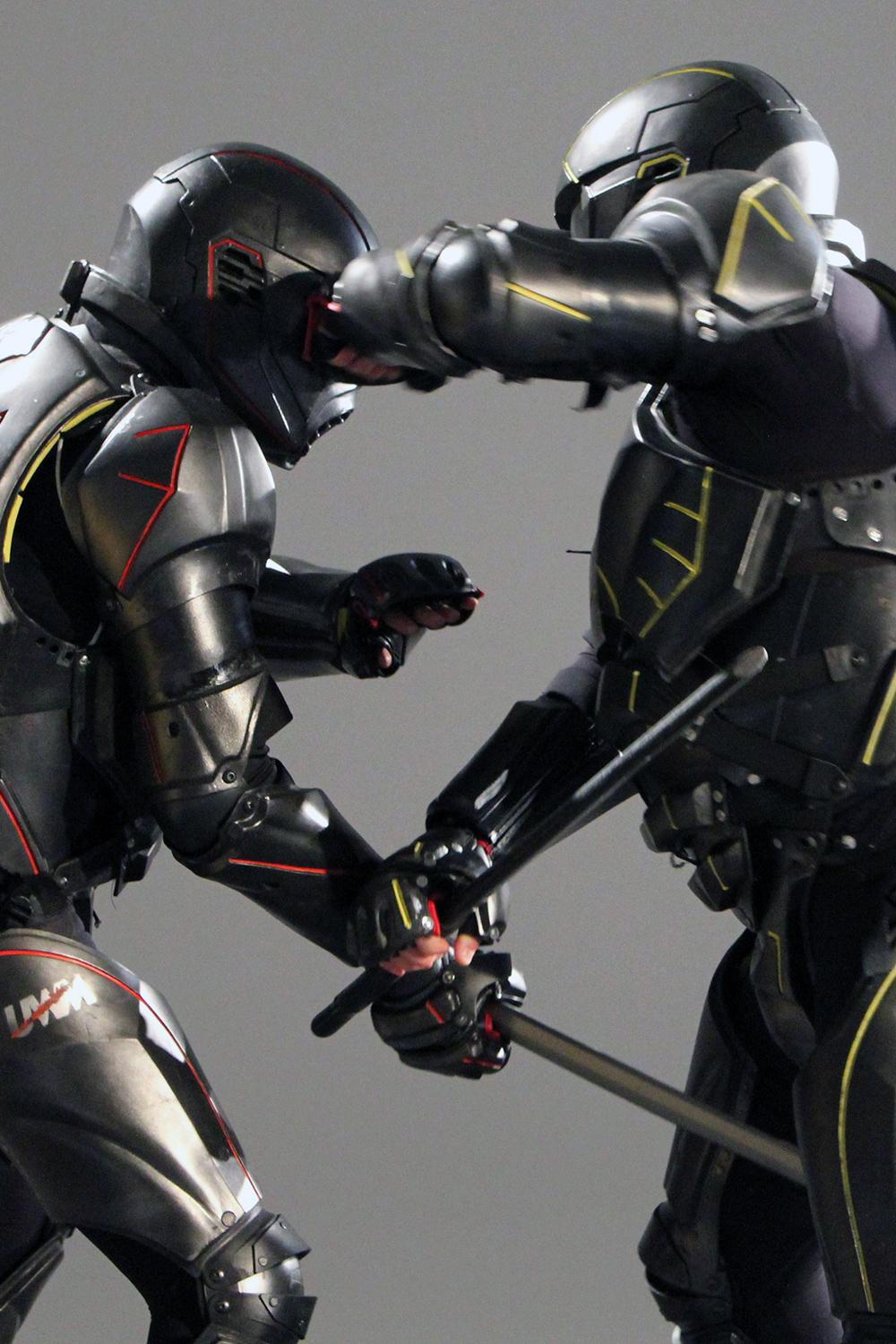 “Our objective,” he says, “is to promote a new global combat sport with weapons. So the unified in Unified Weapons Master is about bringing all the different weapons arts from all around the world together in a single competition. There’s roughly 300 distinct martial arts practiced around the world, and of those styles, 96 of them are either entirely weapons-based, or have a significant amount of weapons-based training in their curriculum. What we want to do is bring all of those styles together in a competition, much like UFC did with mixed martial arts.”
The only problem is that, barring all-out death matches, there’s really no way for weapons based martial artists to really test their skills. When you’re practicing with, say, a battle axe or a katana, you can’t actually follow through on the last shot because there’s a pretty good chance you’ll murder your opponent.
So how exactly do you facilitate a weapons fight without actually killing anybody? In a word: technology.
The suit
To make all of this possible and enable this sort of next-gen gladiator fighting, UWM’s founders have spent the past two years engineering a special suit called the Lorica — a name which literally translates to “body armor” in Latin. But don’t let the name fool you; this thing is much more than a series of hard plates designed for protection. The suit does do that, of course, but protection is just one part of the equation.
“The armor itself is made out of a sort of sandwich of high-performance materials.” Pysden tells us. “On the outside there’s some impact- and penetrative-resistant materials such as carbon fiber, and beneath that there’s a bunch of polycarbonate material and elastomeric foam, which is impact absorbent.”
If you check out some of the demo videos the company has put together, you can see for yourself what Pysden is talking about when he says “impact absorbent.” There’s footage of a guy getting repeatedly beaten over the head with a staff, and it doesn’t seem to faze him even the slightest bit.
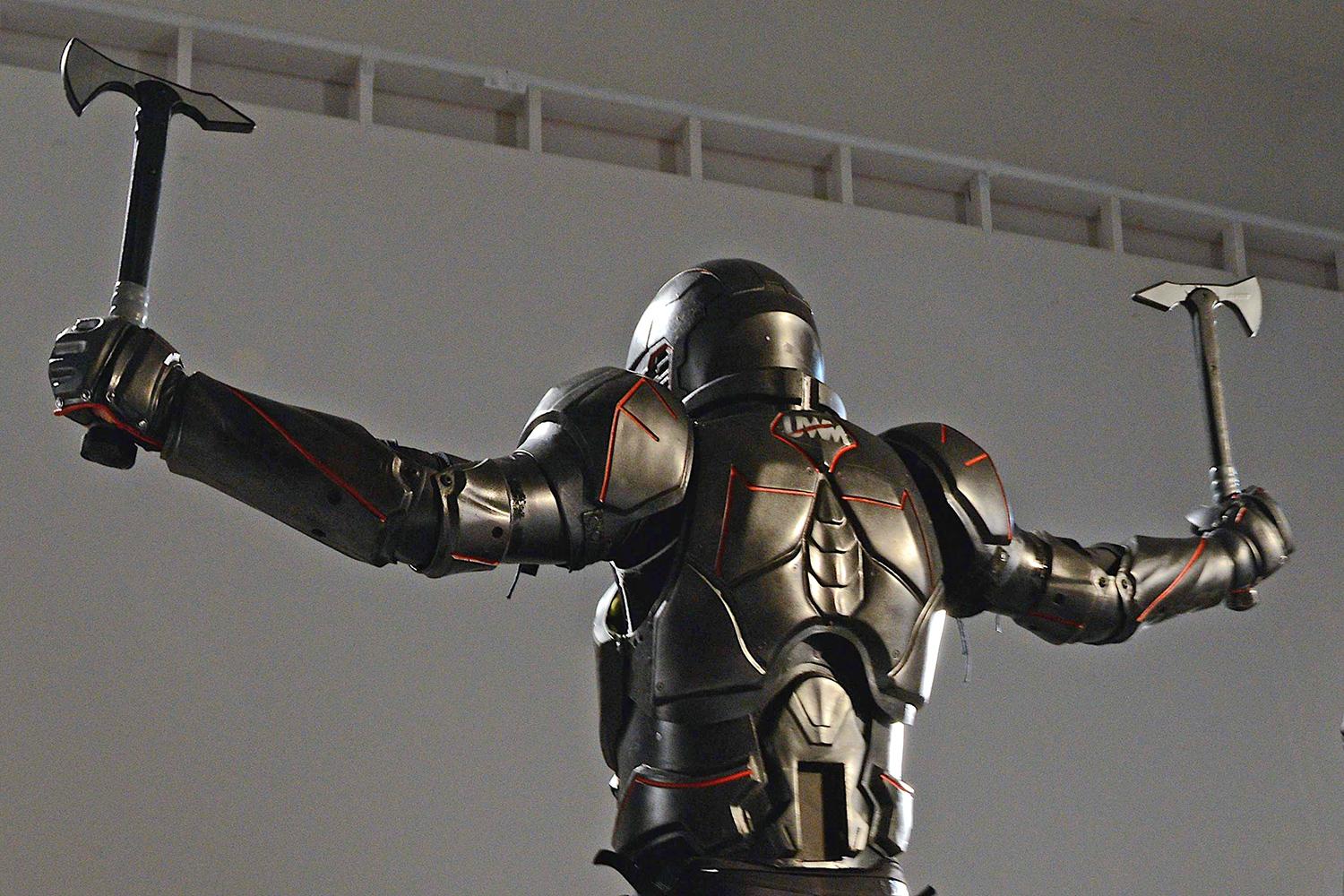
“We deliberately over-engineered the suits, for obvious reasons,” he says. “Our chairman and co-founder, Justin Forsell, has tested the suit himself, and we’ve done that with world-champion martial artists. So in other words, we’ve put the best people available up against guys in the suits and had them attack with traditional martial arts and weapons-based martial arts, and the suits have passed with flying colors. They are very, very well built.”
But under the hood is where things really start to get crazy.
Underneath all that carbon fiber and impact-resistant foam, the Lorica is outfitted with a dizzying array of sensors, all of which are designed to detect when a given part of the armor is struck. The suit uses a combination of piezoelectric shock/vibration sensors and accelerometers to measure not only where a fighter lands a hit on his opponent, but also the approximate severity of the blow. Amazingly, all of this data is collected by the suit in real time during a fight and beamed wirelessly to a special ringside computer system that keeps score.
The scoring system hasn’t been fully ironed out just yet, but according to Pysden, UWM’s custom-built software draws on medical research to calculate the damage that would’ve been inflicted on an unprotected body. Therefore, once the system is finished, it’ll presumably work a lot like an old-school arcade fighting game: Every time a fighter is dealt a blow, his or her health bar will drop by an amount commensurate to the severity and location of the hit. So in other words, when the first UWM fights kick off in 2015, they’ll probably look a lot like Mortal Kombat, but in real life.


But of course, you can’t have a proper live-action arcade-style weapons brawl if both fighters are lumbering, heavy-footed human armadillos. A good fight requires a certain measure of agility, so in addition to all the armor plating and sensor tech, UWM had to design the Lorica in such a way that it still allowed freedom of motion.
“We had to solve a bunch of problems before we built the prototypes” Pysden explains. “People have been building armor for thousand of years, but what they’ve never had to do before is encase all of this technology in the armor and make it work. But more importantly, when the knights were fighting back in the medieval days, they weren’t throwing kicks to the head. They were generally on horses or on foot, and typically weren’t using martial arts as part of their combat. That’s the big difference here — we wanted to develop suits where you had the articulation and mobility to fight as you would in unarmed, unarmored combat, but to be able to do that with weapons.”
Round two
UWM has made some impressive progress in the past couple years, but building the suits was only half the battle. They’ve still got a long road ahead of them before fights begin. At present, the company has produced four working prototypes of the Lorica, so for now, the next step is finalizing the design and building production versions of the suit.
“We’re hoping to hold competitions by early next year, so we’ve still got some more work to do to build the production models of the suit and take the software up to world-class quality,” Pysden says. “But we’re close to finalizing our Series B round of funding, and once we do that we’ll have the resources we need to build out those production versions of the suit.”
When the first UWM fights kick off in 2015, they’ll probably look a lot like Mortal Kombat, but in real life.
“From there, we want to slowly build things out,” he says, “and get feedback from those guys on the build, the scoring system, and how it all works. Then we want to slowly improve that until it’s ready to launch on a larger scale. Eventually, we want to hold competitions in countries all around the world.”
“We’ve got the historical European martial artists chomping at the bit to take on the various Asian styles, and we can’t wait to see who comes out on top there. We’ll have knife-fighting champions, sword-fighting champions, staff fighters — all those different styles will be able to compete against each other for the first time. What we eventually think will happen is certain styles and certain weapons forms will actually come out on top, but we won’t know that for sure until we start competition.”