1. Home
  2. Space
  3. Emerging Tech
  4. News

Space tourism company Virgin Galactic sends passenger into space for first time

Add as a preferred source on Google

Though SpaceX is the big name in the field, it’s not the only company planning to make tourists trips into space a reality. Virgin Galactic has also been working on a project to take private passengers outside of Earth’s atmosphere, and this week it sent its first passenger to the edge of space. Virgin Galactic has been working on commercial spacecraft since 2004. But it has suffered setbacks such as the dramatic crash of the Virgin spaceplane SpaceShip Two VSS Enterprise during a test flight in 2014, which killed the co-pilot and injured the pilot. Since then the company has been making steady progress on its space program, and conducted a successful test flight to the edge of space last year.

On Friday at just after 11 a.m. ET, the VSS Unity, the new version of the SpaceShip Two, managed to climb to its highest ever altitude, flying at 55.85 miles (90 kilometers) above the Earth,  just short of the generally agreed upon 62 mile (100 kilometer) boundary which is recognized as the start of space. This means that technically, the craft achieved a sub-orbital spaceflight as it reached outer space but its trajectory intersected with the Earth’s atmosphere in such a way that it would not have been able to orbit around the planet. Eventually the company wants to offer not only sub-orbital passengers flights but also orbital human spaceflights as well.

Recommended Videos

Our Chief Astronaut Trainer, Beth Moses, experienced zero-g float time as SpaceShipTwo reached apogee today. Three new @virgingalactic Commercial Astronauts. pic.twitter.com/OrVSm1PAvE

— Virgin Galactic (@virgingalactic) February 22, 2019

Aboard the craft were chief astronaut instructor Beth Moses and pilots Mike ‘Sooch’ Masucci and Dave Mackay. Moses was carried in the passenger cabin, marking the first time that Virgin Galactic has sent a passenger into space. Moses’ job was to evaluate the experience that paying customers will eventually have in the cabin, and when passengers do begin taking trips, she will be the person charged with training them. According to Reuters, she described the experience as an “indescribable ride” and added a message for company founder Richard Branson: “Richard, you’re going to love it.”

The waiting list for Virgin Galactic’s space tourism flights is already 600 people long and includes celebrities like Leonardo DiCaprio and Justin Bieber. But if you want to sign up to experience zero-g for yourself, you better start saving — the trip costs $250,000 for a 90 minute flight.

Georgina Torbet
Georgina has been the space writer at Digital Trends space writer for six years, covering human space exploration, planetary…
Space is becoming Bezos and Musk’s next data center site, and we have every reason to worry
The AI boom is coming for the night sky
How Vast's space station will look in orbit.

AI data centers already consume vast amounts of electricity and water on Earth, so Silicon Valley has begun looking somewhere considerably more spacious... literally.

Elon Musk's SpaceX and Jeff Bezos' Blue Origin, along with several other companies, have proposed enormous constellations of satellites designed to operate as orbital data centers. However, environmental groups and former space officials are now warning that putting them into orbit at the proposed scale could have severe consequences for Earth's atmosphere and the night sky.

Read more
The first possible exomoon is here, and it makes our Moon look hilariously tiny
Scientists may have found the first exomoon, except this one is the size of Jupiter
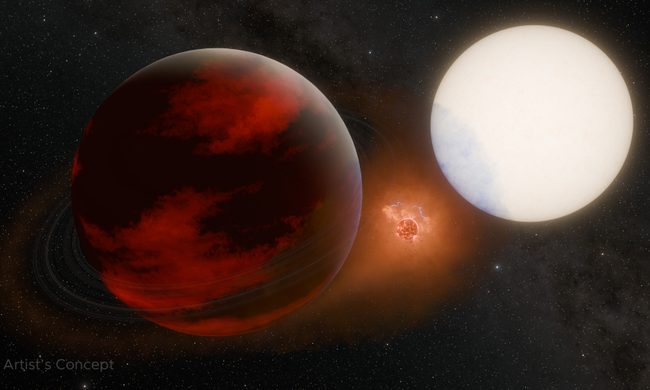
This artist’s concept depicts a potential volcanic moon between the exoplanet WASP-49 b, left, and its parent star. New evidence indicating that a massive sodium cloud observed near WASP-49 b is produced by neither the planet nor the star has prompted researchers to ask if its origin could be an exomoon.

We have already discovered more than 6,000 planets outside of our immediate neighborhood. Yet, finding a moon orbiting one of those distant worlds has proved considerably harder. Astronomers may finally have something close to the real deal, but this particular object stretches the word “moon” almost beyond recognition.

Using the European Southern Observatory’s Very Large Telescope in Chile, researchers detected strong evidence for a moon-like object in the CD-35 2722 system. Further observations are still necessary to confirm the discovery, but it could become the first confidently detected natural satellite outside our solar system. There is still one tiny complication though. This moon is apparently massive.

Read more
China’s answer to SpaceX’s reusable rockets literally catches boosters in a net
SpaceX catches boosters on legs. China just used a net.
Ammunition, Missile, Weapon

SpaceX's playbook for recovering a rocket booster generally involves legs, a precisely controlled vertical landing, and either a concrete pad or a drone ship. 

China just managed to pull off something similar, but in a slightly different way, and on July 10, it tested the method as well.

Read more