Brewing your own beer lies somewhere between science and alchemy. There’s precision involved, of course: scales, measuring cups, temperature gauges. But also spilling, estimating, and just plain making it up as you go.
Which means, after controlling the process as much as humanly possible, you leave it to sit, waiting, wondering how it will turn out. Sometimes it’s barely drinkable. Other times, that beer might as well be your firstborn, you’re so proud.
PicoBrew could spark a revolution in home brewing.
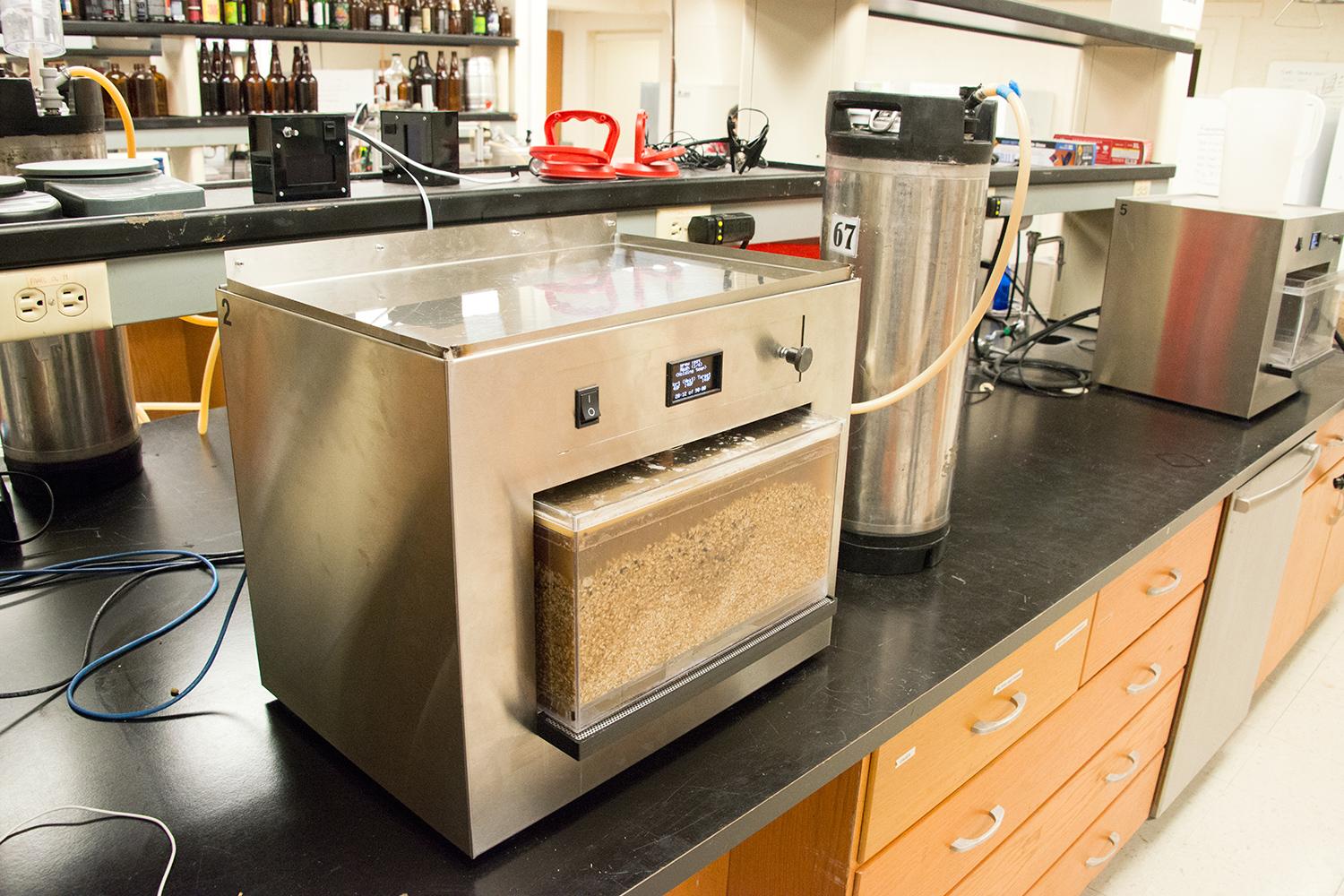
Probably not. Which are all the X factors that brothers Bill and Jim Mitchell are hoping to strip from the equation with the PicoBrew Zymatic, a set-and-forget beer machine that lets you brew with a mouse click – and revolutionize the home brewing scene in the process.
PicoBrew Zymatic
Brewery in a box
“We’re leaving the art, and we’re taking out the drudgery,” Bill explains inside a former chemistry lab north of Lake Union in Seattle, which now headquarters PicoBrew. “That’s the key goal here.”
“We’re leaving the art, and we’re taking out the drudgery.”
Around three to four hours later, the wort – raw liquid that will eventually become beer – is ready to be chilled and fermented. The rest of the steps are identical to what you go through in home brewing, and your concoction will be ready to drink in one or two weeks.
The whole process is controlled from Web-based software on your laptop, which connects over your home network. The PicoBrew includes pre-made recipes across all the major categories of beer, as well as a generator to create your own.
The last straw
After home brewing for six years, Bill dreamt up the Zymatic after a bad batch of beer tested his patience for the last time. “I made a great batch, and tried to make another of the same beer. And it came out wildly different. Wildly worse,” he recalls. “It’s so hard to hit your temperatures accurately, your volumes accurately. And it’s so hard to repeat a batch.” He compares the situation to golf: One great game hooks you for the next 30 games as you desperately try to repeat it.
The brothers figured, if they could automate the unreliable parts of brewing homemade beer, precisely controlling the process, they could not only make repeatable batches, they could dramatically lower the barriers to entry for home brewing. Zymatic takes human error out of the equation. You can’t overheat it, you can’t boil it too long, and you can’t create something you can’t make again.


In PicoBrew’s onsite tasting room, there are six PicoBrewed beers on tap, including a citrusy light American lager, a sweet brown, a complex-but-easily-drinkable stout, and a rich, hoppy IPA modeled after the famous Pliny the Elder IPA. And it tastes like … good beer. Really good beer.
How did they model a home brew after one of the most sought-after microbrews on the west coast? Easy. The recipe can be found on a number of homebrew forums, and with the PicoBrew’s recipe generator, all it takes is a few simple keystrokes and a stop for ingredients at an online homebrew supplier.
Ruffling feathers
With this new level of convenience and precision, the PicoBrew could spark a revolution in home brewing, a craft that has remain virtually unchanged since it was federally legalized in 1978, for the first time since Prohibition. And as it usually goes with revolutions, there are opponents.
It tastes like … good beer. Really good beer.
One of the most noteworthy opponents was Annie Johnson, the American Homebrewers Association’s 2013 Homebrewer of the Year. “During the Kickstarter phase, she told us, ‘In my homebrewing group, a lot of people are pissing on your product,’” Bill says.
The team reached out and asked her to take a look behind-the-scenes. “She walked through, she tasted the beers … and she told us we should enter them in contests, because you know, she’s a judge.

“She came back the next day, and we made a couple test batches. Then she came back a week later, and we tasted the beer, and she was blown away.” Now, Johnson has joined PicoBrew, working for them on the Zymatic.
Extinction of the bucket?
After three years of development and a dozen prototypes, the PicoBrew Zymatic is in production and ready to ship to customers. Many of them might be brewing for the first time. When the brothers’ hugely successful Kickstarter campaign sought $150,000 and raised more than four times that amount, they realized the Zymatic resonates with consumers, not just enthusiasts.
Can both “old-fashioned” homebrewing and PicoBrewing coexist? “Very few people, once they’ve PicoBrewed, go back,” Bill says.
It’s like asking whether anyone with an automatic drip coffee maker would continue to make it on the stovetop. They could … but why would they?
Something to ponder over your next beer.